Category: Educational Resources

  • When Resolution Requests Don’t Scale: How to Pre-Authorize Execution at Volume

    When Resolution Requests Don’t Scale: How to Pre-Authorize Execution at Volume

    Resolution Requests (R2s) are designed for uncertainty.

    They work best when changes are infrequent, exceptions are novel, and each decision needs to be evaluated in context. In those cases, slowing the decision without stopping the work is exactly the right strategy.

    But not every operation lives in that regime. When volume increases, certain “exceptions” stop being exceptional. Equipment breaks down. Capacity shifts. Carriers swap assets. The same patterns repeat, and resolving each one manually reintroduces the very judgment pressure RRs were meant to remove.

    That’s the point where authorization must move from ad-hoc resolution to pre-authorized execution.

    This article explains how that transition works, and how to use Admiral Execute when volume makes one-off R2s impractical.

    The structural constraint R2s are not meant to solve

    R2s exist because authorization often needs to travel across company boundaries without leaking context. They provide a safe way to handle uncertainty when participants change or information is incomplete.

    But R2s are intentionally conservative. Each request, pauses a binding decision, routes it to an authority, and waits for confirmation. That’s the right behavior when the scenario is rare, the risk is ambiguous, or the cost of delay is low.

    It becomes the wrong behavior when the same situation happens dozens of times per week, the decision criteria are already known, and speed matters more than deliberation. At that point, resolving each case individually isn’t safer, it’s slower.

    The how-to question: when do you move to Execute?

    The practical rule is simple: If you can describe the condition under which a change is acceptable before it happens, you should pre-authorize it. That’s what Execute is for.

    Execute doesn’t replace R2s. It absorbs repetitive, predictable authorization paths so they don’t need to be re-decided each time.

    A concrete example: pre-authorized carrier swap

    Let’s walk through a scenario where R2s no longer scale.

    The situation:

    • A shipper tenders a high-volume lane to Carrier A.
    • The contract allows carrier swaps under defined conditions (breakdown, equipment unavailability).
    • Carrier A frequently relies on Carrier B for contingency capacity.

    This is not an exception. It’s expected behavior. Resolving every swap through RRs would slow execution, flood approvers, and eventually push decisions back to the frontline. The dock or gate shouldn’t judge “this is probably just a normal swap”. Instead, the swap is pre-authorized in Execute.

    Step-by-step: how Execute handles the swap

    1. The policy is encoded upstream

    Before execution begins, the shipper and Carrier A agree to a policy:

    • Carrier A may transfer custody to Carrier B under specific conditions.
    • Carrier B equipment must meet defined criteria.
    • All swaps must be visible in execution systems.

    That policy lives in Execute. Not in inboxes, not in side agreements.

    2. The breakdown occurs

    Carrier A experiences an equipment issue mid-lane.

    Instead of calling the shipper, sending emails, creating an R2, or asking the gate to “just let it through”, Carrier A dispatch assigns the load to Carrier B’s equipment inside Execute.

    3. Custody transfers are recorded automatically

    Carrier B accepts custody through the platform. At this point the execution record updates, the authorized equipment changes, and the swap is explicitly marked as such.

    No human judgment is required to interpret what happened. The system knows.

    4. The driver arrives at the gate

    Carrier B’s driver shows up. The livery is different. The tractor number doesn’t match the original plan. The driver wasn’t part of the original tender. In a traditional workflow, this is a judgment moment.

    In Execute, it isn’t.

    5. What the gate sees

    At the gate, the operator sees this load has an authorized carrier swap. This equipment is the currently authorized asset. This driver is associated with that equipment. The swap occurred under pre-approved conditions.

    No phone calls. No paperwork inspection. No “does this feel right?” decision. Execution proceeds because authorization already exists.

    Why no R2 is required here

    Nothing about this situation is ambiguous. The conditions were known. The policy was agreed to. The authorization was pre-granted. Creating an RR at this point would not increase safety — it would reintroduce delay and pressure without adding information.

    This is the key distinction:

    • RRs resolve uncertainty.
    • Execute scales.

    How this prevents judgment from creeping back in

    The most dangerous moment in freight execution is when something looks slightly different and someone has to decide whether to allow it anyway.

    Execute removes that moment by ensuring that, authorized changes are visible, unauthorized ones are blocked, and frontline teams are never asked to infer intent. They don’t decide whether a swap is legit. They see that it already is.

    How this fits with the rest of the system

    Resolution Requests still matter. They handle new scenarios, edge cases, first-time decisions, and genuine uncertainty. Execute takes over when those decisions become patterns.

    Together, they form a ladder:

    • Resolve uncertainty once.
    • Encode the result – this is why recording a decision is important.
    • Execute it repeatedly without friction.

    Stay Connected

    Want more insights like this? Follow Level5Fleet for future articles, freight industry trends, and updates on building a smarter, more secure supply chain:
    🔗 LinkedIn
    🐦 X: @Level5fleet
    📘 Facebook
    📸 Instagram
  • The Vibration Test That Nearly Destroyed a Washing Machine (and Our Startup)

    The Vibration Test That Nearly Destroyed a Washing Machine (and Our Startup)

    A lock has two failure modes — and both matter

    A cargo lock doesn’t just have to prevent unauthorized access. It also has to allow authorized access every time.

    A lock that fails closed under vibration is just as disruptive as one that fails open. In freight operations, reliability isn’t binary security. It’s continuity. Authorized drivers, scheduled docks, and compliant handovers depend on the lock behaving predictably after thousands of miles of real-world motion.

    That’s why vibration isn’t a secondary consideration for the Admiral Lock. It’s a primary design constraint.

    That means long-term reliability isn’t about surviving a single shock. It’s about enduring millions of small ones without loosening, drifting, or degrading.

    Can we afford testing?

    Let’s get something out of the way up front: yes, we believe in rigorous fault analysis. No, that doesn’t mean we recommend throwing high-value hardware into household appliances (though someone did suggest it).

    When we talked about MTBF testing in our last article, we covered wear and tear over thousands of cycles. But there’s a second villain in the reliability story: vibration. It’s how your trailer tries to shake its components apart — mile after mile, bolt after bolt.

    Big companies, with budgets the size of our hopes and dreams, just instrument a real trailer and drive it over custom test routes. They call it real-world testing. We call it… financially ambitious.

    So what’s a scrappy startup to do?

    The Washing Machine Incident

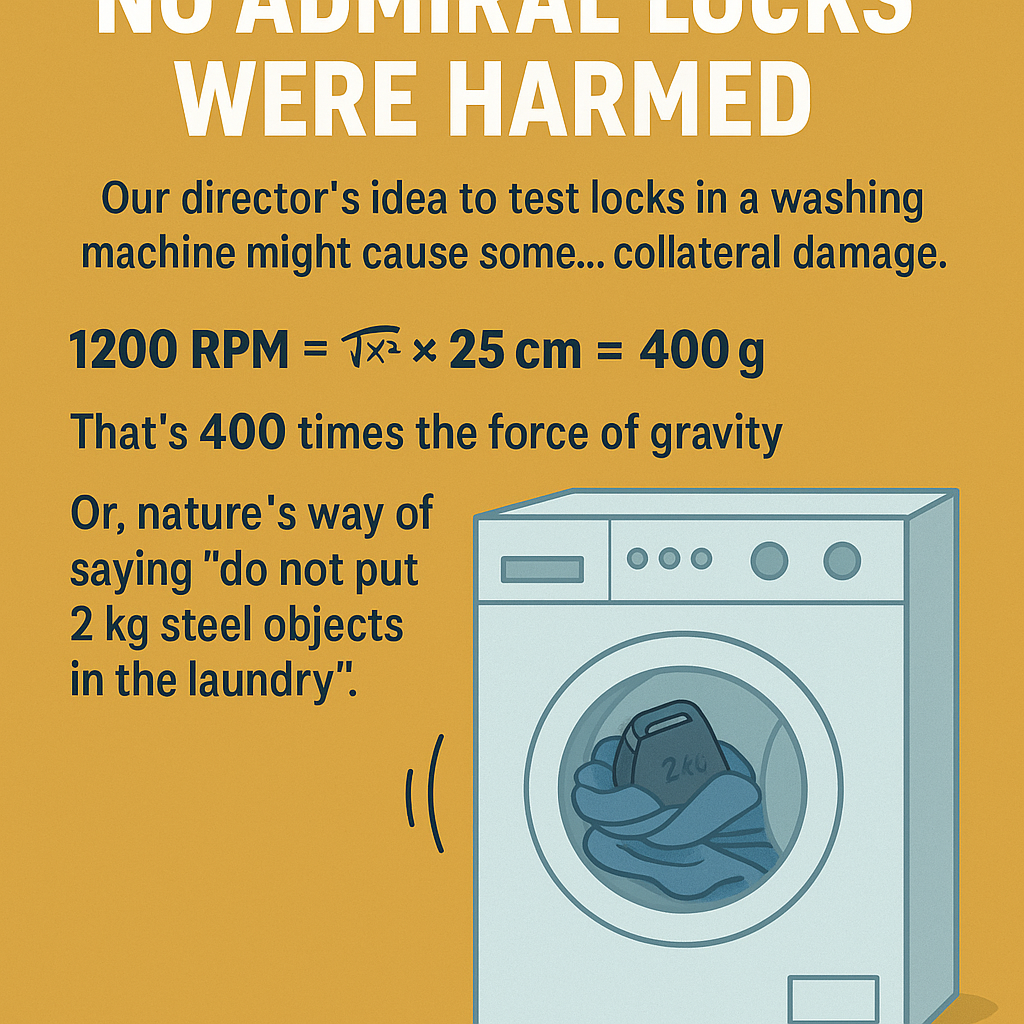
    Our director once half-seriously proposed wrapping a prototype Admiral Lock unit in towels and chucking it into a washing machine set to “Tsunami Spin” mode. It wasn’t our best idea. It was our most dangerous.

    Why? Because physics. That’s why.

    Let’s do the math (don’t worry, it’s light — we promise).

    The Admiral Lock weighs 2kg. Let’s imagine the drum radius is 25 cm and spinning at 1200 RPM. That’s about 125 rad/s.

    The g-force at the edge?

    a = rω² = 0.25 * (125)² = 3906 m/s²

    Which is nearly 400 g. Four. Hundred. G. That’s not vibration — that’s a weapon. A heavy person falling onto an office chair might spike 1–2 g.
    At 400 g, your Admiral Lock would hit the washing machine drum with 200 times the force of your butt hitting a chair. And if that drum comes apart, your landlord’s going to want answers.

    So yeah, we didn’t do that.

    The MIL-STD-810 Way

    Instead, we based our approach on MIL-STD-810H, a standard used by the U.S. military to simulate the environmental stresses equipment will endure. Vibration testing under this standard helps you understand how a product responds to real-world abuse — in all three axes.

    We matched our vibration profile to a conservative version of the MIL profile for cargo truck transport. Why conservative? Because our insurance doesn’t cover “launched through the ceiling at Mach 2.”

    Our vibration table runs in X, Y, and Z axes, simulating the compound motion that occurs when a trailer hits potholes, rumbles across train tracks, or spends three hours in the Bronx.

    Estimating Real-World Motion

    We couldn’t afford to instrument every route, but we could estimate typical frequency ranges and amplitudes from public data and transport studies. We then tuned our profile to emphasize:

    • Frequencies between 10–500 Hz
    • Varying power spectral density (PSD) levels
    • Axis coupling, because real-world vibration is chaotic, not polite

    So… Why Bother?

    Because failures don’t just come from wear — they come from shaking, rattling, and the occasional driver who thinks speed bumps are a suggestion.

    Good testing means fewer surprises. And no washing machines were harmed in the process.

    Want to know more about how we design for survivability? We’ll show you how we make this stuff (almost) indestructible. Contact us or bring your own towels, just not for spin cycle testing.

    Stay Connected

    Want more insights like this? Follow Level5Fleet for future articles, freight industry trends, and updates on building a smarter, more secure supply chain:
    🔗 LinkedIn
    🐦 X: @Level5fleet
    📘 Facebook
    📸 Instagram
  • When Your Car Door Jams, You Use the Other Door. But What If the Only Door is INSIDE?

    When Your Car Door Jams, You Use the Other Door. But What If the Only Door is INSIDE?

    Interior cargo locks reduce attack surface, but they concentrate responsibility. If the lock is inaccessible, the system must detect degradation before access is needed. That’s the design problem this article addresses.

    Ever had a car door lock jam on you? Frustrating—but luckily, you just shimmy around and pop open another door. Problem solved.

    But in cargo trailers or containers, there’s only one door. A single point of failure. Question is: why would anyone design a lock you can’t open externally? Isn’t that asking for trouble?

    Turns out, there’s a smart reason. Interior locks are actually recommended by the Transported Asset Protection Association (TAPA), a global freight security standard, because external access points become targets for thieves and accidental misuse.

    In other words, external overrides aren’t just convenience, they’re vulnerabilities. You can’t really have an external override “just in case” and still claim high protection. When you design a system without an external override, reliability stops being a nice-to-have. It becomes a design obligation.

    Reliability without an override

    The solution is to track operation parameters continuously. The goal? Catch anomalies before they become incidents. Maintenance is scheduled proactively, not reactively, based on the tiniest deviations from normal behavior. This works well in other industries like aviation engine monitoring.

    We apply the same principle to our interior locks:

    • We measure how much force the actuator is using
    • We track how many cycles it’s been through
    • We look for changes in resistance, timing, and movement profile

    Failure modes

    So, what could go wrong with a lock? Locks fail quietly long before they fail completely. Failures can occur in three ways:

    1. Software hiccups (like your phone freezing, annoying, but fixable)
    2. Electronic glitches (think “check engine” light in your car)
    3. Mechanical jams (think rusted hinge or sticky lock)

    To reduce those risks, we run MTBF (Mean Time Between Failures) testing, simulate environmental wear, and apply predictive maintenance models.

    But that’s not enough. Because sometimes, failure doesn’t look like failure until it’s too late.

    Traditional monitoring looks for known faults. But in systems designed to run unattended for long periods, unknown degradation matters just as much. That’s why we also use anomaly detection trained on normal behavior, not to predict failure perfectly, but to flag deviation early.

    How does anomaly detection work?

    Imagine a security guard who doesn’t memorize faces, but learns how people normally behave. When something seems off, even if it’s never happened before—they flag it.

    This technique works the same way: algorithms learn what “normal” sensor behavior looks like, then raise a red flag when something strays too far from baseline.

    That’s key, because traditional systems rely on predefined fault signatures. If you’ve never seen a specific failure before, you might miss it entirely. But these algorithms say: “This pattern doesn’t feel right”—and that gives you time to act.

    Think of it as keeping your car door from jamming in the first place—no awkward climbing required.

    Interior locks only make sense if reliability is engineered as deliberately as security. That’s the bar we design against.

    Stay Connected

    Want more insights like this? Follow Level5Fleet for future articles, freight industry trends, and updates on building a smarter, more secure supply chain:
    🔗 LinkedIn
    🐦 X: @Level5fleet
    📘 Facebook
    📸 Instagram