Category: Educational Resources

  • Introducing Proof Without Breaking Operations

    Introducing Proof Without Breaking Operations

    How teams phase in identity, representation, and authorization

    By now, this series has established a clear operational method. Frontline teams should not be asked to perform due diligence under time pressure. The burden of proof should sit with the requester. Decisions should be protected by recording why they were made, not just what happened. Proof should be classified — identity, representation, and authorization — so teams stop guessing. And infrastructure is required to support providing proof.

    At this point, most organizations reach the same conclusion: the method makes sense, but adopting it changes how people interact with us.

    That’s unavoidable. This approach doesn’t just alter internal workflows. It reshapes expectations for customers, carriers, drivers, brokers, and contractors. Adopting it isn’t a tooling decision. It’s a change-management exercise.

    Where teams tend to fail isn’t disagreement with the method. It’s speed. They try to introduce everything at once: authorization rules without context, proof requirements without explanation, friction before trust exists. The reaction is predictable. Partners feel blocked. Frontline feels exposed. Exceptions creep in, judgment quietly replaces proof, and the system reverts to its old shape.

    Teams that succeed take a different path. They phase the change.

    Most start with identity, not because it solves the problem, but because it’s the lowest-risk entry point. The first requirement introduced is simple: operational requests must be tied to a real, verifiable person before information is disclosed. This builds on work teams already do through onboarding, contact verification, and basic KYC. Execution doesn’t change. No one is blocked from doing their job. What changes is intentionality. Information is no longer shared casually. Identity is no longer assumed. Requests are no longer anonymous.

    Identity works as a starting point because it controls information, not execution. Mistakes are recoverable. It familiarizes partners with proof-based interaction and creates muscle memory without disrupting flow. Just as important, teams are explicit about what identity does not do. Identity does not authorize changes. It does not bind companies. It does not replace representation or approval. That clarity prevents overreach.

    During early adoption, many teams consciously substitute identity checks for proof that would ideally be authorization. That can be acceptable — if it’s done honestly. In practice, this means allowing identity-verified requests to proceed even when authorization proof doesn’t yet exist, while explicitly recognizing the residual risk. The goal isn’t to pretend the risk is gone. It’s to reduce the most obvious attack surface, gain incremental protection over anonymous requests, and acclimate counterparties to the expectation that proof will increasingly be required.

    In this phase, identity functions as a training mechanism, not a substitute. Frontline teams must be coached to understand that proceeding on identity alone still carries contractual risk, that responsibility hasn’t fully shifted, and that this should be acknowledged and documented. Being able to say, “We proceeded based on identity verification alone; authorization proof was not available,” preserves honesty and momentum at the same time. Substitution is safe only as long as the residual risk remains visible. The moment it disappears, the method breaks.

    Once identity discipline is in place, a deeper gap becomes obvious. Most organizations already perform company-level due diligence during onboarding — carrier vetting, shipper KYC, insurance verification. But that diligence lives outside daily operations. It isn’t connected to action. So the next requirement emerges naturally: company due diligence must be linked to representation, not just stored at setup.

    People stop being “just contacts.” They become representatives acting for a specific company, within a defined scope, in a specific context. This is where routine-sounding requests quietly introduce risk: dispatcher handovers, driver substitutions, “no-change” swaps. Without representation clarity, these are inferred through familiarity and continuity. With it, they become verifiable. This phase bridges the gap between knowing who someone is and knowing what they are allowed to do, and it’s where documentation starts to matter in a concrete way. Representation is asserted. Scope is recorded. Decisions become defensible.

    Authorization comes last, because it’s where the method becomes real — and where unmanaged change causes the most damage. The requirement here is explicit: changes that bind contracts must be backed by verifiable authorization that reaches the point of execution. Reroutes, timing changes, equipment swaps, mid-load exceptions all fall into this category.

    Authorization has a non-negotiable constraint. It must be tied to a specific load and moment, and it must reach the decision-maker without leaking exploitable information. Frontline operators need to know that authorization exists, that it came from the correct party, and that it applies to this request. They must not be exposed to who approved, how approval was obtained, or which internal relationships can be manipulated later. Knowing that approval exists is necessary. Knowing who approved often creates new attack surface.

    Crucially, authorization must not transfer responsibility back to the frontline. Proof satisfies authorization. It does not ask the operator to judge credibility.

    Teams meet these requirements in different ways depending on partner size and technical maturity. What matters is the pattern, not the implementation. Smaller partners often operate in a shared decision space where proof exists without being copied, forwarded, or re-explained. Larger partners rely on external attestation, where authorization is asserted and verifiable while internal context remains abstracted. In both cases, execution sees proof, not people, and frontline judgment is removed.

    This sequence works because each phase introduces a new requirement only when the organization is ready for it. Identity builds discipline without disruption. Representation links existing diligence to action. Authorization enforces contracts without guessing. At no point is the frontline asked to “be more careful,” and at no point is responsibility silently pushed back downstream. Change is absorbed, not resisted.

    Whether teams are retooling, building internally, or evaluating vendors, the test remains the same. If a system requires frontline operators to infer intent, recognize names, judge credibility, or decide whether approval “sounds right,” it violates the method. Not because it’s poorly designed, but because it recreates due diligence under pressure.

    Up to now, this series has focused on method. The next entries focus on mechanisms: how identity proof is requested without friction, how representation is asserted and recorded, and how authorization reaches execution without leaking context. Not as features, but as patterns that make this change sustainable.

    Because the hardest part isn’t knowing what to do. It’s introducing it without breaking everything else.

  • Where to Start: Applying Proof With the Tools That Exist Today

    Where to Start: Applying Proof With the Tools That Exist Today

    Reducing risk now, without rebuilding your stack

    So far, this series has focused on what needs to change in freight execution. We’ve shown why frontline judgment collapses under pressure, why proof has to replace improvised due diligence, why identity, representation, and authorization are distinct, and why introducing all of this at once usually backfires.

    At this point, most teams arrive at the same practical question:

    How do we start applying this method now — without rebuilding our systems or forcing partners into a big switch?

    That question isn’t about tools yet. It’s about change management.

    From here, organizations typically take one of two paths. Some decide to build new internal systems around these principles. Others want to reduce risk immediately, while deferring larger system changes until the method has proven itself operationally.

    This section focuses on the second path — not because it’s the end state, but because it allows teams to begin applying the method today, without breaking existing workflows or requiring uniform adoption across partners. The second path uses an existing trust infrastructure – a set of software layers designed to surface proof, carry it across organizational boundaries, and deliver it to the point of decision without shifting judgment back onto the frontline.

    Before going further, it’s important to be clear about what this approach is — and isn’t.

    It does not replace your TMS, your contracts, or your onboarding diligence. It does not require every counterparty to log into the same system. And it does not assume all participants operate at the same maturity level.

    Instead, it introduces a shared trust infrastructure that sits alongside existing systems. Each party retains their own accounts, their own due diligence, and their own workflows. They participate only where risk and readiness justify it. Different parties can operate at different levels at the same time, with residual risk remaining visible throughout.

    That flexibility is what makes change possible.

    Starting where risk actually enters: external requests

    Most operational risk does not enter through clean, structured workflows. It enters through messages that arrive outside the system of record.

    A dispatcher sends an email asking for a change.
    A carrier forwards a message from a shipper.
    A driver calls with instructions they received verbally.

    In these moments, frontline teams are forced to decide whether to trust the request — often with little context and no shared record.

    The first step in change management is not enforcement. It’s visibility and documentation.

    This is where the simplest tool in the trust infrastructure comes into play.

    When a request arrives via email — whether from a customer, carrier, broker, or driver — the operator forwards that email to a designated verification address. Nothing about the request changes. No one is blocked. No workflow is replaced.

    What changes is what happens next.

    The system reflects back what proof already exists about the requester. Is the sender a known individual? Are they associated with a company? Has that company been previously verified? Is there any existing context tied to this load?

    At the same time, the operator sees what proof is missing. Is this only identity? Is representation unclear? Is authorization absent?

    Crucially, the operator does not have to decide this alone. The status of the request becomes visible in a simple interface, where the decision — approve, deny, or defer — can be recorded along with the reason.

    Nothing is enforced. Nothing is automated. But the method begins to operate.

    Proof is surfaced instead of inferred. Residual risk stays visible instead of being absorbed. Decisions are documented instead of reconstructed later.

    This is the lowest-change way to begin. It works wherever email already works, and it introduces proof discipline without disrupting execution or requiring partner coordination.

    Adding structure when inference stops scaling

    As teams gain experience, a pattern emerges. Some types of requests recur. Some decisions carry more weight. Some inbox conversations become long, confusing, and risky to interpret after the fact.

    This is where teams introduce structure — not to enforce authority, but to remove ambiguity.

    Instead of handling a change request entirely over email, an operator initiates a structured request tied to a specific load. This happens in a shared console, where the request, the parties involved, and the decision context are explicitly recorded.

    The requester receives the request through their own account. They respond in the same structured space. Representation is no longer inferred from continuity or familiarity — it is made explicit. The request is tied to a load, scoped in time, and documented by default.

    Importantly, this still does not bind authority.

    The purpose of this step is not to enforce contracts. It is to replace guesswork with structure. Each party uses their own account. Each retains their own due diligence. Participation remains voluntary and incremental.

    This level is appropriate when requests repeat, when context matters, and when email no longer scales — but before full enforcement is required.

    Enforcing authority only where execution demands it

    Some changes cannot rely on structure alone. When a request alters routing, timing, custody, or physical execution, authorization must reach the point where action occurs.

    This is where the enforcement layer comes in.

    At this level, requests are evaluated against defined boundaries. Approvers see full context when approval is required. Once authorization is granted, that authorization propagates across organizational boundaries and reaches execution points — drivers, yards, gates — without exposing who approved or how the approval was obtained.

    Execution sees only what it needs to see: that authorization exists, that it applies to this load, and that it is valid now.

    Judgment is removed from the execution layer. Responsibility stays with the requester. Proof satisfies authority without asking frontline operators to assess credibility or infer intent.

    This layer is introduced last, deliberately, because it changes execution behavior. Teams only adopt it once identity discipline and representation clarity are already in place.

    Why this works as change management

    This approach succeeds because it does not demand uniform adoption or a single leap.

    Teams start with visibility when requests arrive outside their systems. They add structure where inference becomes dangerous. They enforce authorization only where risk justifies it.

    At every stage, residual risk remains visible. Responsibility is not silently shifted downstream. Frontline teams are protected from having to perform due diligence under pressure. Change is absorbed gradually, not resisted.

    What follows next is no longer theoretical. The tools that support this method live inside a shared trust infrastructure called Admiral. Its first layer, Resolve, is where teams start: handling requests that arrive outside formal systems, surfacing identity and representation, and documenting decisions without disrupting execution. Resolve includes lightweight entry points for email-based requests as well as structured, load-scoped requests when context needs to be explicit. The second layer, Execute, is introduced later, when teams are ready to bind authorization directly to physical execution and remove judgment from the point of action. Each layer maps directly to the framework described in this series, and each can be adopted independently, in sequence, as risk and readiness evolve.

    If you want to see how this method is supported in practice:

    Admiral Resolve — handling external requests, surfacing proof, and documenting decisions without disrupting execution
    Admiral Execute — binding authorization directly to physical execution when enforcement is required

  • GPS – What the thieves don’t want you to know.

    GPS – What the thieves don’t want you to know.

    GPS tracking provides visibility but is vulnerable and insufficient as a core theft prevention mechanism because it can be jammed or go silent, and because alerting is not enforcement.

    Put a geofence around a yard and an alert pops up when the trailer breaches it. That feeling of control is intoxicating – until you remember that GPS is just one sensor in a messy, physical world that thieves have learned to exploit.

    Visibility gets fragile the moment an asset sits still. Trailers rest for hours or days; trackers go quiet to save battery and data costs. Silence is expected – and that quiet window is perfect for ‘Bob’ to move the trailer, trans-load pallets, and vanish long before anyone notices an alarm.

    “What about motion events? Don’t they wake the trailer up?” Sure. But Bob knows he can jam the signal. Jammers – GPS and cellular alike – used to be exotic tools. Now, software-defined radios and open-source kits have pushed the price down to about $150, and you don’t need an ex-CIA agent to operate one.

    “Okay, but we’ve got cloud heartbeats.” Sometimes. Yet a heartbeat that pings every 30 minutes is a blunt instrument. No report could mean “all good”… or “we’ve been blinded.” Relying on the cloud to notice silence hands Bob a window: jam, move, disappear. By the time a Security Operations Center ticket is opened, the load is long gone. The cloud sees nothing unusual – because quiet trailers are expected to be, well, quiet.

    And that’s only the old-school pull-and-transload game. Geofences won’t stop pilferage or strategic thefts.

    The Shift: From Visibility to Enforcement

    GPS is a visibility layer, not the safety net you bet on. Defense must be preventive, not reactive. And it has to span the entire chain: from cyber intrusion to truck-stop opportunism.

    That’s why decision-making needs to move onto the trailer. Local enforcement changes the game. A trailer can be retrofitted to refuse release the brake or block door access unless authorization is satisfied: a vetted driver tag, a cryptographic handshake with a paired key fob, or a time-and-location envelope verified by onboard sensors. Accessing cargo becomes an authenticated process, not a map coordinate and a remote thumbs-up.

    Layered Senses, Layered Defense

    Worried about ‘spoofers’ faking an entire route? Fair. That’s why detection has to be multi-sensor.

    Micro-Electro-Mechanical System (MEMS) accelerometers and gyros built into advanced microchips don’t care what the GPS claims – they feel motion. If the GPS story and the MEMS story story don’t match, the trailer responds: keep the doors and brakes locked. Suddenly, diversion and trans-loading are not a quick score.

    The Bottom Line

    GPS is wonderful when everything’s fine: fast, comforting, and familiar. But it can be disabled with a readily available $150 jammer. If you want fewer theft headlines and fewer midnight recovery calls, make local enforcement the baseline.

    If you’re ready to stop treating visibility as security, Admiral Enforce can help. We design the policy logic that lives on the trailer, build the enforcement hardware that actually prevents theft, and integrate with your existing operations so that when the cloud is blind, the trailer is not.

    Book a demo — we’ll draft a short pilot plan you can run right in your own yard.

    Stay Connected

    Want more insights like this? Follow Level5Fleet for future articles, freight industry trends, and updates on building a smarter, more secure supply chain:
    🔗 LinkedIn
    🐦 X: @Level5fleet
    📘 Facebook
    📸 Instagram

  • Can Security Turn Competition into Cooperation?

    Can Security Turn Competition into Cooperation?

    For more than two decades, the freight industry has dreamed of a digital exchange that could perfectly match capacity with demand: a marketplace where every truck, trailer, and shipment could find its counterpart in real time. Many have tried. Few have endured.

    Each platform promised efficiency, transparency, and lower costs. Yet most eventually faced the same quiet collapse – not from lack of technology, but from the logic of incentives.

    The Dilemma Beneath the Dashboard

    Economists would call it a Prisoner’s Dilemma.

    Every shipper wants broad visibility but fears losing control. Every carrier wants access to freight but fears margin erosion. So both hedge. They maintain private relationships, keep partial visibility, and use digital platforms selectively.

    Individually, each decision is rational. Collectively, the result is fragmentation – multiple systems, duplicated effort, and persistent fraud and theft.

    That’s what game theorists call a stable but inefficient equilibrium. Everyone’s strategy makes sense given everyone else’s, but the system as a whole underperforms.

    Why Defecting Makes Sense

    Defection – choosing autonomy over cooperation – offers immediate benefits: flexibility in pricing, direct relationships, less dependency on third-party platforms.

    And for years, it carried no penalty. You could step outside the system and still ship freight safely. Which meant that even as technology advanced, the payoff for cooperating never exceeded the freedom of going it alone.

    Changing the Payoff Structure

    But what if defection isn’t free anymore?

    What if operating outside a verified network means exposure to cargo theft, double brokering, false identities, and stolen credentials? And what if cooperation automatically brings protection: trailers that lock out unauthorized access, telematics that verify custody, and rules that can be enforced by the equipment itself?

    In that world, cooperation stops being idealistic. It becomes the rational choice. The equilibrium shifts:

    • Defection = exposure.
    • Cooperation = protection, verification, and efficiency.

    The payoff structure has changed.

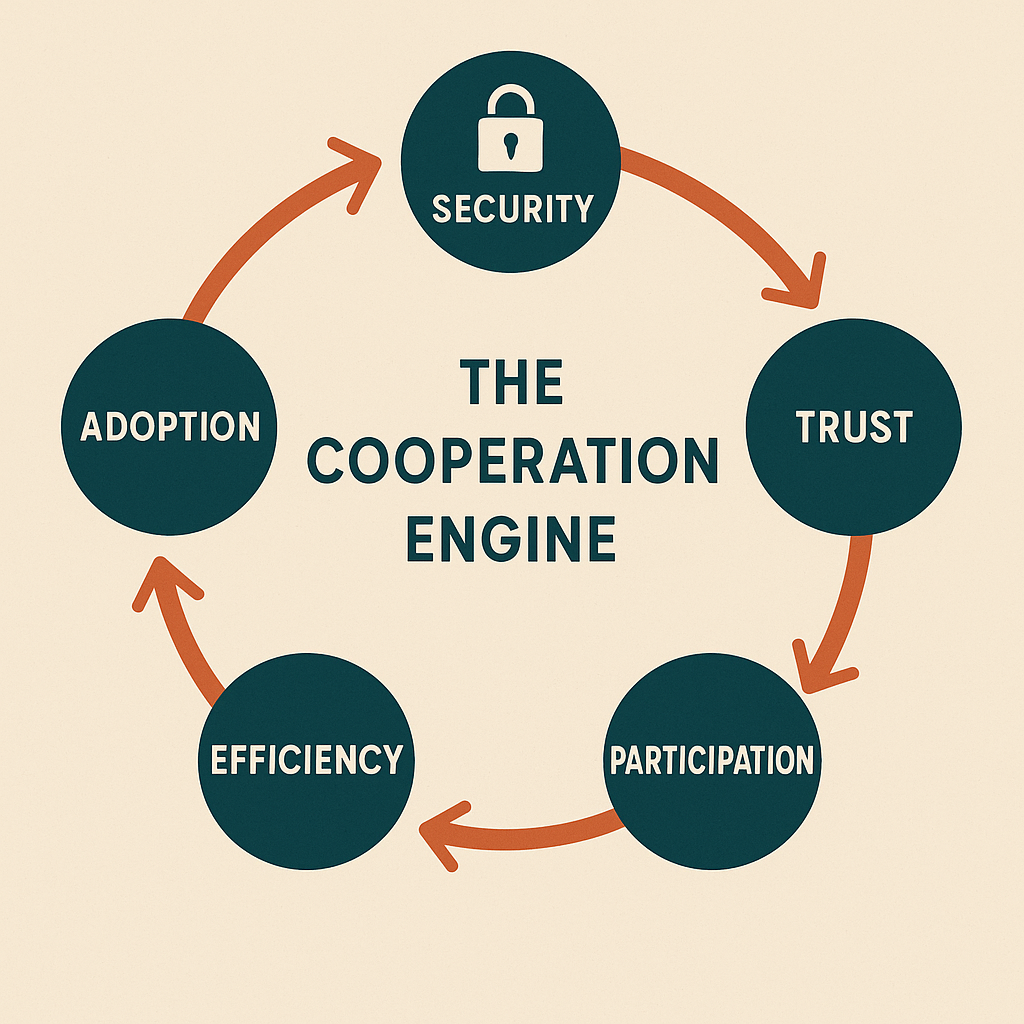
    When staying inside a secure, verifiable network materially reduces theft and fraud, participation isn’t altruism. It is risk management. And participation compounds: as more shippers and carriers transact under enforced custody rules, discovery improves, dwell drops, and rework shrinks. Efficiency stops being a promise and becomes the baseline.

    That raises a fair question: who loses when those efficiencies are gained?

    Not the shipper or the carrier. The “losers” are waste and opacity: cargo theft, double brokering, phone-tag scheduling, and spreadsheet reconciliations. The surplus doesn’t vanish; it reallocates into fewer losses, faster turns, cleaner audits, and tighter cash cycles. That’s a win-win grounded in physics (locks and telemetry), not sentiment.

    Carrier Autonomy

    And what about autonomy? Does a secure venue erode it? Only if the venue takes a position.

    In a stock-exchange model, the platform is neutral infrastructure: participants author their own prices and constraints, the venue standardizes contracts and identities, and the equipment enforces only the rules the parties chose. Competition remains intact – carriers still differentiate on service, shippers still choose on value – while the market becomes efficient through transparent discovery and standardized execution, not through a yield-optimizing “house algorithm.”

    In other words: cooperation without concession. Autonomy is preserved, competition continues, and the gains come from removing loss and friction – not from shifting power to the platform.

    From Trust to Enforcement

    True cooperation doesn’t come from better integrations. It comes from credible enforcement. When trust moves from policy to mechanism, when decisions are resolved explicitly, when execution is coordinated across parties, and when equipment itself can enforce who is allowed to move or access freight, then trust stops being a leap of faith. It becomes infrastructure.

    In practice, that means connecting resolution (who is authorized to decide), execution (how those decisions propagate across yards, docks, and carriers), and enforcement (where custody and access are physically constrained). These layers — Resolve, Execute, and Enforce — form a trust infrastructure that does not depend on goodwill, supervision, or perfect coordination.

    At that point, competition doesn’t disappear; it becomes safer. Carriers still compete on service. Shippers still compete on price. But the baseline of trust (who is allowed to act) is enforced by design.

    A New Equilibrium

    The freight market doesn’t need another exchange. It needs a new equilibrium, one where cooperation pays more than defection because security, not trust in counterparties, guarantees fairness.

    That’s what we’re building at Admiral: a trust infrastructure that allows equipment itself to enforce custody and compliance, turning a fragmented market into a self-governing one.

    When cooperation is safer than autonomy, competition finally works.

    Learn more

    The question isn’t whether freight can be digitized, it already is. The question is whether digital systems can enforce trust the way paper and people once did.

    If you believe the industry can’t scale on goodwill alone, it’s time to rethink how security rewrites the rules of cooperation.

    Let’s have that conversation.

    Stay Connected

    Want more insights like this? Follow Level5Fleet for future articles, freight industry trends, and updates on building a smarter, more secure supply chain:
    🔗 LinkedIn
    🐦 X: @Level5fleet
    📘 Facebook
    📸 Instagram

  • Freight’s Double Problem—and the On-Trailer Answer

    Freight’s Double Problem—and the On-Trailer Answer

    Freight has a double problem. The cost of coordination creates opportunities for theft, and theft, in turn, increases the cost of coordination. As processes strain under speed and volume, teams rely more on judgment and improvisation. That’s when mistakes creep in, and it’s also when organized theft thrives.

    Consider this familiar scenario: It’s 7:12 a.m. at Gate 3. Steve pulls up with his tractor; the paperwork pinball has been going since dawn. Broker emails, updated PDFs, a phone that won’t stop. The line’s growing, the system is lagging, and Lina wants the dock back on schedule, so she does what busy yards do under pressure: she waves Steve through.

    Lucky break—this time it really was Steve.

    Down the road, a meat processor in Tennessee wasn’t as lucky: a fake trucking company picked up ~80,000 lbs of beef (≈$350,000) and vanished. You know these stories. They’re not one-offs; they’re part of a wider surge in identity-based theft and fictitious pickups across North America.

    In both cases, the opening is the same: verifying who’s allowed to act costs time and attention when the yard is under pressure. So decisions get simplified, exceptions get waved through, and trust fills the gap.

    When incidents happen, the usual response is to add more checks, calls, alerts, and audits — which raises the cost of coordination even further, ensuring the same moment will break again tomorrow.

    Why we keep landing in this spot

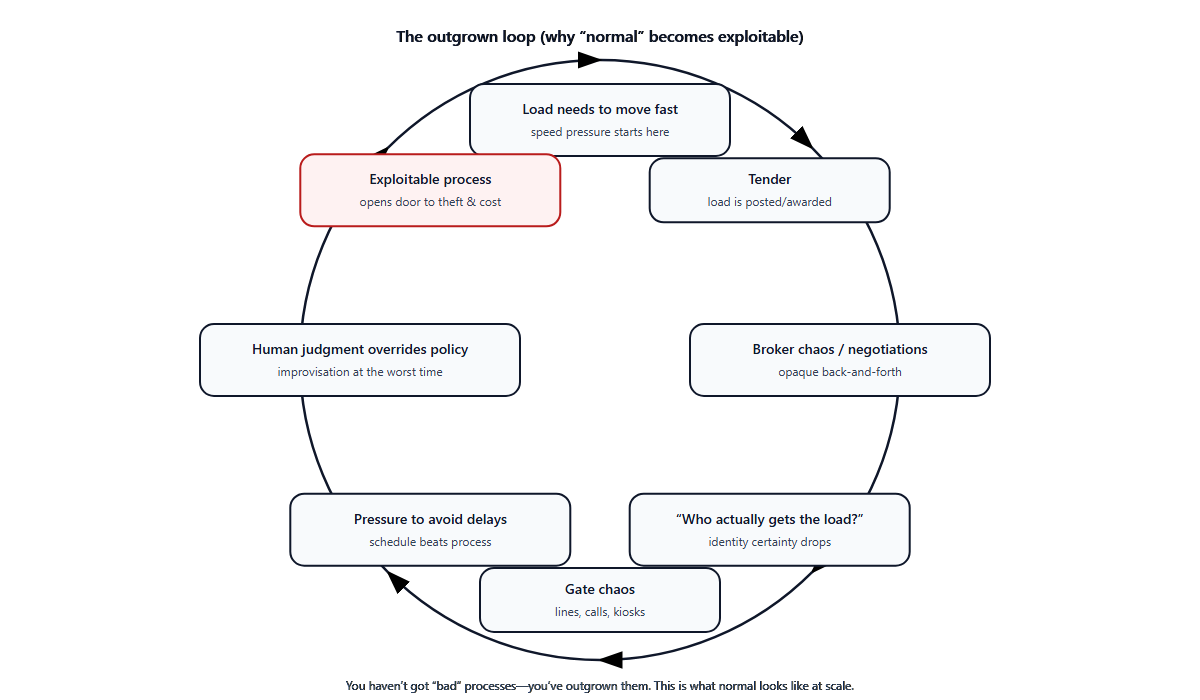
    It’s not that we have “bad processes.” We’ve outgrown the ones that used to work. We digitized forms and added dashboards, but custody policy still lives in inboxes and calls. At today’s speed and scale, the pattern repeats:

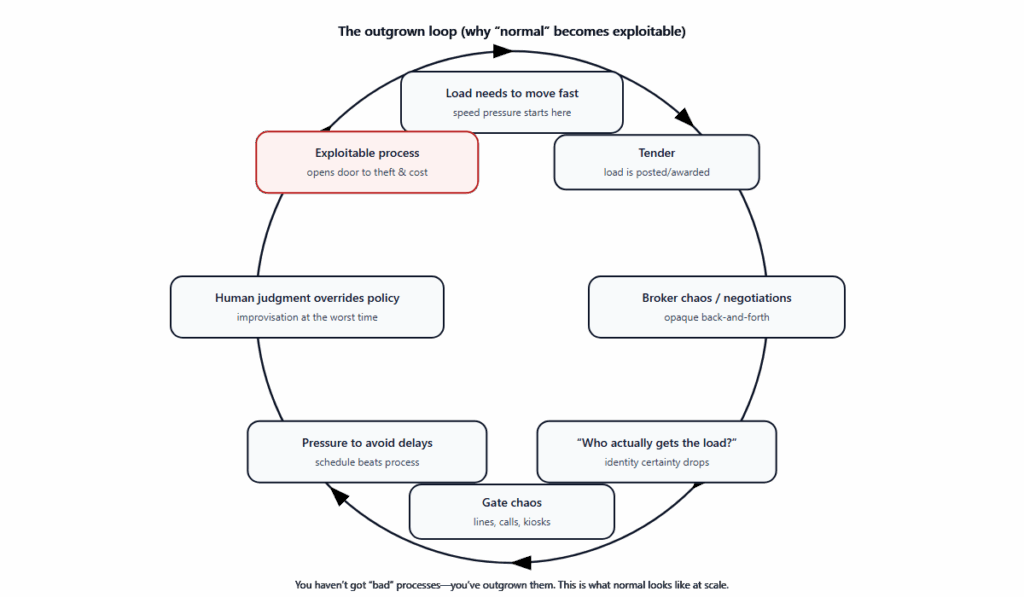
    Load needs to move fast → tender → broker chaos / negotiations → “who actually gets the load?” → gate chaos → pressure to avoid delays → human judgment overrides policy → exploitable process.

    None of that makes Lina negligent. It makes her normal, and normal is exactly what organized theft relies on. The loop doesn’t just waste minutes; it multiplies cost and risk. Inefficiency invites improvisation; improvisation creates openings; openings get exploited.

    The real problem isn’t theft. It’s trust under pressure.

    Strategic theft and operational leakage look like separate problems. They aren’t. Both emerge from the same root cause: trust breaks down when execution outruns verification.

    We didn’t get here because people stopped caring. We got here because custody decisions are still resolved through inboxes, phone calls, and judgment calls: exactly where pressure is highest. Dashboards added visibility, not authority. Alerts added noise, not certainty.

    That’s why the same moment (a busy gate, a delayed dock, a late tender) produces both outcomes:

    • mistakes and inefficiency when people improvise, and
    • exploitation when bad actors take advantage of that improvisation.

    This is not a tooling gap. It’s an infrastructure gap.

    Trust needs infrastructure, not supervision

    True cooperation doesn’t come from tighter integrations or more alerts. It comes from credible enforcement. It comes from turning policy into mechanism.

    When trust moves from “someone checked” to “the system enforces,” the problem changes. Decisions are resolved explicitly. Execution stays aligned across parties. And the equipment itself constrains what’s allowed to happen.

    That’s what we mean by trust infrastructure, and it has three layers:

    • Resolve — who is authorized to decide and approve changes, without ambiguity.
    • Execute — how those decisions propagate across companies, yards, docks, and handoffs under pressure.
    • Enforce — where custody and access are physically constrained, so out-of-policy actions are blocked, not debated.

    When these layers are connected, trust stops being a leap of faith. It becomes part of how freight moves.

    Where freight matching fits

    Digital freight matching benefits enormously once trust is enforced. Markets clear efficiently when, identities are real, authorization is explicit, and execution doesn’t depend on last-minute judgment calls.

    When policy lives on the trailer and execution aligns automatically, coordination costs fall. At that point, private, automated matching becomes viable as a byproduct of alignment.

    A quick word on TSR (and how Admiral compares)

    If TSR rings a bell: it’s the TAPA’s Trucking Security Requirements with 3 levels, the lowest of which allows self-certification, and the highest requires independent 3P audit. It’s focused on monitoring/response and documented procedures. Admiral trust infrastructure meets that bar and goes further by preventing out-of-policy events at the trailer itself (identity + time + location must align before access), which reduces the need to “chase” alerts after the fact.

    Why this is safer (and calmer)

    When policy lives on the trailer, the riskiest moment of the day is no longer the most chaotic. Lina doesn’t need to wave people through on faith. Steve doesn’t need to prove he’s not Bob. And the CFO doesn’t need paramedics on speed-dial.

    Stay Connected

    Want more insights like this? Follow Level5Fleet for future articles, freight industry trends, and updates on building a smarter, more secure supply chain:
    🔗 LinkedIn
    🐦 X: @Level5fleet
    📘 Facebook
    📸 Instagram

  • The One Vulnerability Behind Cargo Theft — and Why Simple Infrastructure Beats Complex Fixes

    The One Vulnerability Behind Cargo Theft — and Why Simple Infrastructure Beats Complex Fixes

    There’s a well-known engineering urban legend about the space race. Faced with the challenge of writing in zero gravity, one team spent years developing a pressurized pen. The other used a pencil.

    The story isn’t really about cost or cleverness. It’s about recognizing when a problem that looks complex is actually constrained by a simple failure, and choosing to solve that instead.

    Freight theft is a similarly complex problem. The surface area is enormous: fictitious pickups, impersonation, forged documents, substitutions, last-minute changes, collusion, break-ins, cyber attacks, GPS spoofing, straight trailer theft, etc. Each incident looks different. Each seems to demand its own countermeasure.

    But if you peel away the noise: the prisoner’s dilemmas, the coordination failures, the escalation of monitoring — the same vulnerability appears again and again.

    They exploit how difficult it is, in the middle of execution, to reliably tie a request to three things: who is making it, who they represent, and whether they are authorized to ask for that change right now. When any of those links are ambiguous, judgment fills the gap.

    That gap is not created by negligence. It’s created by pressure. Schedules compress, exceptions stack, systems lag, and decisions have to be made before context can be reassembled. Trust is carried informally: through emails, forwarded PDFs, phone calls, and “this seems right.”

    The instinctive response is to build a better pen: more precision, more sensing, more alerts, more review after the fact. These systems can work, but only by increasing the cost of coordination, ensuring that the same gap will open again under pressure.

    The alternative is to build the pencil instead.

    Once you recognize the vulnerability, the requirements become clear. Trust has to survive execution — not as policy or intent, but as something enforced by the asset itself at the moment it matters. Proof has to be scoped to a specific load, valid for a specific moment, and able to reach the point of action without leaking context. Authorization must be verifiable and physically enforceable by the equipment, without exposing who approved or how, so frontline teams can act without guessing and out-of-policy actions simply cannot proceed, even when things move fast.

    That is the premise of this post. Not that freight is simple, but that its most expensive failures originate from a single structural weakness. Build infrastructure that holds at that seam, and much of the complexity collapses with it.

    Stay Connected

    Want more insights like this? Follow Level5Fleet for future articles, freight industry trends, and updates on building a smarter, more secure supply chain:
    🔗 LinkedIn
    🐦 X: @Level5fleet
    📘 Facebook
    📸 Instagram

  • Understanding TSR, and Why Admiral Enforce Takes a Different Path

    Understanding TSR, and Why Admiral Enforce Takes a Different Path

    Transportation Security Requirements (TSR), developed by TAPA, are widely referenced in Europe and increasingly encountered in global supply chains. In North America, we frequently encounter carriers and shippers who are not familiar with what problem TSR certification is actually trying to solve.

    This article is meant to do exactly that: explain what TSR is, why its three levels exist, and why Admiral Enforce was designed to operate outside that framework. Intentionally. It is an account of two different cargo security models.

    What TSR is trying to achieve

    At its core, TSR exists to standardize how freight security is monitored, responded to, and audited. It assumes that security incidents will occur, and that risk is reduced by detecting deviations quickly, ensuring someone is responsible for responding, and documenting that controls were in place.

    TSR does not start from the question “how do we prevent actions from occurring at all?”. It starts from the question “how do we ensure deviations are visible, responded to, and provable?”.

    Everything that follows flows from that assumption.

    Why TSR has levels

    The three TSR levels are not different philosophies of security. They are escalations within the same philosophy, each added to address residual risk left by the previous one.

    At a high level:

    • Lower levels establish documented procedures and basic visibility, creating consistency and accountability.
    • Intermediate levels add continuous monitoring, active response, and formal audit requirements, ensuring that deviations are detected and acted on during execution.
    • Higher levels introduce direct human supervision and independent verification, acknowledging that some risks cannot be mitigated through monitoring alone.

    As risk tolerance decreases, TSR adds more visibility, faster escalation, tighter response loops, and stronger proof that controls were followed.

    Within a detect-and-respond model, this progression is rational and internally consistent.

    Why monitoring and supervision become inevitable

    Because TSR is built around observation and response, certain design consequences follow naturally.

    If deviations must be detected quickly, monitoring must be continuous. If monitoring is continuous, someone must be watching. If someone is watching, escalation paths and response protocols must exist. If responses carry contractual or insurance weight, audits must follow.

    These are not optional add-ons. They are how assurance is increased inside the monitoring paradigm.

    This is why higher TSR levels introduce increasing operational and financial burden — not because the standard is overreaching, but because monitoring alone cannot collapse execution risk. It can only manage it.

    Where the execution gap remains

    Across all levels, TSR governs process: what should be in place, who should respond, and how compliance is demonstrated. What it does not attempt to do is enforce authorization at the point of execution.

    When something ambiguous happens in the middle of a move like a reroute request, a substitution, or a timing change, TSR ensures that: the event is visible, someone can be alerted, and response procedures are followed.

    But whether the action proceeds still depends on coordination: calls, confirmation, judgment under pressure.

    That gap is not a failure of TSR. It is simply outside the scope TSR was designed to address.

    Why Admiral Enforce was designed differently

    Admiral Enforce starts from a different question.

    Instead of asking how quickly a deviation can be detected and responded to, it asks whether certain actions should be possible at all unless authorization is already in place.

    Rather than strengthening monitoring and escalation, Admiral Enforce moves enforcement to the asset itself so access, movement, and custody are constrained mechanically, not procedurally.

    This changes the security posture fundamentally. When the asset enforces policy:

    • continuous monitoring becomes less central,
    • real-time response centers become less critical,
    • post-hoc audits become less burdensome.

    Not because visibility is unimportant, but because out-of-policy actions are blocked by design, rather than observed after the fact.

    This is why Admiral Enforce does not map cleanly to TSR levels.

    Why Admiral Enforce is not TSR-compliant — by design

    TSR evaluates how security is monitored, escalated, supervised, and audited.

    Admiral Enforce removes the need for several of those controls by enforcing authorization directly at the point of action. As a result:

    • dual-channel monitoring becomes less relevant because asset can protect cargo even while offline
    • continuous human supervision becomes unnecessary because enforcement relaxes response time
    • operational procedures become automatically enforceable

    This does not place Admiral Enforce above or below TSR. It places it outside the framework TSR was built to evaluate.

    TSR was never designed to certify systems that prevent actions mechanically. Admiral Enforce was never designed to optimize for monitored response.

    They answer different questions.

    Why this distinction matters

    For organizations operating in TSR-governed requirements, compliance remains important. For others, the cost and complexity of monitoring-centric security become a limiting factor.

    Understanding what TSR is, and what it is not, allows teams to make informed decisions aligned with business objectives. The real choice is between:

    • managing execution risk through observation and response, or
    • reducing execution risk by enforcing policy directly on the asset.

    Both approaches are rational. They simply operate at different layers.

    Closing thought

    TSR represents the most mature expression of monitoring-based freight security. Its levels reflect decades of learning about visibility, response, and assurance.

    Admiral Enforce exists because a different possibility is now available: assets that can enforce trust themselves. Not as a replacement for standards. But as an intentional departure from the model that made those standards necessary. Admiral Enforce was designed to address the underlying common root cause of cargo theft.

    Understanding that distinction is the first step toward choosing the right security posture.

    Stay Connected

    Want more insights like this? Follow Level5Fleet for future articles, freight industry trends, and updates on building a smarter, more secure supply chain:
    🔗 LinkedIn
    🐦 X: @Level5fleet
    📘 Facebook
    📸 Instagram

  • Why Automated Trailer Immobilization Scales — and Judgment Does Not

    Why Automated Trailer Immobilization Scales — and Judgment Does Not

    While strategic cargo theft is on the rise, straight theft still constitutes the majority of cases. It happens when trailers are left unattended: in drop yards, overflow lots, rest areas, or unsecured corners of busy operations. These moments aren’t rare edge cases; they’re a structural feature of how freight actually moves.

    And they expose a simple truth: security that depends on supervision or judgment does not scale.

    Why “just lock it” eventually breaks down

    At small scale, manual controls work. A kingpin lock gets applied. A wheel boot goes on. Someone decides the trailer looks safe enough “just for a minute.”

    At enterprise scale, those decisions multiply.

    Every manual control requires someone to apply it, someone to decide when it’s necessary, someone to decide when it can be skipped, and someone to remove it again.

    None of those decisions are unreasonable on their own. But under pressure—late appointments, limited space, drivers needing breaks—discretion becomes variability. And variability is exactly where theft lives.

    This isn’t a failure of discipline. It’s the predictable outcome of asking humans to repeatedly make situational security calls in environments optimized for speed.

    Why immobilization changes the equation

    Automated immobilization removes discretion from the loop. When a trailer cannot move unless conditions are met, protection no longer depends on whether someone remembered, whether it “felt safe enough,” or whether supervision was available.

    The control becomes binary. Either movement is allowed, or it isn’t. That property — consistency without supervision — is what makes automated immobilization the only approach that scales cleanly across fleets, yards, and geographies.

    Why the parking brake is the right control surface

    Choosing how to immobilize a trailer is not a philosophical decision. It’s an engineering one. The parking brake was selected because it already satisfies the hardest constraints of the problem:

    • It exists on every trailer.
    • It is designed to hold stationary loads safely.
    • It is binary in state.
    • It is already safety-rated and deeply understood.
    • It requires no change in driver behavior.

    Most importantly, it is designed to fail safely. Rather than introducing a new mechanical risk, parking-brake immobilization works with systems already trusted to keep equipment stationary under load.

    Safety is not an afterthought

    Any immobilization system worth deploying must answer one question before all others: can this ever activate in motion?

    The answer here is no because of layered interlocks. Multiple independent conditions must be satisfied before immobilization is possible. Crossing them accidentally would require a chain of failures more severe than many everyday mechanical risks already accepted in freight operations.

    In practice, this makes parking brake immobilization safer than many failures operators already plan around: brake leaks, air loss, or mechanical degradation.

    The safety layers

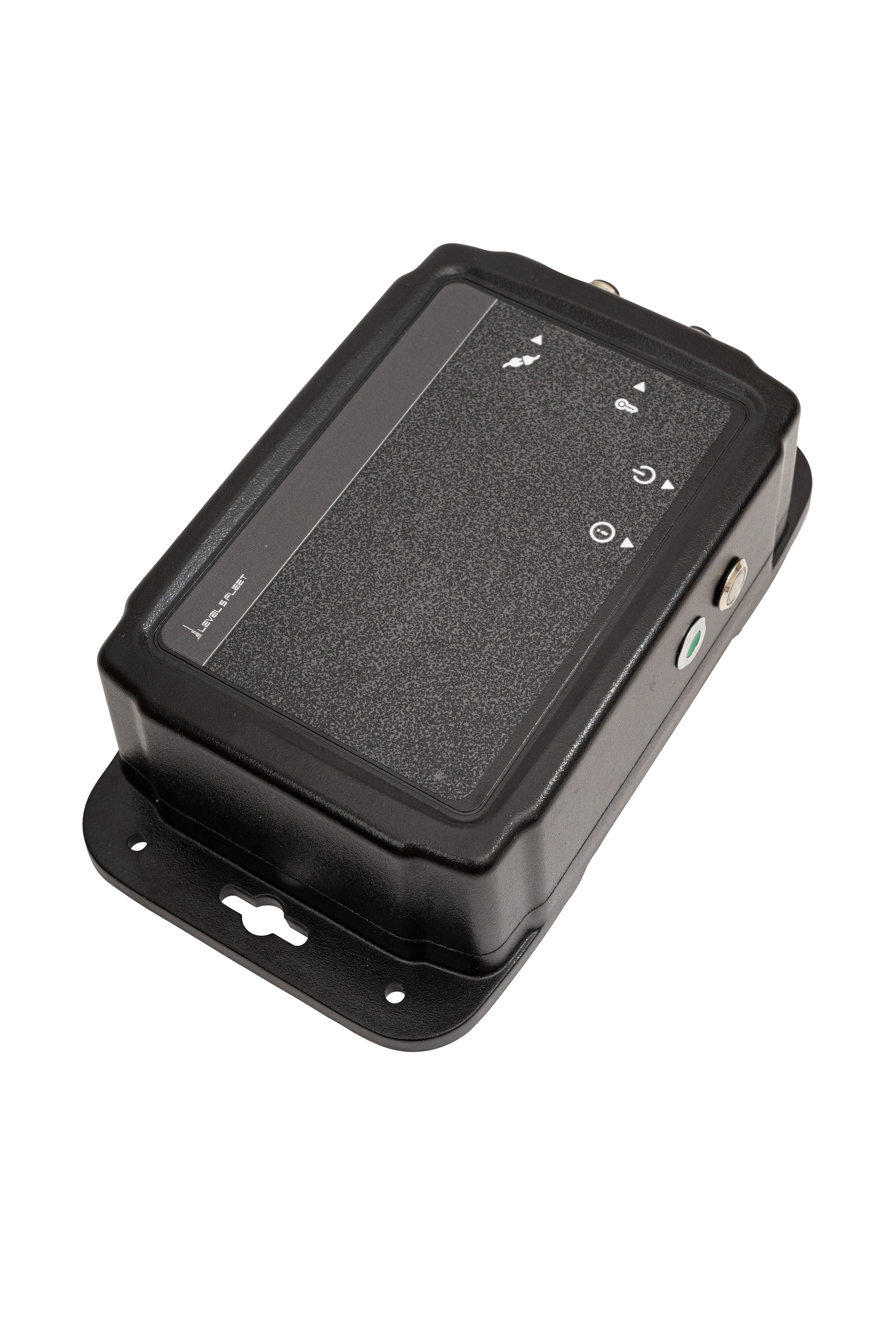
    Admiral Immobilizer, part of Admiral Enforce, is engineered with a triple-layered redundancy to make accidental activation virtually impossible. The layers are:

    • Passive Layer: Electrically isolates the valve. If the switch is off, nothing happens.
    • Logic Layer: Confirms the trailer isn’t moving and isn’t connected to the tractor before switching.
    • Architecture Layer: Ensures the immobilizer can’t be remotely activated. You as an operator can only request it — the trailer decides whether it is safe to engage. There are no “engage now” overrides.

    For additional margin, each layer itself contains redundant safety mechanisms. Let’s take a closer look at the logic layer to illustrate.

    Motion matters more than location (and physics is honest)

    As noted above, the logic layer verifies that no tractor is connected and that the trailer is stationary. Motion detection in turn is informed by two independent signals. If asked to pick signals, GPS would be one of the first choices. Vibrations would be the other.

    Long before GPS existed, engineers learned that machines announce what they are doing through vibration alone. Rolling does not look like lifting. Coupling does not look like dragging. And being tampered with does not look like either, no matter how optimistic someone is about being gentle.

    If your phone can tell the difference between sitting on a desk, riding in your pocket, or falling off a table, it’s already doing motion classification. Trailers are no different. Just louder.

    The same MEMS sensors that quietly rotate screens and count steps can distinguish real movement from interference. These patterns are not subtle. Steel, rubber, and inertia are surprisingly expressive.

    Which is useful, because physics doesn’t need cell service.

    Even when GPS is degraded or unavailable, motion classification continues in the background, providing a second, independent layer of truth about what the asset is actually experiencing.

    Why this matters operationally

    The goal is not to build a smarter lock. It’s to remove the moments where security depends on someone making the right call under pressure.

    When immobilization is embedded at the asset level:

    • unattended trailers remain protected without supervision,
    • exceptions stop being judgment calls,
    • and “probably safe” stops being a security posture.

    This is not about being more restrictive. It’s about being more consistent.

    Where Admiral Enforce fits

    Admiral Enforce was designed around this reality: enterprise security must survive execution without asking for attention.

    Immobilization is one part of that system. It is part of the Admiral Trust Infrastructure. It ensures that protection doesn’t disappear when the yard is busy, the phone rings, or the schedule slips.

    Closing thought

    At scale, security choices are not about intent. They’re about incentives and physics. Controls that require judgment eventually vary. Controls embedded in equipment simply work.

    If the driver is authorized to pull the load, the immobilizer disengages silently. The driver never even knows it was there.

    There’s more nuance when it comes to live loads versus drop-and-hook scenarios. That’s where Admiral Execute enters the picture.

    Stay Connected

    Want more insights like this? Follow Level5Fleet for future articles, freight industry trends, and updates on building a smarter, more secure supply chain:
    🔗 LinkedIn
    🐦 X: @Level5fleet
    📘 Facebook
    📸 Instagram

  • Why Freight Security Fails Off-Channel — and Why Resolution Requests Exist

    Why Freight Security Fails Off-Channel — and Why Resolution Requests Exist

    We at Level5Fleet enjoy technology a little more than most. We’ve been known to debate espresso extraction curves and speculate about whether a Roomba could ever be trusted behind a bar.

    Which is why a familiar story sticks out.

    Imagine ordering takeout through DoorDash, only to have it “picked up” by a courier who never existed. No driver, no delivery, no food. It sounds absurd, because it is. Not because theft is impossible, but because the system itself doesn’t allow the pickup to happen without identity, authorization, and context being aligned inside the platform.

    DoorDash doesn’t rely on monitoring or after-the-fact investigation to prevent fictitious pickups. It prevents them structurally.

    Freight, for historical reasons, does not.

    The real problem isn’t automation — it’s where execution happens

    Over the last few years, freight has seen a surge of AI-assisted booking tools. These systems read emails, parse PDFs, interpret rate confirmations, and respond automatically. From a technical standpoint, it’s impressive work.

    From a systems standpoint, it reveals something else entirely.

    Most of this automation exists to preserve off-channel communication: email threads, forwarded attachments, phone calls, side conversations. Because that’s where booking and changes still happen. AI isn’t replacing the workflow; it’s compensating for it.

    This is less about “using AI poorly” and more about using AI to keep legacy channels alive.

    Why off-channel communication exists — and where it breaks

    Freight didn’t end up relying on email and phone calls by accident. Those channels solve a real and important problem: they move information across company boundaries.

    Shippers, brokers, carriers, yards, and drivers all operate on different systems. Email and phone calls bridge that fragmentation. They let documents move, questions get answered, and exceptions get coordinated when no shared platform exists.

    That flexibility is useful. It’s also why these channels persist.

    The problem is not that email or phone calls are “old.” The problem is that they were never designed to communicate authorization safely.

    An email can carry information, but it cannot:

    • scope authorization to a specific load and moment,
    • prevent forwarding or replay,
    • abstract who approved from those executing,
    • or serve as a canonical, tamper-resistant source of truth.

    As a result, authorization sent over off-channel communication inevitably leaks context. Names appear. Relationships are exposed. Approval paths become visible. What started as coordination becomes an attack surface.

    This is the common exploit gap: when execution depends on interpreting messages rather than verifying authorization, judgment fills the gap, and that gap is exactly where strategic theft operates.

    Why preserving off-channel workflows creates structural risk

    Email is flexible. That’s also the problem. When execution-critical decisions happen over email, context leaks, authorization becomes ambiguous, and verification moves to humans under pressure.

    You can monitor inboxes. You can scan attachments. You can flag anomalies. But none of that changes the fact that execution is occurring outside the system that is supposed to enforce it.

    This is why fraud detection, anomaly models, and war rooms emerge. They are not mistakes. They are rational responses to an architecture that cannot enforce correctness at the point of action.

    Why “war rooms” are rational — and still insufficient

    Large brokers didn’t build monitoring centers because they enjoy overhead. They built them because when execution is off channel, someone has to watch everything.

    Patterns get analyzed. Lanes get flagged. Suspicious capacity expansions get escalated. It’s sophisticated, serious work. But the very existence of a war room tells you something important: the system can detect risk, but it cannot prevent execution when authorization is wrong.

    The design alternative: eliminate off-channel execution

    The alternative is not better monitoring. It’s removing the channel where ambiguity enters. That’s the design principle behind Resolution Requests.

    Instead of preserving email as the execution surface and trying to interpret it more accurately, Resolution Requests move execution-binding changes into a controlled, scoped workflow:

    • Requests are tied to a specific load
    • Authorization is explicit and verifiable
    • Proof reaches the point of execution without leaking context
    • Frontline operators verify that approval exists, not who approved it

    This is not about AI replacing judgment. It’s about eliminating the moment where judgment is required.

    Why this matters at execution

    When changes are handled off-channel, every handoff becomes a trust exercise: Is this request legitimate? Is this person authorized? Is this timing valid?

    Resolution Requests collapse that uncertainty. Execution no longer depends on reading between the lines of an email or trusting that context survived forwarding.

    The system either confirms authorization—or it doesn’t.

    Structural intelligence beats artificial intelligence

    AI is exceptionally good at complex pattern recognition. Using it to interpret fax-like workflows isn’t wrong, it’s just compensating for a deeper constraint. That’s the difference between artificial intelligence and trust infrastructure. The latter changes the flow so fewer decisions need to be interpreted at all.

    The future of freight security isn’t smarter inboxes. It’s fewer inboxes involved in execution.

    Closing thought

    Every industry eventually learns the same lesson: monitoring scales until it doesn’t. Enforcement scales when it’s built into the protocol. Resolution Requests exist because freight reached that inflection point.

    Not because people failed. Because the channel did.

    Stay Connected

    Want more insights like this? Follow Level5Fleet for future articles, freight industry trends, and updates on building a smarter, more secure supply chain:
    🔗 LinkedIn
    🐦 X: @Level5fleet
    📘 Facebook
    📸 Instagram

  • How to Coordinate Authorization with Unknown Parties — Without Creating an Exploit Gap

    How to Coordinate Authorization with Unknown Parties — Without Creating an Exploit Gap

    Most awkward workflows don’t start as bad ideas. They start as workarounds.

    When systems don’t quite support what needs to happen, people don’t stop operating, they improvise. They forward emails. They screenshot documents. They call someone who “should know.” They invent processes that technically work, even if no one would design them that way from scratch.

    Freight is full of these adaptations because execution routinely crosses company boundaries without a shared trust layer. And that constraint forces operations into models that are vulnerable to cargo theft, fraud, and costly mistakes.

    Why off-channel communication exists — and why it’s still a problem

    Email, phone calls, and PDFs persist in freight for a good reason: they move information across companies.

    Shippers, brokers, carriers, yards, and drivers all operate on different systems. Off-channel communication bridges that fragmentation. It lets documents move, questions get answered, and exceptions get coordinated when no shared platform exists.

    That flexibility is useful. The problem is that email and phone calls were never designed to communicate authorization safely.

    They can carry information, but they cannot scope authorization to a specific load and moment, nor prevent forwarding or replay, nor abstract who approved from those executing, nor serve as a canonical source of truth at the point of action.

    As a result, authorization sent off-channel inevitably leaks context. Names appear. Approval paths become visible. Responsibility drifts back to individuals under pressure.

    This is the common exploit gap: when execution depends on interpreting messages rather than verifying authorization, judgment fills the gap, and that gap is exactly what strategic theft and operational mistakes exploit.

    The real question: how do you authorize unknown parties?

    This is the hard case freight keeps running into. You don’t control every participant. You don’t know everyone who will touch the load. And yet execution still has to move.

    So is: How do you coordinate authorization with parties you don’t control, without leaking attackable information or forcing frontline judgment?

    Any solution that works has to meet a few hard requirements:

    • Authorization must be scoped to a specific load.
    • It must be verifiable without revealing who approved or how.
    • It must reach the point of execution intact.
    • And it must let frontline teams act without interpreting paperwork.

    This is where Resolution Requests come in.

    The method: coordinating authorization without off-channel execution

    Resolution Requests (RRs – or R2s) are not “better messages”. They are a way to move authorization through execution. Here’s how the method works in a familiar messy scenario.

    Step 1: The broker creates a Resolution Request

    A broker initiates an R2 for a specific load and tags the shipper as the resolver (the authority who can approve binding changes). The R2 now becomes the authorization container for that load.

    Step 2: Visibility without authority leakage

    The broker can add carrier dispatch to the R2 for visibility. Dispatch can see that authorization exists and that it’s current — without seeing internal approval context or private relationships.

    If dispatch needs a change, they request it inside the same RR. No side emails. No forwarded screenshots. The identities of the parties and their company representations real-time verifiable in that authorization container.

    The shipper approves or denies, and the decision is recorded in context.

    Step 3: The unexpected participant shows up

    Now the hard part. The driver arrives early. The gate operator was never part of the original chain. Neither has access to the R2. This is where traditional workflows force judgment.

    With R2s, the gate has options, and none of them require inspecting paperwork.

    Step 4: Three policy-controlled options at the gate

    Depending on company policy, the gate can:

    1. Verify that authorization exists
      The gate confirms that the load is authorized for early pickup if company policy permits reading the R2.
    2. Request scoped access under the existing R2
      The gate submits a read request inside the RR, with justification. The authorizer decides. The decision is logged and bounded.
    3. Create a linked R2 requesting proof of existence
      If the gate should not see details at all, they create a new R2 that references the original. The authorizer confirms or denies, without exposing context.

    In all cases, the gate is not asked, to judge authenticity, to interpret emails, or to decide who to trust. Their only decision is whether to request verification.

    Why this works operationally

    This method does something subtle but critical: It slows the decision without slowing the work. Execution continues.
    Trucks don’t queue unnecessarily. Frontline teams don’t improvise.

    But binding decisions are paused until authorization is verified, not inferred. That’s exactly what the operations strategy calls for when uncertainty rises.

    Why this replaces fraud detection — not improves it

    Many systems try to preserve off-channel execution and compensate with monitoring, anomaly detection, or escalation teams. Those approaches are rational responses to the constraint — but they don’t remove it.

    Resolution Requests remove the need to interpret messages at execution. Authorization either exists, or it doesn’t. The system answers the question before a human has to guess.

    That’s trust infrastructure. And that’s how you coordinate authorization with unknown parties without creating an exploit gap.

    Stay Connected

    Want more insights like this? Follow Level5Fleet for future articles, freight industry trends, and updates on building a smarter, more secure supply chain:
    🔗 LinkedIn
    🐦 X: @Level5fleet
    📘 Facebook
    📸 Instagram