Category: Educational Resources

  • Securing Critical Mineral Supply Chains: From Observation to Enforcement

    Securing Critical Mineral Supply Chains: From Observation to Enforcement

    Executive Summary

    Critical minerals have moved from industrial inputs to strategic assets. They underpin energy systems, defense capabilities, and advanced manufacturing. Governments increasingly treat their supply chains as matters of economic and national security, and organizations sourcing these materials are under growing pressure to ensure not only availability, but integrity.

    Yet most efforts to secure these supply chains still rely on observation. Materials are tracked, documented, and occasionally inspected. Losses are investigated after they occur. Controls are applied at facilities, borders, and checkpoints.

    This approach assumes that custody is preserved as materials move through the chain.

    In practice, custody is repeatedly handed off, and at each handoff, enforcement weakens. Under scale and time pressure, decisions rely on people, procedures, and assumptions. This creates conditions where diversion, substitution, and tampering can occur without immediate detection.

    Securing critical mineral supply chains therefore requires a shift. The objective is not only to observe what happens, but to ensure that what is allowed is what actually occurs. This requires enforcement that operates at the point of execution and travels with the material through every stage of transit.

    1. From Resource Security to Supply Chain Integrity

    Historically, mineral security has focused on access to resources. Governments and companies have sought to secure upstream supply through ownership, contracts, and diversification.

    That model is no longer sufficient. Critical minerals are now embedded in complex, multi-stage supply chains that span jurisdictions, intermediaries, and transportation modes. The concept of security has expanded from resource acquisition to control across the entire chain, from extraction to final delivery.

    At the same time, geopolitical competition has intensified. Critical minerals are increasingly treated as leverage within trade policy, industrial strategy, and international alliances.

    Under these conditions, the problem is no longer simply whether material is available. It is whether the material that arrives is the material that was intended, and whether its movement adhered to defined conditions. This is a question of supply integrity.

    2. Where Integrity Breaks in Practice

    Critical minerals are frequently transported in containers, particularly in processed or semi-processed form. These containers move through a sequence of environments, each with different actors and controls.

    They leave a mine or processing facility, move overland by truck or chassis, pass through port operations, and are loaded onto vessels. At each stage, custody changes hands.

    The vulnerabilities are not evenly distributed. They concentrate at specific points.

    During inland transport, the primary risk is diversion. Drivers may deviate from planned routes, sometimes with the involvement of external actors. Cargo theft incidents frequently involve hijacking or diversion of trucks in transit, particularly where high-value goods are involved.

    At ports and terminals, the risk shifts. Here, access is controlled but widely distributed. Multiple parties interact with containers, often under time pressure. Insider involvement becomes a significant factor, as access rights, information, and operational knowledge can be misused.

    During maritime transit, visibility is limited. Inspection is selective, and systems rely on documentation and prior checks. Errors or tampering that occur before loading may persist undetected through the voyage.

    Across these stages, the pattern is consistent. Control is strongest at defined checkpoints, and weakest in between.

    3. The Limits of Observation-Based Security

    Most existing approaches to mineral supply chain security are observational.

    Tracking systems provide location data. Documentation records transfers of custody. Inspections validate contents at specific points. Physical seals indicate whether a container has been opened.

    These measures are necessary, but they share a common limitation. They do not determine what is allowed to happen. They record or infer what has happened.

    In environments where decisions must be made quickly and repeatedly, reliance on observation creates gaps. A shipment may be visible, but still diverted. A container may be sealed, but still opened and resealed. A process may be documented, but not followed.

    As supply chains scale, these gaps widen. Inspection does not scale with volume. Documentation does not prevent deviation. Visibility does not enforce compliance.

    This is why supply chain security frameworks emphasize screening, credentialing, and documentation across participants and shipments.

    These measures improve assurance, but they do not eliminate reliance on execution.

    4. The Structural Gap: Authority and Execution

    At the core of the problem is a structural separation.

    Authority is defined upstream, in contracts, policies, and procedures. Execution occurs downstream, at the point where containers are moved, opened, or handed over.

    Between these two, there is a gap.

    When a container is loaded, someone has authority to approve that action. When it is transported, someone has authority to determine its route. When it is opened, someone has authority to grant access.

    But at the moment these actions occur, enforcement is often indirect. It relies on compliance, oversight, or after-the-fact verification.

    This separation is manageable under controlled conditions. It becomes fragile when operations scale, handoffs multiply, and decisions are made under time pressure.

    It is in this gap that most integrity failures occur.

    5. From Control Around the Container to Control At the Container

    Security measures today are typically applied around the container. Facilities are secured. Perimeters are monitored. Escorts accompany shipments. Systems track movement.

    These measures attempt to influence behavior externally. An alternative approach is to embed control at the point where actions occur.

    If access to a container is governed by enforceable authorization, opening it without that authorization becomes impossible, rather than merely prohibited. If movement is conditioned on defined parameters, deviation becomes constrained rather than detectable after the fact.

    In this model, enforcement does not depend on continuous supervision. It operates locally, at the container or its immediate interfaces.

    This changes the role of the broader system. Tracking, documentation, and inspection remain, but they no longer carry the burden of preventing unauthorized actions. They confirm and record outcomes that are already constrained.

    6. Applying Enforcement to Mineral Logistics

    For critical minerals, the relevant actions are specific.

    A container must not be opened without authorization. A container must not be moved outside defined conditions. A container’s contents must not be altered or substituted without detection.

    These conditions can be enforced at the container and its immediate transport interfaces.

    During inland transport, coupling between container and chassis can be governed so that movement occurs only under defined authorization. This reduces reliance on driver compliance and external oversight.

    At ports, access to the container can be controlled so that opening requires explicit authorization tied to the shipment, rather than generalized operational access.

    During handoffs, authority can be transferred in a controlled manner, ensuring that each actor can perform required actions, but only those actions.

    In this model, enforcement travels with the container. It does not depend on the environment in which the container happens to be.

    7. From Loss Prevention to Supply Assurance

    The implications of this shift extend beyond theft prevention.

    When enforcement is applied at the point of execution, the outcome is not only that unauthorized actions are prevented. It is that authorized actions can be verified.

    A shipment can be shown to have remained within defined conditions from origin to destination. Access events are governed and recorded. Deviations are either prevented or explicitly captured.

    This changes how supply integrity is established.

    Instead of relying on documentation and inspection to infer compliance, organizations can demonstrate that compliance was enforced.

    In a context where critical minerals are tied to regulatory requirements, ethical sourcing, and geopolitical considerations, this distinction becomes significant. It supports not only security, but assurance.

    Conclusion

    Critical mineral supply chains are becoming central to economic and national security. Ensuring their integrity requires more than tracking, documentation, or inspection.

    These tools provide visibility, but they do not guarantee that execution aligns with intent.

    As supply chains grow more complex and the stakes increase, the gap between authority and execution becomes the primary source of risk. Addressing that gap requires enforcement that operates where actions occur and persists across handoffs.

    Moving from observation to enforcement does not replace existing controls. It complements them by ensuring that what is permitted is what actually happens. Admiral is an example of a system designed to implement the custody enforcement model described in this paper. More information on Admiral’s enforcement approach is available at: Admiral Enforce | Physical enforcement on trailers & containers.

    In a supply chain where custody changes hands repeatedly, integrity must be more than an assumption. It must be a condition that is maintained throughout the journey.

    Stay Connected

    Want more insights like this? Follow Level5Fleet for future articles, freight industry trends, and updates on building a smarter, more secure supply chain:
    🔗 LinkedIn
    🐦 X: @Level5fleet
    📘 Facebook
    📸 Instagram

  • Enforcement Without Ownership

    Enforcement Without Ownership

    How Shippers Can Establish Trailer-Level Custody Through Carrier-Provided Enforcement

    Executive Summary

    In road freight, shippers absorb the operational and economic consequences of loss, theft, misrouting, and non-compliance, even when execution is delegated to carriers and brokers. This exposure exists regardless of whether contractual liability formally rests elsewhere. Loss events consume shipper time, disrupt customers, and degrade service reliability.

    The question facing shipper logistics and transportation managers is therefore not one of fault or accountability, but of control: How can a shipper ensure that custody requirements are enforced during execution when trailers, drivers, and day-to-day operations are controlled by carriers?

    This paper addresses that question directly. It presents a practical model for how shippers can define custody requirements, decide where enforcement should reside, and require carriers or brokers to provide trailers equipped with the appropriate enforcement capabilities.

    What Enforcement Means in This Paper

    In this paper, enforcement does not refer to monitoring, oversight, or post-event investigation.

    Enforcement refers to the ability to physically allow or prevent actions at the trailer during execution, based on predefined conditions, without requiring continuous supervision.

    Specifically, enforcement means that cargo access, and where applicable movement of the trailer, is evaluated at the moment the action is requested against explicit criteria such as identity of person requesting access, time, and location. When those criteria are satisfied, the action proceeds. When they are not, the action is prevented or constrained, and proof of the decision is generated.

    Enforcement in this sense is local, event-driven, and executable. It is distinct from visibility, which observes what happens, and from policy, which specifies what should happen. This approach removes the need for procedural seals as a primary control. Seals may still be used, but access enforcement no longer depends on them.

    The Core Decision: Who Enforces Custody During Execution?

    At the core of trailer-level custody is a structural decision about where enforcement authority resides during execution. There are two viable enforcement models in road freight.

    In the first model, the carrier enforces shipper-defined custody requirements using enforcement systems it operates on the trailer. The carrier assumes custody under explicit, enforceable conditions and demonstrates compliance through proof generated at execution. Authority to grant access remains with the carrier, subject to the shipper’s specified rules.

    In the second model, enforcement authority is explicitly assigned to the shipper or consignee. While the carrier continues to execute the move, access and, where applicable, movement authorization are enforced against shipper- or consignee-issued authority at the trailer itself. In this model, the shipper does not take operational control of the trailer, but retains control over access decisions.

    In either model, authority can be assigned dynamically. The remainder of this paper examines how shippers can select between these two models and apply them in practice.

    Establishing Need Through Risk Tiering

    Shippers should not require the same level of enforcement for every load. As with insurance, compliance, and safety programs, custody requirements should be aligned with risk.

    A risk-tiered approach allows shippers to define where enforcement is necessary and where procedural controls are sufficient.

    At the lowest tier, shippers may accept procedural controls alone. These loads are low value, low diversion risk, and operationally forgiving. Seals, SOPs, and post-event visibility are adequate.

    At the next tier, shippers require trailer door access to be enforced, not merely secured. This does not refer to mechanical padlocks, seals, or procedures that rely on driver compliance. It refers to systems that evaluate opening authority at the trailer itself and physically prevent access unless predefined conditions are met.

    To be viable at scale, this enforcement must operate without manual intervention, without reliance on driver behavior, and without per-load setup. Access decisions must be executed automatically at the moment of opening, and generate verifiable proof regardless of who is operating the trailer.

    This tier addresses common exposure such as pilferage, yard dwell, and drop-and-hook operations by replacing procedural controls with executable access rules that survive routine freight operations.

    A higher tier adds conditional access. Door opening is allowed only when identity, time window, and location constraints are satisfied. This tier is appropriate where early pickup, impersonation, or appointment sensitivity creates risk.

    At the highest tier, shippers require conditional immobilization. Movement of the trailer can be restricted when predefined breach conditions occur, such as unauthorized rerouting or access attempts.

    Risk tiering provides a defensible basis for enforcement requirements and prevents overreach.

    Selecting an Enforcement Model by Operational Flexibility

    Risk tiering determines whether enforcement is required. The enforcement model determines who holds authority.

    The choice between enforcement models is a function of how much operational flexibility a shipper requires after execution begins.

    For freight where intent is stable and unlikely to change after pickup, carrier-enforced custody is sufficient. In this model, the shipper specifies custody conditions in advance, the carrier enforces those conditions at the trailer during execution, and proof is returned at close-out. The shipper does not need to participate during transit, coordination overhead is minimal, and the model aligns naturally with brokered freight and standardized operations.

    In contrast, some freight requires the ability to adapt intent after pickup. Changes in delivery timing, destination, consignee authorization, or exception handling may be necessary while the load is already in motion. In these cases, shippers may require retention of access or movement authority. Enforcement remains local to the trailer, but authority to grant or modify access is issued by the shipper or consignee through a shared trust infrastructure.

    This second model introduces additional overhead in the form of authority transfer and governance, but that overhead buys operational flexibility that does not otherwise exist. It allows shippers to adjust custody conditions during execution without renegotiation, re-tendering, or manual coordination with carriers, while preserving the carrier’s role in physical execution.

    Both models are valid. The difference is not control versus trust, but whether custody conditions are expected to remain fixed or may need to evolve once the shipment is underway. Both models can coexist within the same network, applied lane by lane or load by load.

    Translating Risk and Enforcement Model Into Carrier Requirements

    Once risk tiers and enforcement models are defined, the shipper’s task is not to deploy technology, but to specify capability requirements that carriers must be able to meet. These requirements express what the trailer must be capable of enforcing during execution, and where enforcement authority is expected to reside, without dictating how carriers implement those capabilities.

    For a given tier, the shipper defines what the trailer must be capable of enforcing. For example, a load may require a trailer equipped with an electronically enforceable door lock that supports identity- and time-based access. Another load may additionally require conditional immobilization under defined scenarios.

    The shipper does not dictate how the carrier implements these capabilities, only that the carrier must be able to demonstrate compliance. This approach mirrors how frameworks such as TAPA TSR are used to align expectations around facility and process security using a shared language of requirements, rather than prescriptive implementations.

    The distinction is that, in this case, the shared language applies to execution at the trailer. Instead of certifying environments or procedures, the shipper specifies what actions must be enforceable during execution, and the carrier demonstrates that its equipment and operations can meet those requirements.

    Carriers that possess trailers with the required enforcement capabilities can accept the load. Carriers that do not cannot. This mirrors how equipment requirements, temperature control, or regulatory certifications are handled today.

    The matrix below illustrates how risk tier and enforcement model interact, and how authority can reside with the carrier or be assigned to the shipper or consignee without changing who executes the haul.

    Risk TierOperational Flexibility RequiredEnforcement ModelWho Holds Authority During ExecutionTypical Use Cases
    Tier 0NoneProcedural controls onlyN/ALow-value freight, loss-tolerant lanes
    Tier 1LowCarrier-enforced access controlCarrierPilferage-prone freight, yard dwell, drop-and-hook
    Tier 2ModerateCarrier-enforced conditional accessCarrier (within shipper-defined constraints)Early pickup risk, appointment-sensitive docks
    Tier 2ModerateShipper-assigned access authorityShipper or consigneeLoads where access conditions may change post-pickup
    Tier 3HighShipper-assigned access + conditional immobilizationShipper or consigneeHigh-value freight, rerouting or strategic theft risk

    The Role of Brokers in Enforcement

    Brokers operationalize shipper requirements through routing decisions. When a shipper specifies an enforcement tier as part of a load tender, the broker routes that load only to carriers that can meet the requirement.

    Compliance becomes part of acceptance and close-out, not an afterthought. Proof of enforcement is provided alongside other delivery artifacts.

    This approach does not require brokers to manage technology. It requires them to respect custody requirements in the same way they respect equipment, service level, and regulatory constraints.

    Operational Outcomes and Conclusion

    By adopting a risk-tiered approach to custody and specifying enforcement as a carrier capability, shippers can achieve enforceable custody without disrupting execution. Access and, where applicable, movement rules are applied at the trailer, at the moment they matter. Proof is generated as part of execution rather than reconstructed afterward, shifting disputes from interpretation to verification.

    More importantly, this approach moves shippers away from reliance on assumed compliance. Custody conditions are no longer implicit in procedures or contracts, but explicit, enforceable, and resilient to handoffs during execution.

    In road freight, effective custody does not require ownership of trailers or direct operational control. It requires clarity about where enforcement authority should reside and discipline in expressing custody needs in a form that carriers and brokers can execute. Risk tiering determines when enforcement is required. The selected enforcement model determines whether authority remains with the carrier or is assigned to the shipper or consignee to enable post–pickup adaptability.

    When these elements are combined, shippers can materially improve execution outcomes while preserving the delegated operating model on which freight depends. This approach does not introduce new power structures or require industry-wide change. It aligns authority, execution, and accountability using mechanisms that already exist, applied at the point of execution.

    This is not a theoretical construct. It is a practical operating model that ensures access and movement authorization are enforced physically during execution, regardless of who owns the equipment.

    One implementation of this operating model is provided by the Admiral Trust Infrastructure, which enables trailer-level enforcement of access and movement authority in both carrier-enforced and shipper-assigned custody models. Admiral Enforce is designed to operate within existing carrier and broker workflows, allowing custody conditions to be executed physically at the trailer without requiring asset ownership or continuous supervision.

    Readers interested in how these concepts are implemented in practice can learn more at:
    https://www.level5fleet.com/products/enforce

    Stay Connected

    Want more insights like this? Follow Level5Fleet for future articles, freight industry trends, and updates on building a smarter, more secure supply chain:
    🔗 LinkedIn
    🐦 X: @Level5fleet
    📘 Facebook
    📸 Instagram

  • Securing Commodity Containers in Maritime Trade

    Securing Commodity Containers in Maritime Trade

    An Operationally Viable Model for Prevention, Custody, and Control

    Executive Summary

    In maritime commodity trade, the objective is not visibility.
    The objective is custody enforcement, specifically, using lockout mechanisms on the container door so it cannot be opened without authorization. Visibility can support investigation and recovery. Custody enforcement prevents loss, dispute, and silent compromise before they occur.

    High-value commodities move through long, distributed supply chains involving inland transport, ports, vessels, and transshipment points. Across this journey, containers are assumed to remain intact once sealed, custody is inferred through handoffs, and tracking is often mistaken for control. These assumptions do not survive execution.

    This paper treats custody enforcement as a foundational requirement for securing commodity containers and examines how it can be achieved within the operational realities of maritime logistics. Rather than proposing idealized security models, it focuses on what is operationally viable given the constraints of container leasing, global scale, and non-destructive handling. It outlines an end-to-end approach that prioritizes prevention, accountability, and auditability without changing how maritime trade fundamentally works.

    Custody Enforcement Is the Missing Control

    Commodity losses in maritime trade rarely result from a lack of procedures, inspections, or monitoring tools. They occur because custody is assumed rather than enforced.

    Once a container is sealed, the system relies on symbols of trust. A seal implies that contents remain unchanged. A handoff implies responsibility. A tracking signal implies safety. None of these implications are enforceable. When a container passes through multiple parties and jurisdictions, custody becomes probabilistic. When something goes wrong, responsibility is reconstructed after the fact, often without certainty and often too late.

    Custody enforcement changes this dynamic. Rather than merely observing, it ensures that access to the container is constrained — by who may open it, when it may be opened, and where that opening is permitted. It preserves accountability across time and distance by making access explicit, authorized, and recorded. Without custody enforcement, maritime security remains reactive by design.

    Why Custody Enforcement Is Difficult at Sea

    The absence of custody enforcement in maritime trade is a consequence of structural constraints that most security concepts fail to accommodate.

    The first constraint is the container leasing model. Marine containers are circulating infrastructure. They are leased, repositioned globally, and reused across carriers, routes, and customers. They do not return to the same operator on predictable cycles. Any security approach that assumes permanent installation, asset ownership continuity, or guaranteed device recovery is incompatible with this reality. Security cannot be treated as a fixed attribute of the container itself. It must be scoped to the journey.

    The second constraint is scalability. Maritime logistics scales through repetition and standardization. Any solution that introduces manual overhead, reverse logistics, or device inventory management fails at scale. Operators cannot be expected to track hardware, coordinate returns, or manage exceptions without eroding the efficiency that maritime trade depends on. Custody enforcement must operate as a turnkey service. It must be applied at origin, removed at destination, and disappear operationally once the journey begins.

    The third constraint is tamper protection without destruction. Commodity risk is interior risk — the unauthorized access or manipulation of cargo inside the container. Any custody control must therefore protect against both overt opening and covert tampering, without relying on destructive installation or leaving residual hardware behind.

    This calls for interior installation of lockout mechanisms. At the same time, containers cannot be drilled, welded, or modified. Leasing agreements prohibit destructive alterations, and residual hardware creates liability. Effective protection must therefore be physically robust, non-destructive, and leave no trace once removed.

    Any custody model that violates one of these constraints will fail operationally, regardless of its technical merits.

    Enforcement, Not Observation

    Within this model, custody enforcement is achieved through cryptographic control rather than tamper-evident seals or passive tracking.

    A cryptographic seal enforces who may open the container, where they can open, and when. It records where the seal was applied and broken, when those events occurred, and under whose authority access was granted. The resulting record is non-repudiable. It does not rely on inference or reconstruction.

    This distinction matters. Tracking and sensors can indicate where a container is and whether a door has been opened. Custody enforcement changes the operating condition by constraining access in advance, rather than merely reporting it after the fact. For commodity security, this distinction determines loss, liability, and trust.

    Importantly, enforcement does not require continuous observation to be effective. What it requires is certainty at access points. The system does not require real-time visibility or continuous supervision. Access policy is embedded on the container itself and travels with it, allowing the system to enforce and record access.

    End-to-End Application in Maritime Trade

    Applied to a typical commodity movement, custody enforcement begins at the inland origin. The container is sealed under authorization, with the event cryptographically recorded. During over-the-road transit, the seal constrains access. At the port, custody persists through handoff and loading without requiring intervention. During ocean transit, enforcement continues without reliance on continuous connectivity. At destination, the container is opened under authorization, and the seal produces a verifiable custody record.

    Throughout this journey, the system prioritizes prevention over detection. Unauthorized access is constrained, not merely flagged. Accountability is preserved without imposing new operational burdens on carriers, terminals, or shippers.

    This custody enforcement model is not theoretical. It is already implemented in systems designed specifically for high-value freight execution.

    Admiral is one such system. Its implementation demonstrates that custody enforcement can be achieved within the constraints of container leasing, global scale, and non-destructive handling — without changing how maritime trade operates.

    Progressive Adoption Without Operational Risk

    Maritime systems evolve conservatively for good reason. Any new control must prove itself under real conditions before it is trusted at scale.

    Custody enforcement is best introduced progressively. An initial proof of capability demonstrates end-to-end control across a real shipment. A subsequent pilot scales volume and validates operational fit. Enhanced capabilities can be introduced once value is demonstrated and operational confidence exists.

    This progression is not a compromise. It is a disciplined approach to reducing risk without disrupting established workflows.

    Conclusion

    By treating custody enforcement as a requirement rather than an aspiration, and by grounding it in the realities of container leasing, scalability, and non-destructive handling, it becomes possible to secure commodity containers without changing how maritime trade operates.

    Custody that survives the ocean is not achieved through more observation. It is achieved through enforcement that is operationally viable. Admiral is an example of a system designed to implement the custody enforcement model described in this paper. More information on Admiral’s enforcement approach is available at: Admiral Enforce | Physical enforcement on trailers & containers.

    Stay Connected

    Want more insights like this? Follow Level5Fleet for future articles, freight industry trends, and updates on building a smarter, more secure supply chain:
    🔗 LinkedIn
    🐦 X: @Level5fleet
    📘 Facebook
    📸 Instagram

  • Trust That Survives Execution: Why Maritime Security Cannot Scale on Detection Alone

    Trust That Survives Execution: Why Maritime Security Cannot Scale on Detection Alone

    Maritime security conversations almost always begin with inspection. How fast can containers be scanned, how accurate are detection systems, how much throughput can ports handle before congestion overwhelms operations. These are reasonable questions, but they start too late in the chain. They assume that inspection is where confidence is created.

    Inspection is necessary. But inspection alone cannot resolve the condition that allows contraband to move at scale.

    The missing layer is trust infrastructure that reaches the container itself and survives execution across time, distance, and handoffs.

    The root cause

    Contraband does not persist because ports lack scanners, inspectors, or procedures. It persists because containers are trusted by default once sealed, and that trust is assumed to remain intact as the container moves through complex, high-pressure environments. Seals are treated as evidence of integrity. Processes are treated as evidence of compliance. The absence of alerts is treated as evidence of safety.

    None of these assumptions are enforceable.

    Under real operating conditions—congestion, transshipment, labor constraints, jurisdictional boundaries—trust quietly degrades into probability. And probability forces judgment. Someone must infer whether a seal still means what it was supposed to mean, whether a process was followed as intended, whether silence implies safety. Judgment, even when exercised by capable professionals, does not scale.

    This is not a failure of people. It is the predictable outcome of a system that lacks enforceable trust at the asset level.

    Augmenting scanning

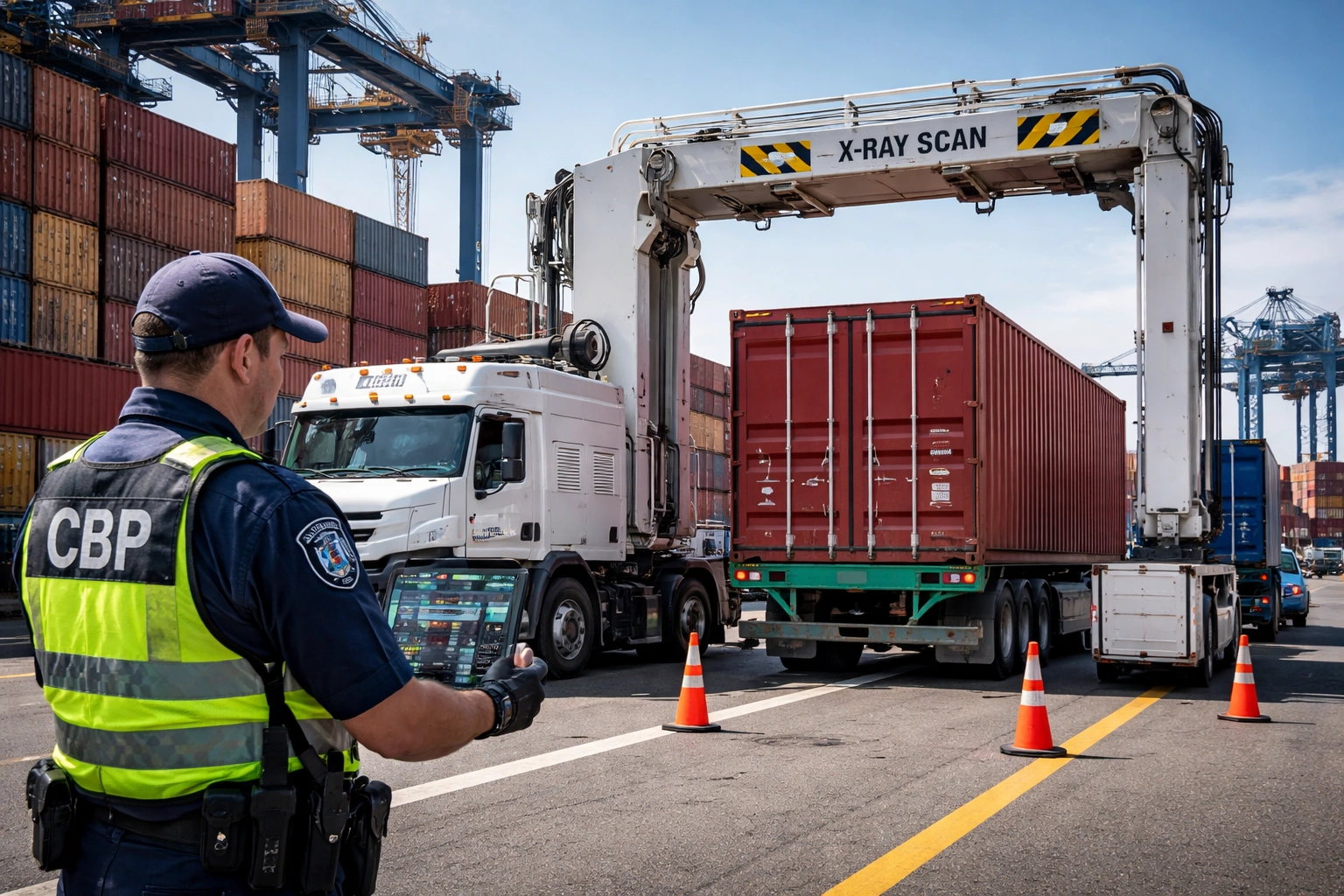
    Inspection systems are optimized to answer a narrow question: is there contraband inside this container at this moment? They are not designed to answer whether the container was accessed after sealing, where that access may have occurred, or whether the container’s integrity has changed during its journey. Inspection operates without provenance.

    The Port of Dubai offers a clear illustration. In 2023, the port physically inspected over two hundred thousand containers and identified a few hundred contraband shipments. To their credit, the port focused on what inspection systems can do well: reducing inspection time from hours to minutes and lowering per-inspection cost. They succeeded operationally. But structurally, the system still required inspecting more than two hundred thousand containers to establish confidence, because inspection was the only available mechanism for certainty.

    The bottleneck was never speed. It was the absence of trust signals that could exist before inspection.

    Visibility tools attempt to fill this gap, but visibility is observational, not protective. Tracking, scanning, and monitoring increase awareness. They help prioritize inspections and document outcomes. They do not change what a container can or cannot do. Visibility cannot prevent unauthorized access. It cannot resolve ambiguity at the moment of action. It cannot prove where trust failed.

    If a container can be opened, resealed, and continue its journey without resistance, every downstream control is reactive. Security begins after integrity has already been compromised.

    Trust and attribution

    All contraband scenarios ultimately reduce to two structural cases. In the first, the container is accessed after sealing—at sea, in transshipment hubs, or in yards—and contraband is inserted. Physical seals may remain visually intact. In the second, contraband is placed inside the container at the point of origin and the container remains untouched thereafter.

    Inspection treats these cases identically. Trust infrastructure does not.

    This is where asset-level enforcement changes the equation. Admiral Enforce does not replace inspection, and it does not compete with detection. It introduces a different capability entirely: a mechanism that refuses unauthorized action and produces an immutable record of what was allowed to happen.

    The Admiral Lock is not a sensor. It is not an alerting system. It is a physical control that prevents opening without valid authorization and records every authorized access event. Each access record is cryptographically verifiable, bound to an individual, time and place, and scoped to the specific container and load. The result is a cryptographic seal that cannot float independently of execution.

    Consider a post-origin interception attempt. With asset-level enforcement in place, the container cannot be opened without authorization. Any attempt either fails outright or leaves an undeniable record of who did it. Authorities can verify where the container was sealed, whether it has been accessed since, and if so, exactly when and where. Inspection becomes confirmation, not discovery.

    Now consider origin collusion. No system can detect hidden contraband without inspection, and Admiral does not claim otherwise. What trust infrastructure provides instead is attribution. If contraband is found and the access record shows no post-origin opening, the trust failure is conclusively bound to the point of stuffing, to a specific individual. Downstream ambiguity disappears. Inspection resources can be targeted, partner trust can be scored, and uncertainty is reduced without guessing.

    Final thought

    Inspection answers what is inside. Trust infrastructure answers when change could have occurred. Together, they allow authorities to inspect fewer containers with higher confidence and shift effort from volume to precision. Without trust infrastructure, inspection must remain broad. With it, inspection becomes surgical.

    Most importantly, asset-level enforcement removes decision moments from the frontline. No one must decide whether to trust a seal. No one must infer whether access occurred. No one must remember what was approved. The container enforces the rule, and the record speaks for itself.

    This is how trust survives execution—not as belief, but as proof that reaches the point of action intact.

    Ports do not need faster inspections alone. They need fewer reasons to inspect. Contraband thrives in ambiguity. Trust infrastructure eliminates ambiguity before inspection begins. Inspection will always be necessary. Judgment will always fail at scale. The missing layer is enforcement that lives with the container.

    Stay Connected

    Want more insights like this? Follow Level5Fleet for future articles, freight industry trends, and updates on building a smarter, more secure supply chain:
    🔗 LinkedIn
    🐦 X: @Level5fleet
    📘 Facebook
    📸 Instagram

  • Operational Strategies for Strategic Theft

    Operational Strategies for Strategic Theft

    Strategic cargo theft is a multi-faceted problem. It emerges from coordination failures across shippers, brokers, carriers, and facilities, and is reinforced by incentives that make cooperation difficult at scale.

    But complexity does not mean paralysis. While the broader dynamics are structural as explored in The Freight Prisoner’s Dilemma, and while enforcement ultimately matters as discussed in Policy on the Trailer — this series focuses on what operators can do today.

    The following entries break down concrete operational strategies that turn the common exploit behind strategic theft into an advantage: steps teams can implement on their own, without waiting for industry-wide alignment or new regulation.

    Strategic cargo theft appears in many forms: impersonation, forged documents, cyber intrusion, and social engineering.

    All of them succeed by exploiting the same underlying condition.

    That condition is not a flaw in freight operations. It is a consequence of how execution spans companies, systems, and time. It is a strength: it reflects how freight execution is designed to move quickly across companies, systems, and roles. When understood correctly, it can be addressed through a set of operational strategies.

    This seven-part series examines that shared failure mode and the strategies operators can use to reduce risk before execution — without slowing work, forcing brittle controls, or relying on guesswork.

    Series Index

    Part 1 — The Common Exploit

    Why impersonation, forged papers, and cyber attacks all succeed for the same reason.

    Introduces the core gap: the difficulty of tying requests to authorization across company and system boundaries — and why this gap shows up mid-load, not at onboarding.

    Part 2 — Shift

    Why slowing down decisions under pressure reduces risk.

    Borrowing from safety-critical industries, this entry introduces the first operational strategy: moving away from frontline due diligence and toward requester burden of proof.

    Part 3 — Protect the Decision, Not the Outcome

    Why documentation is a safety mechanism, not a compliance exercise.

    Shows how documenting decisions, including “wrong” ones, protects frontline teams, improves processes, and prevents blame-driven concealment.

    Part 4 — What Proof Actually Means

    Separating identity, representation, and authorization.

    Introduces a practical framework for understanding different kinds of proof, what each protects against, and why collapsing them creates blind spots.

    Part 5 — When Proof Breaks at Execution

    Why frontline teams are forced back into due diligence.

    Uses concrete scenarios to show how lack of infrastructure collapses decisions back onto individuals — violating the very strategies meant to reduce risk.

    Part 6 — Introducing Change Without Breaking Operations

    How teams phase in proof-based workflows.

    Explains why change management matters more than tools, how teams start incrementally, and how residual risk remains visible throughout the transition.

    Part 7 — Getting Started with Change Management

    Reducing risk now, without rebuilding your stack.

    Outlines a concrete, low-friction path for teams that want to begin applying these strategies immediately — whether they build internally or use shared trust infrastructure.

  • The gap: the common exploit

    The gap: the common exploit

    The attack patterns behind strategic theft are well known. Impersonation. Compromised email accounts. Forged paperwork. Bought or leased MCs. Social engineering over phone or text. On the surface, these schemes look different. In practice, they all rely on the same underlying weakness.

    They exploit how difficult it is, in the middle of execution, to reliably tie a request to three things: who is making it, who they represent, and whether they are authorized to ask for that change right now. When any of those links are ambiguous, judgment fills the gap.

    That shared weakness is what this series refers to as the gap. It appears everywhere operations teams recognize as “routine but risky”: reroutes, driver swaps, delivery changes, equipment substitutions, and the countless “just confirming this is okay” moments that don’t look dangerous until they are.

    One reason the gap is so persistent is that proof of authorization doesn’t live in a single place. There is no canonical source of truth. Identity, representation, and approval are scattered across company boundaries, systems, and conversations. What matters at the point of execution is rarely visible there.

    Operations teams already do due diligence — at onboarding. Companies are verified. Insurance is checked. MC numbers, contacts, and scorecards are reviewed. That diligence is effective for establishing who should be allowed to do what under normal conditions.

    The gap isn’t in setup. It’s in execution.

    During execution, the burden silently shifts. Frontline teams are asked to re-establish trust again, but now under time pressure, with incomplete context, and while work has to keep moving. The same questions resurface — “Is this real?” “Is this allowed?” — but the systems that answered them during onboarding are no longer in reach.

    This is where the gap gets exploited. There is a crucial difference between checking paperwork and verifying that a request is legitimate, authorized, and current. That second step is due diligence — but it’s being performed ad hoc, by the approver, at the worst possible moment.

    This isn’t a process failure. It’s a mismatch of responsibility. The requester is the one introducing uncertainty, yet the approver is forced to resolve it. Fraud and costly mistakes succeed precisely because they push the burden of proof downstream, onto people who are time-constrained, context-limited, and incentivized to keep operations moving.

    Under pressure, humans don’t verify perfectly. They infer. They shortcut. They proceed.

    The gap persists because the system asks the wrong party to prove legitimacy, and asks them to do it when the perceived cost of delay feels higher than the perceived cost of being wrong.

    That is why this series exists.

    Its purpose is not to catalog attack types or assign blame. It is to make this gap visible, because recognizing it is foundational to improving how freight operations actually run. Every entry builds on the same premise: reduce ambiguity, anchor requests to identity, and replace improvised due diligence with explicit proof.

    Only once that shift is understood does it become possible to talk about method, infrastructure, and change — without defaulting back to judgment under pressure.

  • When uncertainty rises, slow the decision

    When uncertainty rises, slow the decision

    When things change mid-load, the pressure is always the same. Work is already in motion. Time is limited. Someone needs an answer now.

    The instinct in those moments is to act quickly. In high-risk systems, that instinct has been proven wrong. When conditions are normal, speed works. When conditions are uncertain, speed amplifies error.

    The most dangerous moments in any operational system are not routine execution. They are spikes — exceptions, conflicting signals, incomplete information. This is when procedures degrade and improvisation takes over.

    Over time, high-reliability systems learned a counterintuitive rule: as uncertainty increases, you slow down. Not to stop work, but to stop guessing. That principle appears wherever the cost of a wrong decision is outsized.

    In aviation, abnormal conditions deliberately introduce friction. Checklists. Cross-checks. Call-and-response. These mechanisms are not designed to delay action. They exist to prevent a fast mistake from becoming a permanent one.

    Freight follows the same pattern, with financial and legal consequences rather than life-threatening ones.

    Most loads move without incident. Failures rarely come from routine flow. They come from exceptions: last-minute changes, unclear authority, instructions passed outside the system. And in those moments, the same instinct resurfaces — keep things moving.

    That instinct is where frontline teams get pushed into the wrong role.

    When authorization does not live where execution happens, frontline operators are forced to answer questions they are not equipped to resolve:

    Is this person who they say they are?
    Do they represent the expected company?
    Are they allowed to request this change right now?

    Answering those questions requires due diligence. Due diligence takes time. It requires context. It spans systems and companies. It cannot be performed reliably in the middle of execution. When it is attempted anyway, responsibility quietly shifts from the requester to the approver.

    This is the mistake frontline teams are pushed into.

    The first strategy is therefore simple: stop due diligence at the frontline.

    If a request requires investigation to proceed, it should not proceed. Frontline operators should not be asked to verify IDs on the spot, validate MC authorities, assess whether paperwork “looks right,” or judge the credibility of a caller under pressure.

    Those are not execution tasks. They are investigative ones.

    Slowing down does not mean saying “no.” It means switching modes. From “Do I believe this?” to “What proof is required for this request to move forward?”

    That proof must come from the requester. It must be verifiable by the approver without judgment. If the request cannot meet that bar quickly and cleanly, the decision slows — even if the work continues.

    This distinction matters because every strategic attack succeeds the same way. It transfers the burden of proof to someone who does not have the time, tools, or context to carry it.

    This series is built on a single principle: move from frontline due diligence to requester-carried proof. Everything else — documentation, classification, infrastructure, and change management — follows from that shift.

  • Protect the decision, not just the outcome

    Protect the decision, not just the outcome

    Once you stop asking frontline teams to perform due diligence under pressure, a second requirement appears almost immediately. You have to give them a way to make their decisions defensible.

    This isn’t an abstract governance concern. It’s an operational one. In the moment, the goal isn’t to be perfect in hindsight. It’s to make a call that can be explained, protected, and improved upon later.

    Consider a familiar scenario. A broker calls mid-load requesting a reroute. The frontline operator does what the system now asks of them. They slow the decision just enough to avoid guessing. They shift the burden of proof back to the requester. They ask for confirmation and authorization.

    The broker can’t provide the required proof in time. The request is denied.

    At that moment, the most important thing is not whether the decision will turn out to be “right” weeks later. The most important thing is whether the operator can clearly record what was requested, what proof was required, what proof was missing, and why proceeding would have transferred responsibility onto them.

    That record is what makes the decision defensible.

    Without it, the organization only sees a blunt outcome: a legitimate request was denied. With it, the organization sees something very different: the request failed because the burden of proof wasn’t met. Those two interpretations lead to entirely different conversations, and only one of them leads to improvement.

    This is where the second operational strategy becomes unavoidable. Frontline teams need tools that let them document the reason for a decision, not just the decision itself. Not later, when details are fuzzy. Not buried in inboxes or reconstructed from memory. In the moment, while context is still intact.

    This kind of documentation isn’t about compliance theater. It’s about job safety. It’s what allows people to act carefully without being punished for it.

    High-reliability systems have learned this the hard way. In aviation, captains make final calls under uncertainty all the time. Those calls are documented, including the reasoning and constraints present at the moment of decision. Crucially, that documentation is protected. It isn’t used to punish pilots based on outcomes. It’s used to understand what information was missing, what procedures failed to supply it, and what the system quietly asked the human to compensate for.

    That protection is what enables honesty. And honesty is what makes improvement possible.

    When frontline decisions aren’t documented properly, reviews collapse into outcome-based judgment. If the outcome was bad, the question becomes “Why did you approve this?” If the outcome was inconvenient, it becomes “Why didn’t you approve this?” Either way, responsibility slides back onto the individual, regardless of what they could reasonably have known at the time.

    That dynamic produces exactly the behavior organizations say they want to avoid. People guess. They bend rules. They approve borderline requests to avoid being second-guessed. They hide uncertainty instead of surfacing it. The gap quietly reopens.

    Effective documentation changes the question entirely. Instead of asking who made the wrong call, it asks whether the decision was reasonable given the proof available at the time. That requires capturing what proof was requested, what proof was provided, what proof was missing, and why the decision couldn’t proceed without it.

    When that record exists, reviews stop being personal and start being structural. The conversation shifts from blame to process. From “Who messed up?” to “Why didn’t the system produce proof fast enough?” That shift is where learning actually happens.

    Over time, this creates a very different culture on the frontline. When people know their reasoning will be preserved, that defensible decisions won’t be punished, and that mistakes will refine the process rather than their performance review, behavior changes. Guessing stops. Improvisation drops. People stop absorbing risk that doesn’t belong to them.

    The organization becomes safer not because individuals become better, but because proof becomes clearer.

    This second strategy builds directly on the first. Removing due diligence from the frontline reduces error under pressure. Protecting decisions when proof fails to arrive ensures that those moments don’t collapse back into blame or guesswork. Protect the decision. Protect the employee. Improve the burden of proof. That’s how operations mature without slowing down.

    At this point, most teams arrive at the same realization: the idea makes sense, but they don’t actually have a clean way to do it today. That’s not a failure of discipline. It’s a lack of supporting structure.

    So far, the shift has been methodological. Move the burden of proof to the requester. Preserve the reasons behind frontline decisions. None of that depends on a specific tool. But it does require something most workflows don’t naturally provide: a place for proof to land, a place for decisions to be recorded, and a way for context to survive handoffs between people and systems.

    That’s where infrastructure starts to matter.

    The next entries will focus on the practical mechanisms teams use to support this method: how proof is requested without slowing execution, how decisions and reasoning are captured without adding friction, and how authorization stops living in inboxes and memory. Not as a product discussion, but as operational patterns that make these strategies sustainable.

  • What Proof Actually Looks Like

    What Proof Actually Looks Like

    So far, this series has argued for two operational shifts. The first is to stop asking frontline teams to perform due diligence under time pressure, and instead move the burden of proof back to the requester. The second is to protect frontline decisions by recording why a request was approved or denied, not just what happened.

    Together, those changes stabilize execution. They remove guessing from the most dangerous moments and give people cover to act carefully. But they also leave an obvious question hanging in the air.

    What actually counts as proof?

    If teams can’t answer that consistently, they end up right back where they started. They may be better intentioned. They may be more cautious. But without a shared definition of proof, they’re still improvising — just more self-consciously.

    This entry is about closing that gap.

    In practice, frontline teams already feel that different requests carry different weight. A status check feels harmless. A dispatcher change feels riskier. A mid-load reroute sets off alarm bells. Those instincts are usually right. What’s been missing is a shared language for why those requests feel different, and what kind of failure each one exposes the organization to.

    When that language doesn’t exist, proof becomes ad hoc. People ask for whatever feels appropriate in the moment. Familiarity substitutes for verification. Urgency substitutes for authorization. Over time, those shortcuts become normalized.

    The way out isn’t stricter policy. It’s clearer classification.

    Every operational request depends on some combination of three things: identity, representation, and authorization. They sound similar, but they protect against entirely different failure modes. They are not interchangeable, and satisfying one does not imply the others.

    Identity answers a simple question: is this person who they say they are? Many everyday requests fall into this category. Status checks, arrival confirmations, informational updates — things that don’t bind a company or change responsibility. When identity fails here, freight usually doesn’t move incorrectly. What happens instead is information leakage. Details get exposed that make later attacks possible. Social engineering becomes easier. Sensitive load information spreads beyond where it should.

    That’s why identity checks are about containment, not permission. You verify the person, you limit what you disclose, and you resist the temptation to escalate authority just because the interaction feels familiar.

    Representation answers a different question: does this person actually represent the company they claim to act for right now? This comes into play with requests that bind an organization but are framed as routine. A dispatcher handoff. A driver substitution with the assurance that “nothing else is changing.” A quick operational swap that’s presented as continuity.

    These are some of the most commonly exploited gaps because they involve real people and real companies — just the wrong relationships. Identity alone doesn’t protect you here. The failure mode isn’t impersonation so much as false attribution. Someone acts under the assumption of organizational authority that hasn’t actually been established.

    That’s why representation requires more than recognizing a name or a voice. It requires confirming who the person represents in this moment, and what scope they actually have. Past interactions don’t automatically carry forward. Continuity has to be proven, not assumed.

    Authorization sits at the highest level and answers the most consequential question: is this person allowed to make this request right now? This applies to reroutes, timing changes, equipment swaps, delivery changes, and mid-load exceptions — anything that alters terms, liability, or contractual expectations.

    Authorization failures are dangerous precisely because they look like normal operations until something goes wrong. A request may come from a real person at a real company with legitimate representation, and still be unauthorized in context. Permission is not static. It’s situational.

    This is where urgency does the most damage. Under pressure, people infer permission from tone, from familiarity, from how reasonable the request sounds. That’s exactly the moment the system has to slow the decision and push the burden back to the requester. If explicit, verifiable approval isn’t present, proceeding doesn’t just move freight — it transfers responsibility.

    No framework eliminates all risk. Each layer reduces a specific one. Identity limits information leakage. Representation prevents false attribution. Authorization protects against unauthorized commitment. The goal isn’t zero risk. It’s knowing which risk you’re carrying, and making sure you’re not carrying risks you didn’t choose.

    That’s also why documentation matters as much as verification. When a request is approved or denied, the record should make clear which layer of proof applied, what proof was requested, what was missing if anything, and why the decision was reasonable given what was available at the time. That record protects the individual and gives the organization something real to learn from.

    Seen together, the three strategies now form a coherent whole. Shifting the burden of proof removes impossible expectations from the frontline. Documenting reasons makes decisions defensible. And this framework makes proof explicit, so teams aren’t forced to improvise under pressure.

    The result isn’t slower execution. It’s execution that knows what it’s waiting for — and why. The rule: Frontline should only proceed when the proof required by the request is fully satisfied.

    The proof framework

    Proof TypeCore QuestionTypical RequestsPrimary VulnerabilityWhat This Protects Against
    IdentityIs this person who they say they are?Status checks, arrival confirmations, informational updatesInformation leakageReconnaissance, social engineering, exposure of sensitive load details
    RepresentationDoes this person represent the company they claim to act for?Routine handovers, dispatcher changes, driver substitutions with “no change” claimsFalse attribution of organizational intentWrong parties acting under assumed authority
    AuthorizationIs this person allowed to make this request right now?Reroutes, timing changes, swaps, contract deviationsUnauthorized commitmentUnapproved contract changes, liability shifts, disputes

  • Why the Method Collapses Without Infrastructure

    Why the Method Collapses Without Infrastructure

    By now, the operational method is clear. Stop asking frontline teams to perform due diligence under time pressure. Move the burden of proof back to the requester. Protect frontline decisions by recording why a request was approved or denied, not just the outcome. Classify proof into identity, representation, and authorization so people stop guessing.

    On paper, the method is sound. The problem is where it has to operate.

    In freight, proof does not live in one place. It’s scattered across companies, systems, inboxes, and moments in time. Authorization might exist in an email thread. Representation might live in an onboarding file. Identity might be inferred from past interactions. None of it reliably converges where execution actually happens.

    Frontline operators are asked to apply a method that depends on proof, but are rarely given access to that proof at the moment a decision has to be made. When that happens, there are only two options. Either work stops entirely, or proof is reconstructed manually under pressure.

    In practice, reconstruction always wins. And that’s how the method collapses.

    Consider a mid-load reroute. Earlier in the day, a broker and shipper agree to a change. That authorization exists — but it lives in a private email thread between those parties. Later, the carrier dispatcher calls the driver and instructs them to reroute.

    This is a contractual change. It requires authorization from the shipper. The authorization is real. The problem is that the driver has no access to it. They can’t see the broker–shipper conversation. They can’t verify scope or timing. They can’t tell whether the dispatcher is relaying approved instruction or simply issuing one.

    So the driver faces a choice. Refuse to execute and stop the load, or trust the dispatcher’s word. Trust wins.

    What collapses here isn’t policy. It’s reach. Authorization existed, but it couldn’t reach execution. Once that happens, proof degrades into hierarchy and familiarity. A contractual decision gets made without verifiable authorization, not because approval didn’t exist, but because it couldn’t travel.

    The same pattern appears with representation. A carrier dispatcher contacts broker ops and says, “I’m taking over this load — no other changes.” This binds the carrier organization. Representation needs to be established.

    Proof of representation exists somewhere. In onboarding records. In HR systems. In historical relationships. But none of it is current, authoritative, or visible to broker ops during the call. What is visible is continuity: a familiar email domain, a known name, the fact that the conversation seems to follow from earlier messages.

    Those signals substitute for proof. A real person now acts with assumed company authority. Representation is inferred, not verified — not because the broker ignored procedure, but because the system gave them nothing better to work with.

    Even identity failures follow the same logic. A loosely verified external party asks for a status update: load status, ETA, delivery timing. The request feels harmless. Partial identity signals check out. The language is plausible. The timing makes sense.

    Information is shared casually. No immediate harm occurs. But reconnaissance is completed. That information later enables representation claims, authorization requests, and time-sensitive pressure. Identity failure doesn’t move freight. It prepares the ground.

    Across all three scenarios, the pattern is the same. Proof exists. Proof is distributed. Proof is inaccessible at the moment of decision. So frontline operators compensate the only way humans can: by trusting hierarchy, relying on familiarity, inferring intent, and making judgment calls anyway.

    Due diligence reappears exactly where the method said it must not. Not because people ignored the method, but because the method had nowhere to live.

    This isn’t a training problem. It isn’t a discipline problem. It isn’t a vigilance problem. The method fails because proof cannot cross company and system boundaries fast enough to reach execution. When proof can’t arrive, humans are forced to guess. And once guessing returns, the first principle is violated: frontline teams are again performing due diligence under pressure.

    That leads to an unavoidable conclusion. Any system meant to support this method has to meet two hard requirements.

    First, proof has to be tied to a specific load. Identity, representation, and authorization can’t exist as generic credentials or standing permissions. They have to be scoped to a particular load, valid for a particular moment, and reviewable in context. If proof floats independently of execution, it will never reach the frontline intact.

    Second, proof has to reach the decision-maker without leaking information. Frontline operators need to be able to verify that authorization exists, that it came from the correct party, and that it applies to this request. What they must not be exposed to is who approved, how approval was obtained, or which internal relationships can be exploited later.

    Knowing that approval exists is necessary. Knowing who approved is often harmful. Any system that reveals approver identity to the wrong party creates new attack surface instead of reducing it.

    When proof leaks context, responsibility drifts back to individuals. Social engineering becomes easier. Future attacks gain leverage. When proof is properly scoped and abstracted, frontline teams can act without guessing, responsibility stays with the requester, and decisions remain defensible even under pressure.

    That is the difference between verifying authority and reconstructing trust.

    A simple test follows from this. If a system requires frontline teams to infer intent, recognize names, judge credibility, or decide whether approval “sounds right,” it has failed the method. Not because it’s poorly built, but because it violates the first principle it was meant to support.

    The next entries will focus on how teams actually meet these requirements in practice: how proof is requested, how it’s scoped, and how it reaches execution without leaking context. Not as features, but as operational patterns that make this method hold when pressure returns.