Category: Stories

  • Double Brokering Scams: The Hacked Carrier Inbox Behind an Alleged $800K Cargo Theft

    Double Brokering Scams: The Hacked Carrier Inbox Behind an Alleged $800K Cargo Theft

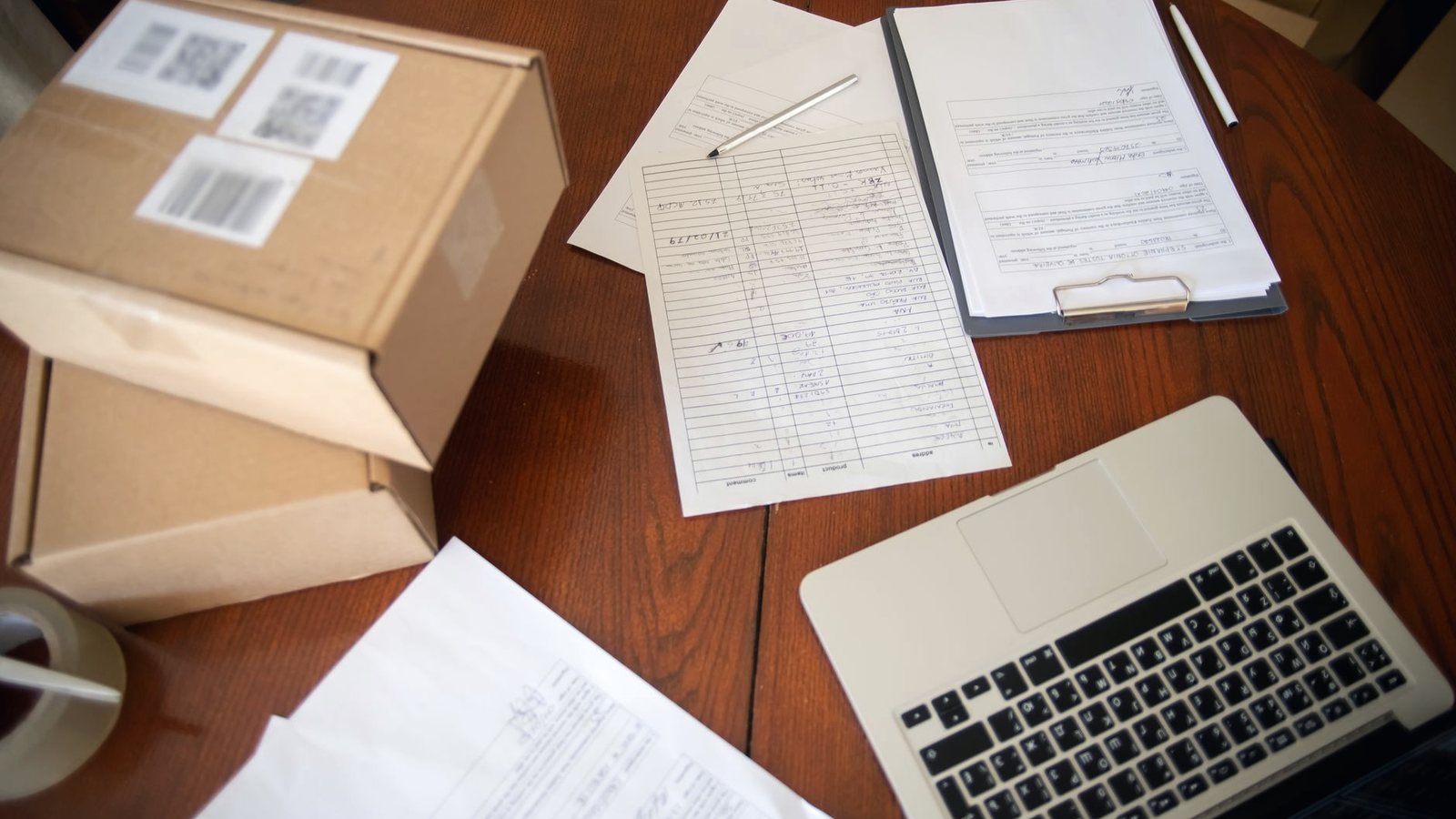
    Desk with shipping paperwork, a laptop and labeled parcels

    Double brokering is when a party that accepted a load as a carrier quietly passes it to a different carrier without the shipper’s or broker’s consent, so the truck that shows up is not the one you vetted. Its more dangerous cousin is carrier impersonation, where nobody legitimate ever had the load at all. A 2026 federal case in Massachusetts shows how that second scheme passed every routine check, and what would actually have stopped it.


    TL;DR

    • Double brokering means a load is handed to an unvetted carrier without consent, and re-brokering without FMCSA broker authority is illegal under 49 U.S.C. § 14916.
    • The statute sets a civil penalty of up to $10,000 per violation, which FMCSA’s inflation-adjusted schedule now lists as up to $13,676, plus liability for the injured party’s claims.
    • In the Massachusetts case, prosecutors allege hacked carrier email accounts were used to book four loads that DOJ says were worth more than $800,000.
    • The DOT number, the MC number and even the FMCSA-registered email address were real, so the usual checks confirmed the wrong thing.
    • A callback to the carrier on a number you already hold, made before loading, would have stopped each load, and it is how the crab theft was uncovered a day too late.

    Table of Contents

    What is double brokering?

    Double brokering is when a party accepts a load as the carrier, then re-brokers it to another carrier without the shipper’s or original broker’s knowledge or consent, usually keeping part of the rate. Without FMCSA broker authority, that is also unauthorized brokering under federal law. Either way, the truck at your dock isn’t the carrier you vetted.

    The term is industry shorthand, not a regulatory one. The federal definitions in 49 CFR 371.2 define a broker as a person who, for compensation, arranges or offers to arrange transportation by an authorized motor carrier. A carrier arranging shipments it has legally bound itself to haul is not acting as a broker. “Double brokering” doesn’t appear there.

    In double brokering trucking cases, the freight often still arrives, but on a truck and insurance nobody vetted. In the fraudulent version, the middleman collects from the broker and never pays the hauler. Freight people often use the same label for a third scheme, carrier impersonation, where a criminal poses as a real, vetted carrier from the start. Trade press used the double-brokering label for the case below. The federal complaint does not, and the difference matters for how you defend against it.

    Is double brokering illegal? Federal law and penalties

    Re-brokering without broker authority is illegal. Under 49 U.S.C. § 14916(a), a person may provide interstate brokerage only if it is registered as a broker under § 13904 and meets the financial security requirements of § 13906. A carrier that takes a load and arranges for someone else to haul it, without its own broker registration, is brokering illegally.

    • Civil penalty: anyone who knowingly authorizes, consents to or permits unauthorized brokering is liable for up to $10,000 per violation (§ 14916(c)). FMCSA’s inflation-adjusted schedule in 49 CFR Part 386, Appendix B, currently lists up to $13,676 per violation.
    • Private liability: the violator is also liable to the injured party “for all valid claims incurred without regard to amount.”
    • Personal liability: liability is joint and several across the company and its officers, directors and principals (§ 14916(d)).

    When double brokering turns into theft, prosecutors bring criminal charges. Here they are interstate transportation of stolen goods (18 U.S.C. § 2314, up to 10 years) and conspiracy (18 U.S.C. § 371, up to 5 years), each with a maximum fine of $250,000.

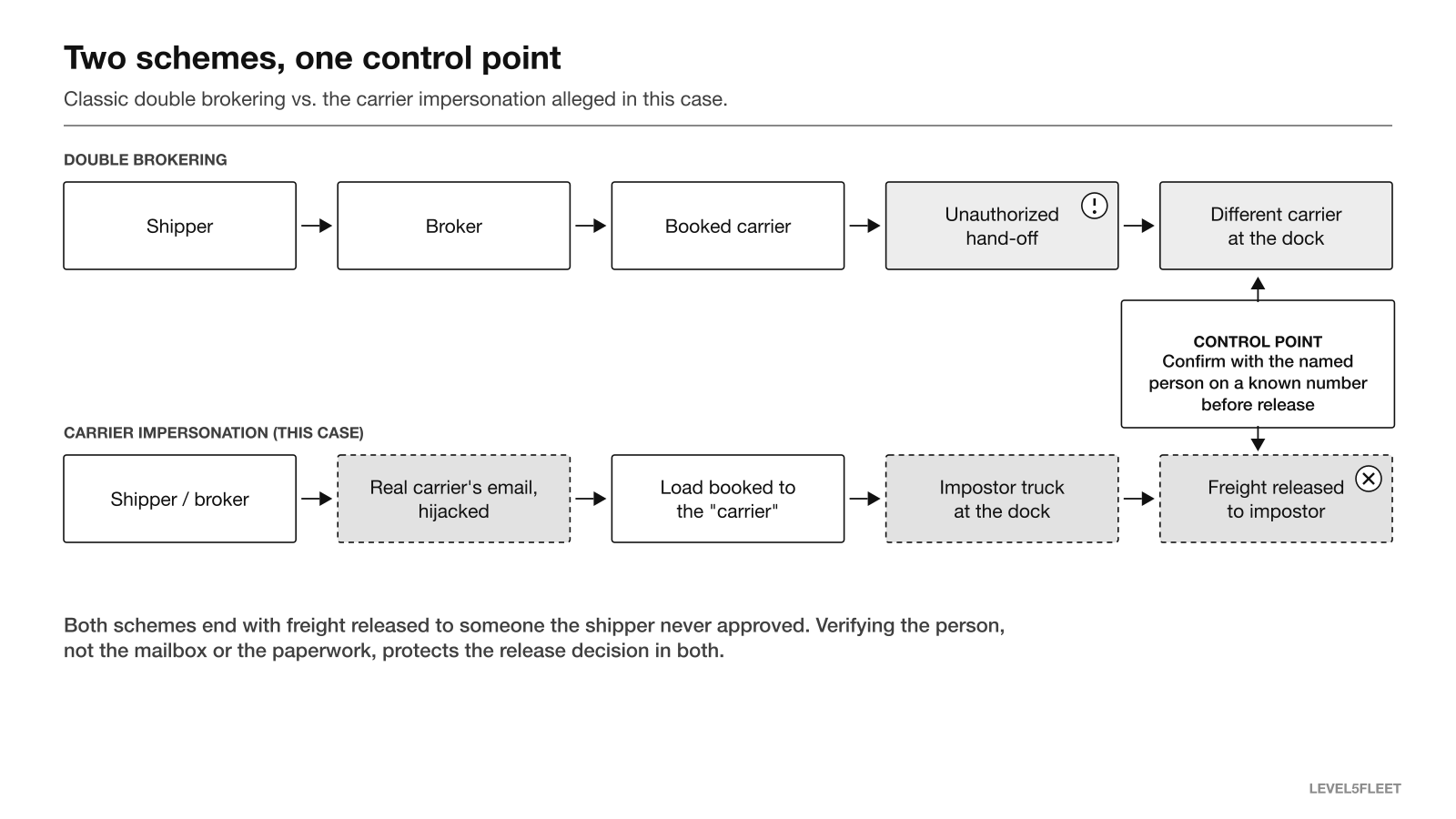
    Double brokering vs. carrier impersonation

    Classic double brokering Carrier impersonation (this case)
    Who wins the load A real carrier Someone posing as a real carrier
    Named carrier involved? Yes, then it hands the load off No. The real carrier never booked it
    Usual outcome Delivered, but by an unvetted truck Freight diverted and resold
    What catches it Matching the truck at the dock to the rate confirmation Confirming the booking with the carrier on a number you already hold
    Diagram comparing classic double brokering with carrier impersonation through a hijacked carrier email, with confirming the named person on a known number as the shared control point.

    The case: one hacked inbox, four loads

    Romoy Forbes, 31, of Deer Park, New York, is charged with interstate transportation of stolen goods and conspiracy. He pleaded not guilty on April 7, 2026, and was released on conditions. Nothing below has been proven in court. Everything comes from the federal complaint affidavit and U.S. Attorney’s Office releases.
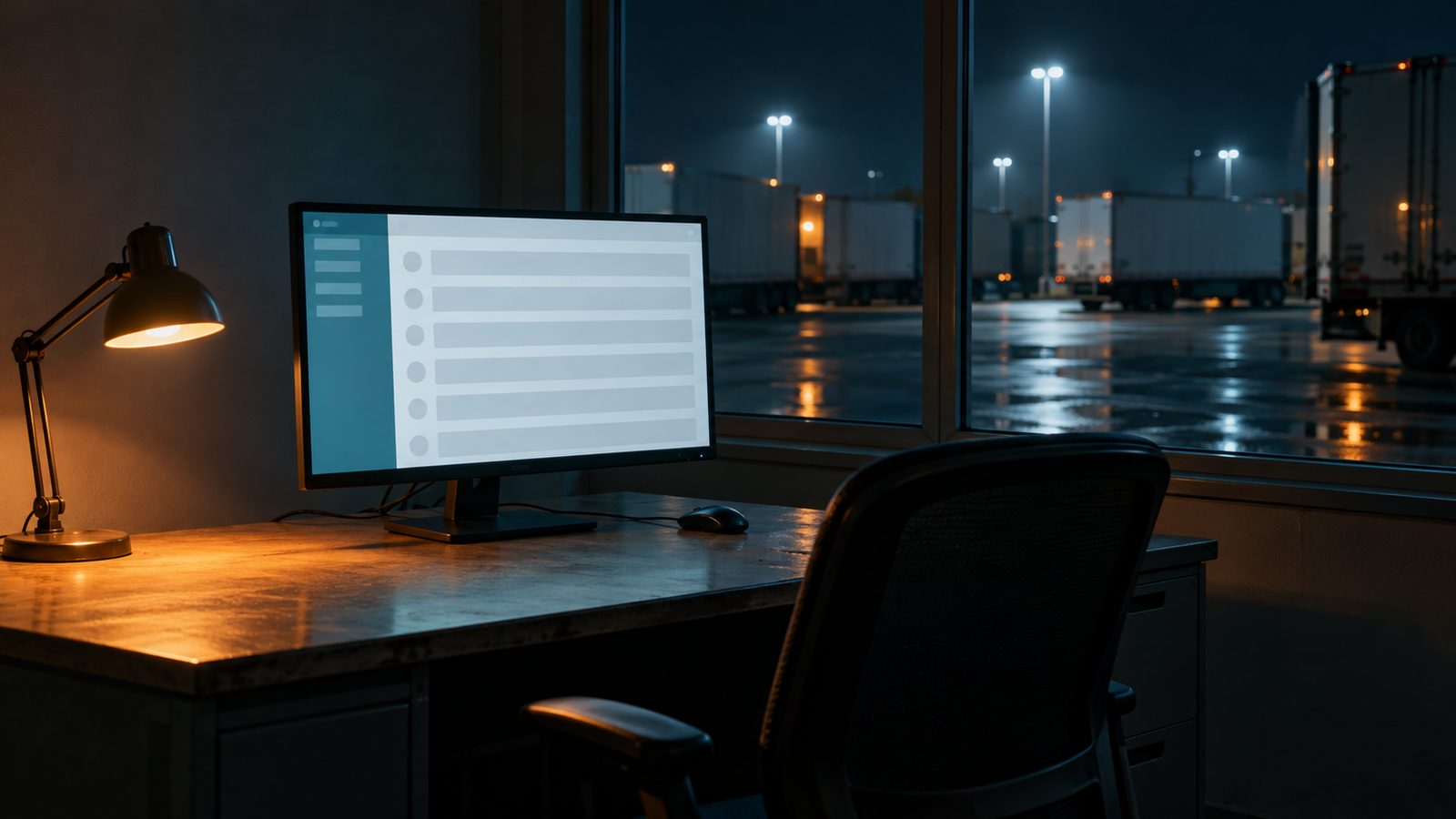
    Dark dispatch office with an email inbox on a monitor and a trailer yard outside

    According to the complaint, the DOT number, the MC number and, in the crab incident, the carrier’s FMCSA-registered email address all checked out. Someone else had simply taken over that inbox first.

    The inbox. Prosecutors allege that a co-conspirator, saved in Forbes’s phone only as “Josh,” gained unauthorized access to real carriers’ business email accounts and used them, and in one case a phone call, to accept posted loads as those carriers. One email from a hacked account, quoted in the complaint, read: “Hey my driver is checked in, we need pu numbers.”

    The pickup. According to the affidavit, Forbes drove to each pickup himself and showed his own New York State ID. Surveillance video at two of the three documented sites captured his face. Nobody had to sneak past anything.

    The photo. When warehouse staff asked for a photo of the truck, a routine anti-fraud step, the co-conspirator allegedly emailed photos of a gray truck with the real carrier’s logo and MC number. Prosecutors say Forbes had driven a red one. In the crab incident, staff did not notice.

    The tracking. When the shipper asked to enroll the driver in GPS tracking, the co-conspirator allegedly supplied a phone number that was not Forbes’s. The shipper ended up tracking a phone, not its freight.

    The crab. On July 15, 2025, Forbes allegedly picked up 33,750 pounds of frozen snow crab, worth about $325,000, in Worcester, Massachusetts. It was bound for Jacksonville, Florida, and it never arrived. Cellphone geolocation instead put Forbes and the load at a grocery-store loading dock in Queens. The next day, the shipper called the real carrier and learned it had been hacked and had never booked the load. When the shipper called Forbes, he blamed a dispatcher named “Josh.”

    The rest. Prosecutors allege the same pattern moved three more loads: beer from Newark, New Jersey, meant for Maine but allegedly taken to Long Island; blueberries allegedly resold for $4,000 in Paterson, New Jersey; and about 14 pallets of designer cologne from Ronkonkoma, New York, taken under a third hacked carrier identity. The complaint says Forbes’s phone shows him negotiating at least two of those sales with a contact saved as “my customer for everything.”

    Why every check passed

    Check Meant to prove What it proved here, per the complaint
    DOT/MC lookup The carrier exists and has authority The carrier was real, but that says nothing about who was using its name
    Email from the FMCSA-registered address The message came from the carrier The mailbox itself was compromised
    Truck photo by email The truck belongs to the carrier It showed the real carrier’s truck, not the one at the dock
    Driver ID at the dock Who is picking up It identified a person, not his link to the carrier
    Phone tracking link Where the load goes It tracked whatever number had been supplied
    Direct callback to the carrier The carrier booked this load It exposed the fraud, but one day after pickup

    Only the last check used information the people booking the load didn’t control.

    Case timeline

    Date Event Source
    June 6, 2025 Beer worth ~$35,200 allegedly picked up in Newark, NJ; bound for Portland, ME, allegedly taken to Long Island USAO-MA indictment release
    June 25–27, 2025 Blueberries allegedly picked up in Winslow Junction, NJ, via a second hacked carrier email; resold for $4,000 in Paterson, NJ Complaint affidavit
    July 14, 2025 Crab load booked by phone in the name of a hacked carrier; paperwork sent to its inbox Complaint affidavit
    July 15, 2025 33,750 lbs of snow crab (~$325,000) allegedly picked up in Worcester, MA; photos of a different truck emailed Complaint affidavit
    July 16, 2025 Load missing; shipper calls the real carrier and learns it never booked the load Complaint affidavit
    July 25, 2025 ~14 pallets of cologne allegedly picked up in Ronkonkoma, NY under a third hacked identity Complaint affidavit
    Jan. 14, 2026 FBI agent signs the criminal complaint affidavit Case 4:26-mj-04061-DHH
    Feb. 5, 2026 Forbes arrested on Long Island USAO-MA release
    Apr. 7, 2026 Pleads not guilty in Worcester; DOJ announces indictment and adds the beer theft USAO-MA release; Boston Globe

    The numbers

    • Over $800,000: DOJ’s total for the four alleged thefts, in the headline of its indictment release.
    • About $325,000 in snow crab, about $430,000 in cologne (some outlets report $433,830), and $35,200 in beer.
    • $4,000: the alleged resale price of the blueberries. No shipment value has been published.
    • About 24 hours: the time between the crab pickup and the call that exposed it.

    Verisk CargoNet’s Q1 2026 report logged 767 supply-chain crime events across the U.S. and Canada, with $131.58 million in estimated losses. Seafood targeting “climbed sharply,” and personal care and beauty thefts rose 178% from Q1 2025, from 18 events to 50. CargoNet named credential harvesting, the compromise of business email used by carriers and brokers, as a primary tactic. “The anti-fraud tools the industry has deployed are working, they’re forcing criminals to invest more in elaborate schemes,” said Keith Lewis, its vice president of operations.

    Warning signs

    None of these proves fraud alone. Each is a reason to verify before release.

    • A message from the carrier’s correct address moves the conversation to a new phone number or a dispatcher you’ve never dealt with.
    • A truck photo emailed on request doesn’t match the vehicle at the dock in color, unit number or the name and MC on the door.
    • The tracking phone number differs from the one the driver gives at check-in.
    • The carrier on the rate confirmation doesn’t match the truck, the driver’s paperwork or the bill of lading. This is the classic sign of double brokering in freight.
    • Someone presses for pickup numbers before your confirmation steps are done.
    • After pickup, tracking goes dark, ETAs slip, and the blame falls on a third party you can’t reach.
    • When you call the carrier yourself, it has no record of the load. Treat that as a theft in progress.

    How to prevent double brokering

    1. Confirm every booking with the carrier on a number you already hold, before the truck arrives. Why: a hijacked inbox controls every reply. A call it didn’t start goes around it.
    2. Treat any change in contact details as a stop event. Why: impersonation depends on new numbers and new “dispatchers.”
    3. Add a no-re-brokering clause to carrier agreements and rate confirmations, and require written consent for substitutions. Why: it makes classic double brokering a clear breach and gives you grounds to refuse a different truck.
    4. Check the driver, tractor and trailer against a pre-alert sent before pickup. Why: an emailed photo can come from anywhere, but the truck at the dock can’t be faked the same way.
    5. Tie tracking to the vetted carrier’s equipment or app, not to a number supplied at booking. Why: a tracking link is only as trustworthy as the number behind it.
    6. Carriers: turn on multi-factor authentication for business email and watch for unusual logins. Why: none of these alleged thefts could have happened without the email compromise.
    7. Report quickly to local police, to the FBI’s IC3 for email compromise, and to FMCSA’s National Consumer Complaint Database. Why: it creates a federal record while the trail is fresh.

    Pro Tip: Make the confirmation call from your own records, not the email signature, and make it before the dock door opens. A callback after a missed ETA only tells you what you lost.

    Perspective: verify the person, not the mailbox

    What stands out to me in this case is not how sophisticated it was, but how ordinary each step looked. Every check confirmed something real: the company existed, the address was its own, the truck in the photo had its logo. But each of those checks confirms the company. The theft happened in the gap between the company and whoever was speaking for it.

    That is why I think “double brokering” undersells this kind of fraud. The term suggests a carrier going rogue. Here the carrier did nothing wrong, and its good record was the weapon.

    The lesson I take is that verification has to run through a channel the requester doesn’t control, at the moment of release. Onboarding tells you a carrier was legitimate months ago, not who is at your dock today. CargoNet’s Lewis said the industry “needs to think beyond tender-phase controls,” and I agree.

    — Gwagsi Glenn, Growth Analyst, Level5Fleet

    Where Admiral fits, and where it doesn’t
    Level5fleet

    We sell trailer security, so here is a plain account of what Admiral would and would not have done here.

    Would have prevented: releasing each load to a carrier that never booked it. Admiral Resolve verifies who is making a pickup, access or change request, which company they act for, and whether they are authorized for that specific load. It records each decision in an audit trail, and emailed requests can be forwarded to it. That is the callback above, made repeatable. That matters in a hijacked-inbox case. Resolve doesn’t treat a real company or a real email account as proof: the named party confirms or declines the request itself, so the instruction is verified with the person it claims to come from, not with whoever controls the mailbox. Our Admiral platform brochure calls this the one unverified link: a load can pass every other check while the person acting for a company was never verified. Resolve is free to start within fair usage limits.

    Prevented upstream, outside Admiral: the email compromise itself, which is a job for the carrier’s own email security.

    Would not have helped: Admiral Enforce, the trailer door lock and the immobilizer keep trailers locked and immobilized until movement is authorized. Here, the cargo was allegedly loaded into equipment the driver brought. Nobody broke into anything. The failure was an identity failure. Admiral’s GPS runs on Admiral-equipped trailers, so it would not have shortened the gap either.

    For classic double brokering: Admiral Execute carries shipper-approved changes, including carrier swaps, into what dispatch, dock and gate teams see. It is designed to protect against unauthorized carrier swaps, so a substitution nobody approved has no approval behind it.

    To put every release behind a verification step, start with Admiral Resolve. There’s no hardware or contract to start.

    FAQ

    Is double brokering illegal?

    Yes, when the party re-brokering has no FMCSA broker registration. Under 49 U.S.C. § 14916, brokering without registration and financial security exposes the company and its officers to civil penalties and to the injured party’s claims. When a registered broker re-brokers a load against its contract terms, the dispute usually turns on that contract, so ask a transportation attorney about your own agreements.

    What is the penalty for double brokering?

    The statute sets up to $10,000 per violation, and FMCSA’s inflation-adjusted schedule currently lists up to $13,676. The violator is also liable for all valid claims of the injured party. Theft charges such as 18 U.S.C. § 2314 can add up to 10 years in prison.

    What is a double brokered load?

    It is a load assigned to one carrier and then handed to another without the shipper’s or broker’s consent. The telltale sign is a mismatch between the carrier on the rate confirmation and the truck or paperwork at pickup.

    How do I report double brokering to FMCSA?

    File through FMCSA’s National Consumer Complaint Database at nccdb.fmcsa.dot.gov, which covers carriers, brokers and other intermediaries. Report stolen freight to local police, and report compromised business email to the FBI’s IC3.

    What are the most common freight broker scams?

    The most common are double brokering, carrier identity theft using a real carrier’s DOT and MC numbers, and business email compromise, where a hijacked inbox books or redirects loads. Verisk CargoNet’s Q1 2026 report names credential harvesting and carrier impersonation as central to organized cargo theft.

    Sources

    1. U.S. v. Romoy Forbes, Affidavit in Support of Criminal Complaint, Case 4:26-mj-04061-DHH (D. Mass., Jan. 14, 2026): https://www.justice.gov/d9/2026-02/usa_v._romoy_forbes_-_complaint_affidavit.pdf
    2. U.S. Attorney’s Office, District of Massachusetts, “New York Man Charged in Multi-State Organized Cargo-Theft Conspiracy” (Feb. 5, 2026): https://www.justice.gov/usao-ma/pr/new-york-man-charged-multi-state-organized-cargo-theft-conspiracy
    3. U.S. Attorney’s Office, District of Massachusetts, indictment release, “Defendant allegedly stole cargo containing over $800,000 worth of beer, snow crabs, blueberries and cologne” (Apr. 7, 2026): https://www.justice.gov/usao-ma/pr/new-york-man-charged-multi-state-cargo-theft-conspiracy
    4. The Boston Globe, “Man arrested for cargo theft pleads not guilty…” (Apr. 7, 2026): https://www.bostonglobe.com/2026/04/07/metro/ny-man-arrested-stealing-cargo-snow-crab-worcester-warehouse/
    5. CDL Life, “Man used hacked trucking company email accounts to steal costly loads of crabs and cologne”: https://cdllife.com/2026/man-used-hacked-trucking-company-email-accounts-to-steal-costly-loads-of-crabs-and-cologne-officials-say/
    6. Overdrive, “FBI details double-brokering cargo theft scheme in felony charges for trucker”: https://www.overdriveonline.com/business/article/15816540/fbi-details-doublebrokering-cargo-theft-scheme-in-felony-charges-for-trucker
    7. Verisk CargoNet, “2026 First Quarter Supply Chain Risk Trends Analysis”: https://www.cargonet.com/news-and-events/cargonet-in-the-media/2026-q1-theft-trends/
    8. Carrier Management, “Despite 5% Decrease in Crimes, Estimated Q1 2026 Cargo Theft Loss Costs Remain High” (Apr. 27, 2026): https://www.carriermanagement.com/news/2026/04/27/287237.htm
    9. 49 U.S.C. § 14916, Unlawful brokerage activities: https://www.law.cornell.edu/uscode/text/49/14916
    10. 49 CFR 371.2, Definitions: https://www.ecfr.gov/current/title-49/section-371.2
    11. 49 CFR Part 386, Appendix B, Penalty Schedule: https://www.ecfr.gov/current/title-49/part-386/appendix-Appendix B to Part 386
    12. 18 U.S.C. § 2314: https://www.law.cornell.edu/uscode/text/18/2314
    13. 18 U.S.C. § 371: https://www.law.cornell.edu/uscode/text/18/371
    14. 18 U.S.C. § 3571 (fine amounts): https://www.law.cornell.edu/uscode/text/18/3571
    15. Federal Register, FMCSA notice on the National Consumer Complaint Database (June 6, 2025): https://www.govinfo.gov/content/pkg/FR-2025-06-06/html/2025-10310.htm
    16. FMCSA National Consumer Complaint Database: https://nccdb.fmcsa.dot.gov/
    17. FBI Internet Crime Complaint Center (IC3): https://www.ic3.gov/

  • Strategic Cargo Theft: How Fake Documents Released a $2.86M Tungsten Load

    Strategic Cargo Theft: How Fake Documents Released a $2.86M Tungsten Load

    Warehouse worker in silhouette holding a clipboard beside storage shelves

    Strategic cargo theft is freight theft by deception: instead of breaking into a trailer, the thief convinces someone in the supply chain to hand the load over. In June 2026, prosecutors allege, a driver used fraudulent identity and registration documents to collect $2,857,500 of tungsten oxide powder from a Pennsylvania dock. The load was released because the paperwork looked right. Nobody confirmed that the person holding it was the booked carrier.


    TL;DR

    • Strategic cargo theft uses impersonation, fake documents, or hijacked identities to get freight released, so the theft happens at the dock with the shipper’s cooperation.
    • On June 25, 2026, about 40,000 lbs of tungsten oxide worth $2,857,500 left Global Tungsten & Powders in Bradford County, Pennsylvania, released to a driver who prosecutors allege presented fraudulent documents.
    • The load was recovered in Indiana two days later because a police license-plate camera network flagged the truck, not because any freight-side system noticed the diversion.
    • A dock release check that confirms documents match the load does not prove the driver works for the booked carrier; only independent verification against the booked carrier does that.
    • The highest-leverage fix is identity-verified release at pickup, while route tracking can only shorten the time it takes to notice a theft that has already happened.

    Table of contents

    What is strategic cargo theft?

    Strategic cargo theft is the theft of freight by deception rather than force. Criminals pose as a legitimate carrier, broker, or driver, often with fake IDs, fictitious businesses, or compromised accounts, and persuade a shipper or broker to release or redirect the load. Verisk CargoNet classifies the pickup version of this fraud as a “fictitious pickup.”

    CargoNet defines fictitious pickups as “criminal schemes that result in the theft of cargo by deception,” carried out by carriers using “fake IDs and/or fictitious businesses set up for the purpose of diverting and stealing cargo.” Its analysts describe groups “increasingly using strategic theft methods, including impersonation and targeted commodity selection.” The FBI uses the same term: its April 30, 2026 public service announcement is titled “Cyber-Enabled Strategic Cargo Theft Surging.”

    The distinction matters operationally. A trailer stolen from a truck stop is a physical security problem. A strategic theft is an authorization problem: every lock, seal, and gate can work as designed and the freight still leaves with the wrong person, because someone with authority to release it was deceived.

    The case: a $2.86M tungsten load released on paperwork

    On June 25, 2026, a shipment of tungsten oxide powder left the dock at Global Tungsten & Powders (GTP) in North Towanda Township, Bradford County, Pennsylvania. Ten pallets, roughly 40,000 pounds, valued at $2,857,500, bound for Mitsubishi Materials Corp. in Japan. The powder is used in batteries, electronics, and defense-grade materials. According to Fox56/WOLF-TV, an authorized trucking company was to collect it and move it toward JFK International Airport for an air shipment overseas.

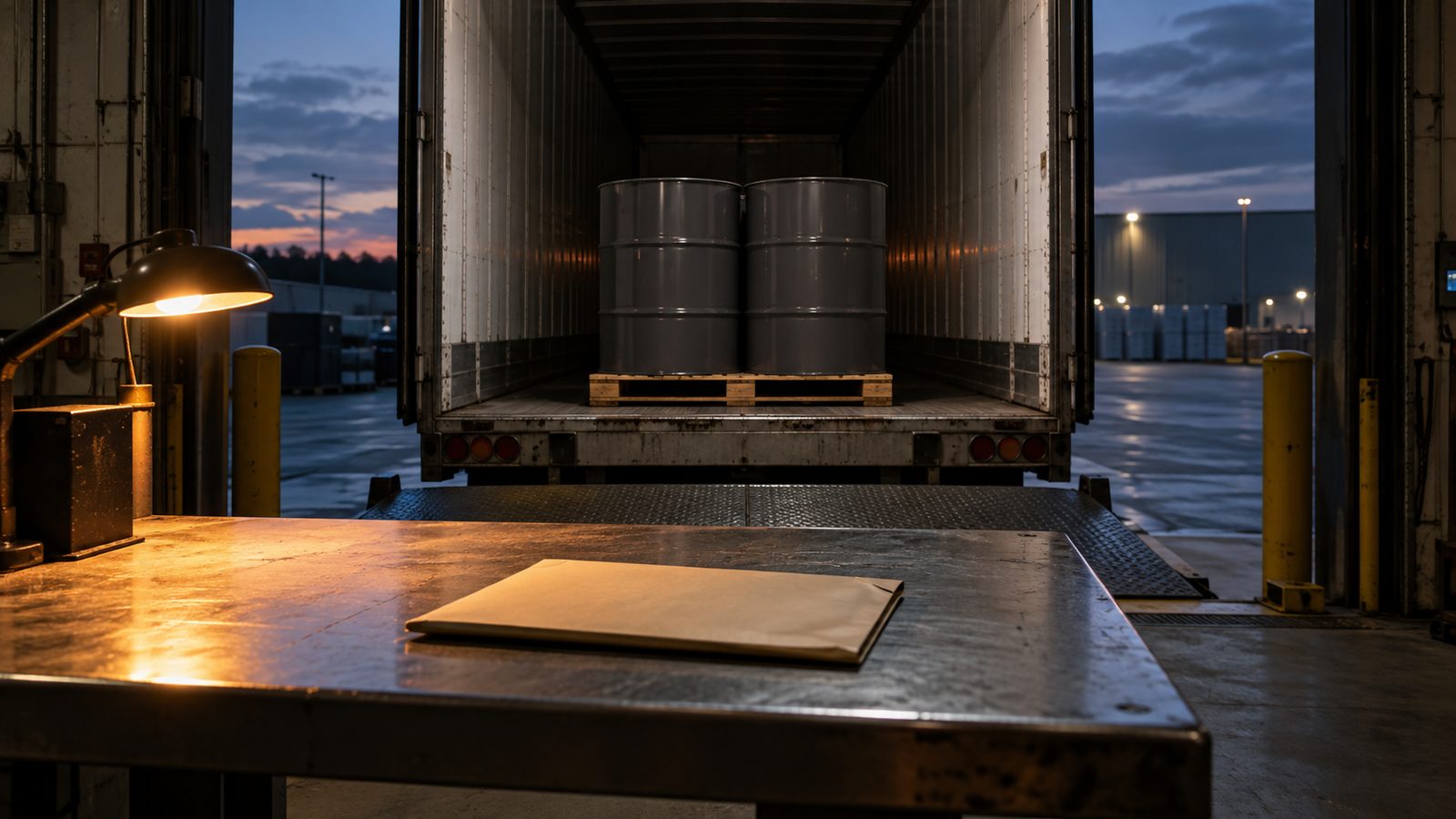
    Metal drums on a pallet inside an open trailer at a dock, with an envelope on the dock plate

    It never got there. Prosecutors allege that Deepak Kumar, 31, of Fresno, California, presented fraudulent identity and vehicle-registration documents at the GTP dock and had the load released to him as if he were the carrier booked to collect it. Nobody broke into anything. The freight left through the front door.

    Two days later, police in Greenfield, Indiana, received an automated alert at around 6 a.m. from the Flock Safety license-plate camera network, flagging a wanted semi tied to the Pennsylvania warrant. Officers stopped the truck on Interstate 70 near Greenfield, in Hancock County, roughly 500 miles west of the plant and nowhere near any route to JFK. No source has explained why, and we won’t guess.

    A search warrant confirmed the tungsten oxide was still in the trailer, intact, and a Mitsubishi Materials representative took possession of it in Greenfield. Indiana charges were dismissed pending extradition. In Pennsylvania, Kumar was held in Bradford County Jail on $200,000 bail and charged with felony theft by unlawful taking of movable property and felony criminal use of a communication facility. These are allegations. At the time of our last review of public reporting, Kumar had not been convicted, and we could not confirm the outcome of his preliminary hearing.

    “With the use of modern technology and diligent police work, Mr. Kumar is in jail,” Greenfield Police Deputy Chief Chuck McMichael told CDL Life. The technology was a police camera network. Nothing in the freight chain caught the diversion.

    The second attempt: Operation Heavy Metal

    On August 5, 2026, in a separate case, an undercover Pennsylvania State Police and federal operation called “Operation Heavy Metal” intercepted an attempted theft of about 18,000 kilograms (roughly 20 tons) of tungsten oxide powder from GTP before it left the property. The defendant, Rohit Ruhal, 29, of Rancho Cucamonga, California, is a different person on a different court track, charged with first-degree felony theft by unlawful taking and two counts of third-degree felony identity theft, and was denied bail. Outlets have reported conflicting dollar values for that load, from $500,000–$750,000 to “more than $5 million,” so we don’t state one. Police have not said whether the cases are connected, but one plant’s tungsten was targeted twice in about six weeks.

    Case timeline

    Date Event Source
    June 25, 2026 About 40,000 lbs (10 pallets) of tungsten oxide powder, valued at $2,857,500, released from GTP’s North Towanda Township, PA dock; prosecutors allege fraudulent documents were used FreightWaves, CDL Life, Transport Topics
    June 27 or 28, 2026 (reports differ) Flock Safety camera alert to Greenfield, IN police; traffic stop on I-70; Kumar arrested on the Pennsylvania warrant FreightWaves, CDL Life, WISH-TV
    June 28–29, 2026 Search warrant confirms the load is in the trailer; Mitsubishi Materials representative takes possession WISH-TV, CDL Life
    July 1, 2026 Indiana charges dismissed pending extradition to Pennsylvania Transport Topics, The Daily Reporter
    July 2026 Kumar extradited, held in Bradford County Jail on $200,000 bail, charged with two felonies Transport Topics, MyHometownToday.com
    August 5, 2026 Separate case: Operation Heavy Metal intercepts an attempted theft of ~18,000 kg of tungsten oxide at GTP; Rohit Ruhal charged and denied bail Fox56, Rocket-Courier

    The numbers: why metals and Pennsylvania are in the frame

    Tungsten was not a random target. Verisk CargoNet estimated U.S. and Canada cargo theft losses at nearly $725 million in 2025, up 60% from 2024, while the average value per theft rose 36% to $273,990. Incident volume barely moved. The losses grew because thieves picked bigger loads.

    The pattern sharpened in 2026. CargoNet recorded 677 supply chain theft incidents in Q2 2026, down 26% year over year, yet estimated losses more than doubled to $304.6 million from $135.7 million. Metal theft rose from 54 incidents to 80, and CargoNet named tungsten among the specialized industrial metals with rising theft. Fictitious pickups barely declined, from 165 to 158 events, even as events classified as theft fell from 488 to 378.

    For cargo theft in Pennsylvania specifically, CargoNet’s 2025 analysis lists the state among those with significant increases, up 24%, with Indiana, where this load was recovered, up 30%. A single $2.86 million load fits the selective, high-value targeting CargoNet describes, which its vice president of operations, Keith Lewis, called a “strategic shift.”

    How a fictitious pickup works at the dock

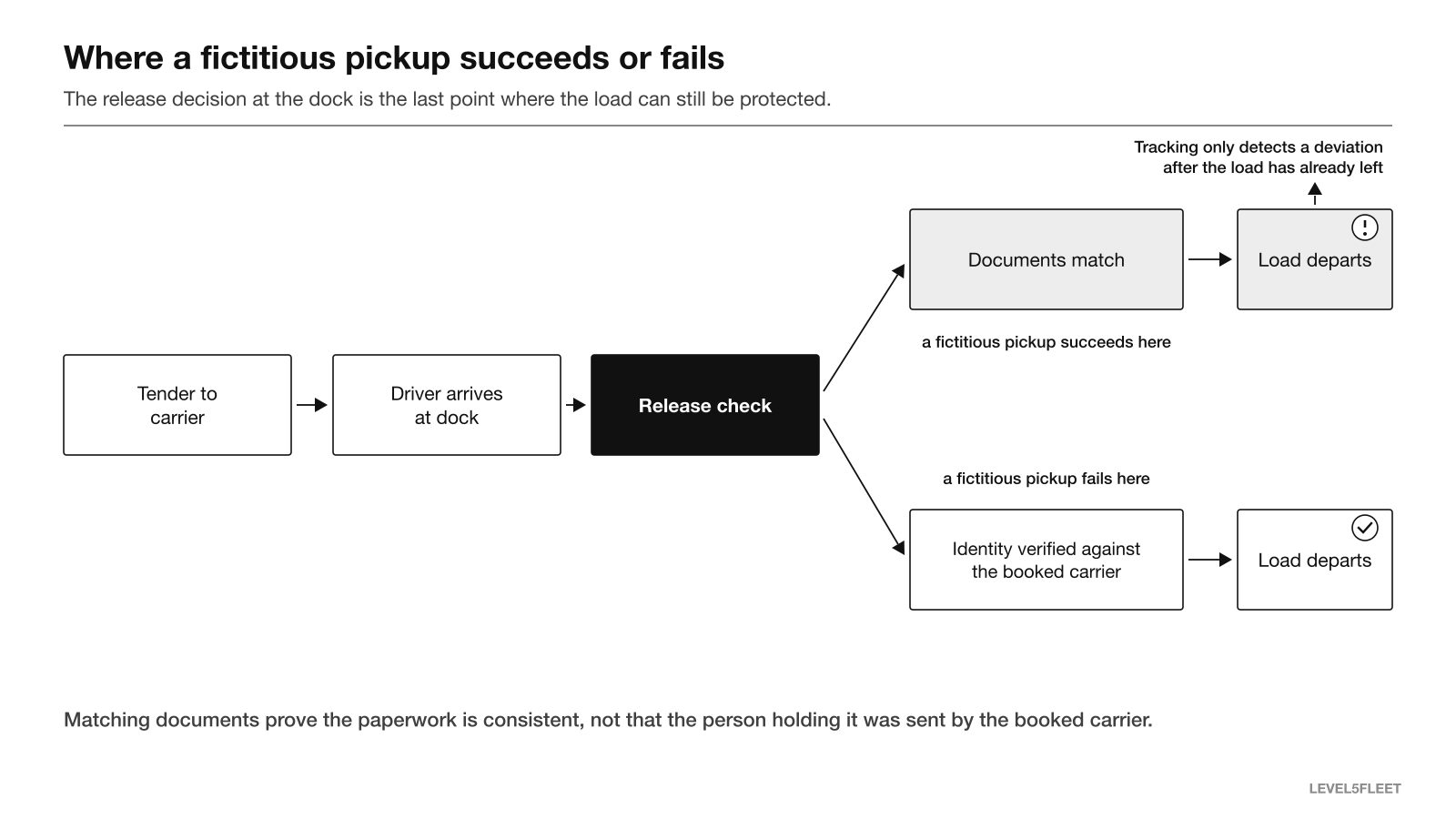
    A shipper tenders a load to a carrier, directly or through a broker. The carrier’s name, a load number, and an appointment window now sit in emails, portals, and phone logs across several companies. On the day, a driver arrives and dock staff run a release check, which in most operations asks whether the paperwork the driver presents matches the paperwork the shipper expects: the right load number, a carrier name that matches the booking, a license, a truck with plausible markings. If it all lines up, the bill of lading gets signed and the freight goes.

    A fictitious pickup succeeds when someone who is not the booked carrier’s driver can make that check line up. Prosecutors allege that is what happened at GTP, with fraudulent identity and registration documents. Public reporting does not describe GTP’s procedure, so we won’t speculate about which step failed. The structural point holds anyway: the dock is checking consistency, and consistency can be manufactured. What the dock rarely checks is the one fact that matters: that the booked carrier itself sent this driver and this truck for this load. The FBI’s first recommendation in its 2026 PSA targets exactly that gap: “Independently verify shipment requests and pickups using secondary methods prior to releasing any loads.”

    Dock release check vs what it proves

    Dock release check What it proves What it does not prove
    Driver quotes the correct load number Someone has seen the load details That the person works for the booked carrier
    Driver presents a license A document was presented That it is genuine, or that the holder was dispatched for this load
    Truck displays a carrier name and USDOT number The truck carries those markings That the truck belongs to, or is operating for, that carrier
    Carrier’s authority is active in FMCSA records The carrier exists and has authority That this driver represents it
    Call to the phone number on the paperwork Someone answers that number Anything; the number came from the person you are trying to verify
    Call-back to the booked carrier on a number you sourced independently The carrier confirms it dispatched a driver That the person at your dock is that driver, unless driver and truck details are matched
    Identity-verified release tied to the booked carrier and load The requester is a verified person acting for the booked company and authorized for this load Cargo safety after departure; that still needs in-transit controls
    Diagram of a dock release check where matching documents let a fictitious pickup succeed and identity verification against the booked carrier stops it.

    Pro Tip: Source every verification contact from your own records, never from the pickup paperwork or the email that arranged it. A check that uses contact details supplied by the requester only tests whether the requester answers their own phone.

    Warning signs of a fictitious pickup

    • A last-minute change of driver, truck, or trailer that arrives without an update from the booked carrier through its usual channel.
    • Contact details that differ from your records: a new phone number, a free webmail address, or an email domain that mimics the carrier’s real one with a small change, a red flag the FBI lists in its 2026 PSA.
    • Pressure to release quickly, especially around holidays or on short-staffed shifts, when CargoNet warns that reduced staffing and time pressure create “verification exposure.”
    • Truck markings, plates, or registration that don’t match the carrier on the booking.
    • Requests to move communication to a personal phone or text thread, or to change the delivery address after pickup.
    • Recent changes to a carrier’s FMCSA contact or insurance information. The FBI’s PSA describes criminals changing a legitimate carrier’s FMCSA contact details and insurance information to take loads in its name.

    How to prevent strategic freight theft: a 7-step checklist

    1. Make release a decision, not a document match. Why: in this case the documents matched well enough.
    2. Verify every pickup with the booked carrier through a channel you sourced yourself. Why: the FBI recommends secondary-method verification before any load is released.
    3. Match driver, tractor, and trailer details to what the carrier confirmed before the truck arrives. Why: confirming that a driver is coming means little if anyone can claim to be that driver.
    4. Treat high-value commodities as a separate risk tier. Why: CargoNet’s data shows organized groups selecting specific high-value shipments, including metals.
    5. Freeze changes at the dock. Why: any driver, truck, or destination change should go back through the booked carrier, not be approved on the spot.
    6. Track the freight, not just the truck, and alert on deviation. Why: it won’t stop a fraudulent release, but it can shrink the gap between theft and discovery from days to hours.
    7. Log every release decision with who approved it and on what evidence. Why: a record speeds recovery and shows where the process broke.

    An operational perspective on paperwork-based release

    The industry has spent years improving carrier vetting at the tender stage. That work matters, but this case shows where it stops. The loading dock is still where custody actually changes hands, and in most operations the dock’s final question is whether the paperwork matches. Paperwork is the easiest thing in the chain to fake, and it gets easier as document tools improve.

    I don’t read this case as a failure by the people on that dock. They ran the check they were given. The failure is that the check verifies documents rather than people, and that no one downstream would have noticed a $2.86 million load heading the wrong way if a police camera hadn’t flagged the truck. Nobody should plan on that kind of luck.

    My view is that release should work like a payment: nothing moves until the party asking has been verified against the party who was booked, and the decision is recorded. That costs minutes at the dock. Even a recovered load costs far more.

    — Gwagsi Glenn, Growth Analyst, Level5Fleet

    Where Admiral fits, and where it doesn’t

    Level5fleet

    Public reporting doesn’t say whose trailer carried the load, and the arrest came from police infrastructure, not a freight platform. So we’ll be exact.

    Intervention Effect in this case Admiral capability
    Identity-verified release at pickup, checked against the booked carrier Would have prevented. The person at the dock was not the booked carrier; that is where this theft could have been stopped. Admiral Resolve checks whether a pickup or access request comes from a real person, acting for the right company, and authorized for that specific load, then records the approval or denial. The named party confirms or declines the request itself, so matching documents alone don’t pass. Resolve is free to use.
    Location tracking with alerts on route deviation Would have shortened detection, likely from days to hours, but only after the fraudulent pickup had already succeeded. Admiral includes GPS tracking with its immobilization and fortification solutions, but only on Admiral-equipped assets. It would not have helped if the load left in unfitted equipment.
    Trailer door locks and immobilization Would not have helped if the load was released into the thief’s own equipment. Locks don’t screen who is allowed to drive away. Admiral Enforce keeps doors locked and trailers immobilized until an authorized credential is presented. It matters most where the equipment is yours, such as drop-trailer and yard handoffs.
    Cargo insurance Would not have helped; it covers the financial loss only. Not applicable.

    In short: Resolve addresses the moment this case turned on, the release decision. When the booked carrier runs Admiral-equipped trailers, the access you approve is also physically enforced by the trailer.

    If your release process still ends with “the paperwork matched,” start by putting Admiral Resolve in front of your next high-value pickup. If you control the trailers, you can request an Enforce Pilot through Admiral Enforce.

    FAQ

    What is a fictitious pickup in cargo theft?

    A fictitious pickup is a strategic cargo theft in which someone poses as the legitimate carrier or driver to collect a load. CargoNet defines it as a criminal scheme that results “in the theft of cargo by deception,” often using fake IDs or fictitious businesses. CargoNet counted 158 fictitious pickup events in Q2 2026, almost unchanged from 165 a year earlier.

    Why is tungsten a target for cargo theft?

    Tungsten oxide is valuable in bulk: the GTP load in this case was worth $2,857,500 for 10 pallets. CargoNet named tungsten among the specialized industrial metals with rising theft in Q2 2026, when overall metal theft rose from 54 to 80 incidents.

    How common is cargo theft in Pennsylvania?

    Verisk CargoNet’s 2025 annual analysis lists Pennsylvania among the states with significant increases, with incidents up 24% from 2024. Neighboring New Jersey rose 50% and Indiana 30%. The GTP plant in Bradford County was targeted twice in about six weeks in 2026, in two separate cases.

    Is cargo theft a federal crime?

    It can be. Under 18 U.S.C. § 659, stealing goods that are part of an interstate or foreign shipment, including obtaining them “by fraud or deception,” carries up to 10 years in prison, or up to 3 years if the value is under $1,000. Many cases, including this one, are charged under state law instead.

    Sources

    1. FreightWaves, “Truck driver accused of using fake documents to steal $2.9M cargo”: https://www.freightwaves.com/news/truck-driver-accused-of-using-fake-documents-to-steal-2-9m-cargo
    2. CDL Life, “Truck driver accused of using fake documents to steal $2.8 million in industrial product bound for Japan, Indiana police say”: https://cdllife.com/2026/truck-driver-accused-of-using-fake-documents-to-steal-2-8-million-in-industrial-product-bound-for-japan-indiana-police-say/
    3. Transport Topics, “Trucker jailed in Indiana in alleged $2.8M tungsten theft” (July 9, 2026): https://www.ttnews.com/articles/trucker-jailed-tungsten
    4. WISH-TV, “Driver arrested in Hancock County after police find $3 million worth of chemical compound bound for Japan”: https://www.wishtv.com/news/crime-watch-8/3-billion-tungsten-oxide-powder-shipment-seized-in-hancock-county-califonia-man-arrested/
    5. MyHometownToday.com, “California man accused of trying to steal nearly $3 million in tungsten oxide powder from GTP”: https://www.myhometowntoday.com/news/regional-news/bradford-county/california-man-accused-of-trying-to-steal-nearly-3-million-in-tungsten-oxide-powder-from-gtp/
    6. Fox56/WOLF-TV, “Man accused of stealing $2.9 million in specialized cargo from Bradford Co. warehouse”: https://fox56.com/news/local/man-accused-of-stealing-29-million-in-specialized-cargo-from-bradford-co-warehouse
    7. The Daily Reporter (Greenfield, IN), “Arrests — June 29”: https://www.greenfieldreporter.com/2026/06/29/arrests-june-29-3/
    8. Fox56/WOLF-TV, “Troopers: Undercover operation stops attempted theft of 18,000 kilos of tungsten oxide”: https://fox56.com/news/local/troopers-undercover-operation-stops-attempted-theft-of-18000-kilos-of-tungsten-oxide
    9. northcentralpa.com, “Arrest announced in Towanda 20-ton precious metal theft bust”: https://www.northcentralpa.com/news/arrest-announced-in-towanda-20-ton-precious-metal-theft-bust/article_41662c7a-eb4b-4b70-9059-e49d4a8ffabf.html
    10. Rocket-Courier, “Second GTP Materials Theft Results in Arrest”: https://www.rocket-courier.com/articles/second-gtp-materials-theft-results-in-arrest/
    11. Verisk CargoNet, “Cargo Theft Losses Surge to Estimated $725 Million in 2025” (January 22, 2026): https://www.verisk.com/company/newsroom/cargo-theft-losses-surge-to-estimated-$725-million-in-2025-verisk-cargonet-analysis-reveals/
    12. Verisk CargoNet, “Cargo Theft Losses More Than Double to $304 Million in Q2” (August 6, 2026): https://www.verisk.com/company/newsroom/cargo-theft-losses-more-than-double-to-$304-million-in-q2-despite-a-drop-in-thefts-driven-by-high-value-metals-and-technology-heists/
    13. Verisk CargoNet, “Verisk CargoNet Assists in Manhattan DA Cargo Theft Indictment Targeting Multi-State Impersonation Ring” (June 9, 2026): https://www.verisk.com/company/newsroom/verisk-cargonet-assists-in-manhattan-da-cargo-theft-indictment-targeting-multi-state-impersonation-ring/
    14. Verisk CargoNet, “Verisk CargoNet Reports Persistent Labor Day Cargo Theft Exposure Across U.S. Freight Networks” (2026): https://www.verisk.com/company/newsroom/verisk-cargonet-reports-persistent-labor-day-cargo-theft-exposure-across-u.s.-freight-networks/
    15. Verisk CargoNet, fictitious pickup / identity theft submission form: https://campaigns.verisk.com/CNET_IDTheft
    16. FBI IC3, “Cyber-Enabled Strategic Cargo Theft Surging,” Alert I-043026-PSA (April 30, 2026): https://www.ic3.gov/PSA/2026/PSA260430
    17. 18 U.S.C. § 659, Interstate or foreign shipments by carrier (Cornell LII): https://www.law.cornell.edu/uscode/text/18/659
  • Freight Broker Fraud: 11 Aliases, $10.1M in Freight, and a 5-Year Sentence

    Freight Broker Fraud: 11 Aliases, $10.1M in Freight, and a 5-Year Sentence

    Close-up of a hand signing a document in a folder

    Freight broker fraud is when someone poses as a legitimate broker or motor carrier to get freight released to them, then diverts it. In one of the clearest recent cases, a Chicago-area man used at least 11 aliases to impersonate real and fictitious carriers and brokers from 2020 to 2023. He pleaded guilty to wire fraud and was sentenced in May 2026 to five years in federal prison for a scheme that took more than $10.1 million in copper and liquor.


    TL;DR

    • Aivaras Zigmantas of Elk Grove Village, Illinois, posed as an agent of real and invented carriers and brokers under at least 11 aliases between March 2020 and September 2023.
    • Shippers, brokers and carriers released loads to him because his paperwork looked legitimate, and the freight was diverted away from its real destination.
    • He was indicted on 13 federal counts in May 2024, pleaded guilty to wire fraud in December 2025, and was sentenced to 60 months in federal prison on May 6, 2026.
    • The failure point was identity at booking, not security on the road, so trailer locks and seals would not have stopped this scheme on their own.
    • The strongest defense is verifying who you are handing freight to through a channel the counterparty did not supply, and recording that decision.

    Table of contents

    What is freight broker fraud?

    Freight broker fraud is any scheme in which someone poses as, or hijacks the identity of, a freight broker or motor carrier to obtain loads or payments they are not entitled to. Common forms include carrier impersonation, fake trucking companies, double brokering and compromised FMCSA records. The usual goal is to get freight released, then divert it.

    The core weakness: most freight changes hands between parties who never meet. A carrier is chosen on a company name, a DOT or MC number and an email address, and every one of those can be copied or invented.

    The FBI’s Internet Crime Complaint Center (IC3) described the same pattern in an April 2026 public service announcement on “cyber-enabled strategic cargo theft.” It reports that threat actors spoof brokers, use compromised carrier accounts to post or accept loads, and update a carrier’s contact and insurance information with federal regulators so they can take loads the real carrier never accepted. IC3 estimates US and Canadian cargo-theft losses reached nearly $725 million in 2025, a 60% increase over 2024, with the average value per theft up 36% to $273,990.

    Freight broker scams are rarely a single load. They are a repeatable process, as the Zigmantas case shows.

    The case: how one man became 11 carriers and brokers

    Between March 2020 and September 2023, Aivaras Zigmantas of Elk Grove Village, Illinois, built what looked like legitimate transportation businesses: fraudulent bank accounts, email addresses and business mailboxes under fictitious names, plus counterfeit identification. He presented himself as a representative of real motor carriers and brokers, and of entirely fictitious ones, using at least 11 aliases, male and female, including a persona named “Kathy Stone.”

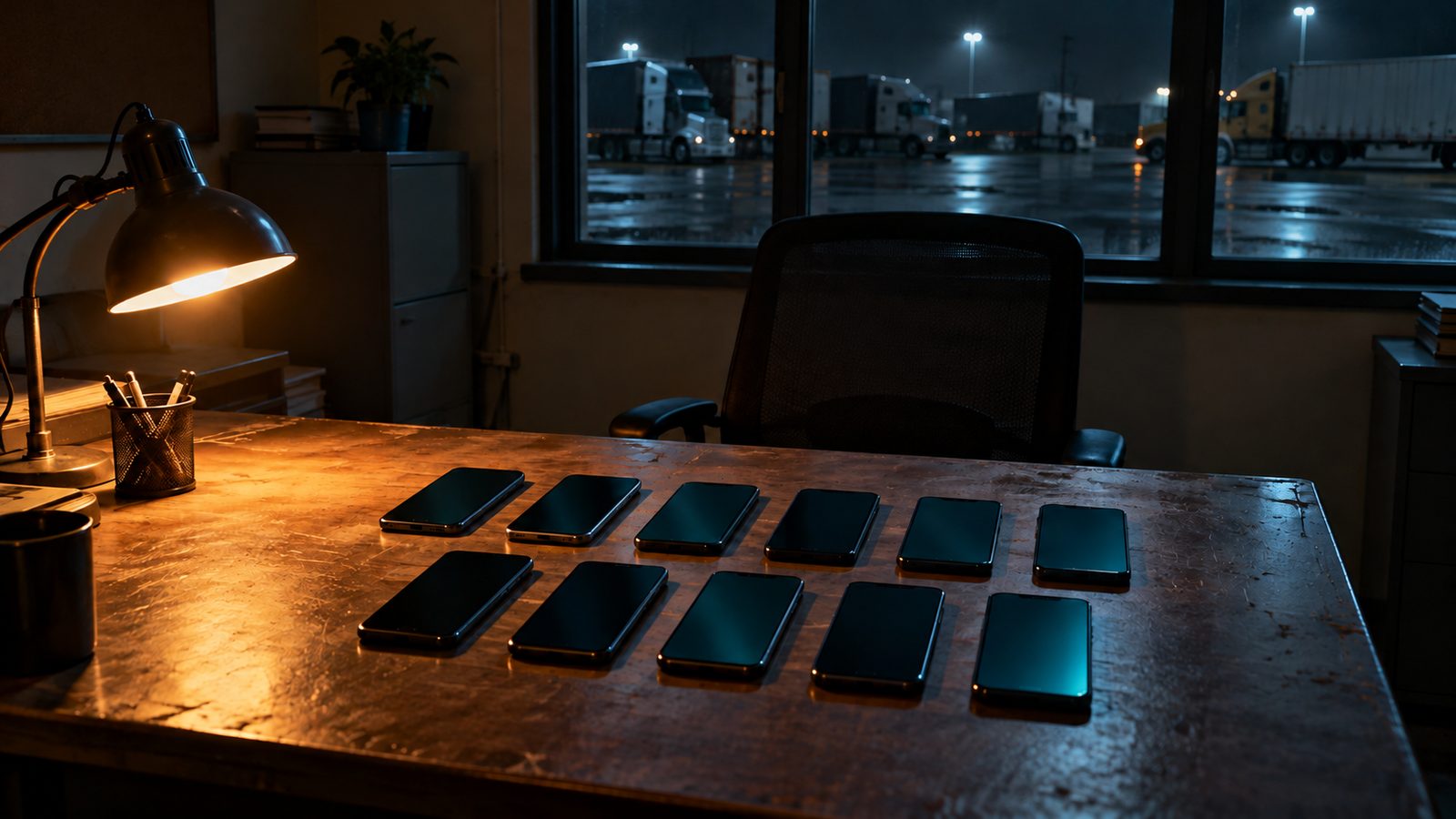
    Eleven phones laid out on a dark dispatch desk with a truck yard visible through the window

    The mechanism was simple, which is part of why it lasted:

    1. A credible identity. A company name, a contact person and paperwork that looked like a real carrier or broker.
    2. A load awarded. Shippers, carriers or brokers accepted that identity and awarded him shipments, handing over legitimate pickup and routing information.
    3. A diversion. Once the freight was released, it was diverted away from its intended destination with the help of others who have not been publicly identified.
    4. Repeat under a new name. Some identities were real companies he impersonated, others he invented outright, so no single red flag repeated the same way twice.

    What he took was specific and valuable. Assistant U.S. Attorney Kate McClelland said he “stole more than $10 million in shipments of copper and liquor by fraudulently posing as employees” of carriers and brokers. Transport Topics reported the scheme involved roughly 90 shipments; no other outlet has confirmed that figure.

    We are deliberately not describing how the documents were made or how the goods moved after pickup. The pattern is what matters: a fabricated identity, accepted at face value, used again and again.

    A note on precision. Zigmantas pleaded guilty to wire fraud. The indictment also charged bank fraud and theft of interstate shipments, and no public source we reviewed states how those remaining counts were resolved. This article does not say he was convicted on them.

    Case timeline

    Date Event Source
    March 2020 Scheme begins, according to the federal indictment USAO-NDIL charging release; CBS News Chicago
    March 2020 – September 2023 Zigmantas uses at least 11 aliases to pose as an agent of real and fictitious carriers and brokers, obtains interstate freight and diverts it USAO-NDIL; CBS News Chicago; FreightWaves
    May 14, 2024 Federal grand jury in the Northern District of Illinois returns a 13-count indictment (case 1:24-cr-00243): 6 counts of wire fraud, 5 of bank fraud, 2 of theft of interstate shipments USAO-NDIL; PacerMonitor docket
    June 2024 Initial appearance in federal court in Chicago; pleads not guilty CBS News Chicago; FreightWaves
    December 2025 Pleads guilty to wire fraud CDL Life; FreightWaves; Transport Topics; Carrier Atlas
    May 6, 2026 U.S. District Judge Elaine E. Bucklo sentences him to 60 months in federal prison USAO-NDIL sentencing release; CDL Life

    The numbers

    Figure What it measures When
    $9.5 million+ Amount stolen, as alleged at indictment May 2024
    $13.5–13.6 million Amount the scheme allegedly intended to steal, at indictment May 2024
    $10.1 million+ Amount stolen, per sentencing-stage figures May 2026
    $14.6 million Amount intended, per sentencing-stage figures May 2026
    11+ Aliases used 2020–2023
    60 months Prison sentence imposed May 6, 2026
    $10.3 million Restitution to 24 companies (reported by Transport Topics only) May 2026

    The totals grew between charging and sentencing, from $9.5 million to $10.1 million stolen, consistent with continued loss accounting. The first number in a freight fraud case is rarely the final one.

    No public source says whether any of the copper or liquor was physically recovered. Restitution is a financial order, not a returned load. That matters, because the American Transportation Research Institute (ATRI) found in October 2025 that 74% of stolen freight is never recovered.

    How freight broker fraud cases get prosecuted

    Freight broker fraud usually crosses state lines and runs on email, phone and bank transfers, which makes it federal. Here, the U.S. Attorney’s Office for the Northern District of Illinois prosecuted, Homeland Security Investigations (Chicago) and U.S. Customs and Border Protection investigated, and the case was handled as part of the Department of Justice’s Trade Fraud Task Force.

    The indictment named three offenses, and it cites the statute for each count: wire fraud under 18 U.S.C. § 1343 (Counts 1–6), theft of interstate shipments under § 659 (Counts 7–8), and bank fraud under § 1344(1) (Counts 9–13).

    Offense charged Federal statute What it covers Statutory maximum per count
    Wire fraud 18 U.S.C. § 1343 A scheme to defraud, or to obtain money or property by false pretenses, carried out using interstate wire communications (email, phone, electronic transfers) 20 years; 30 years and a $1 million fine if it affects a financial institution
    Bank fraud 18 U.S.C. § 1344 A scheme to defraud a financial institution, or to obtain its money or property by false pretenses 30 years and a $1 million fine
    Theft of interstate shipments 18 U.S.C. § 659 Stealing, or obtaining “by fraud or deception,” goods moving in an interstate or foreign shipment, including from a truck, trailer or warehouse 10 years (3 years if the value is under $1,000)

    The timeline is the lesson. The scheme ran about three and a half years before the 2024 indictment and took two more years to reach sentencing. Statutory maximums are ceilings, not predictions: the court imposed 60 months here. Prosecution closes cases; it does not stop the next load from leaving the dock.

    Warning signs of a fake carrier or fake broker

    Drawn from this case and the IC3 advisory. None proves fraud alone; each is a reason to verify through a second channel.

    • The contact details on the rate confirmation or carrier packet differ from those listed for the same company in FMCSA records, or from what you have on file from earlier loads.
    • A familiar company name or email address arrives from a new domain, a lookalike domain or a free webmail account. IC3 warns that familiar names or email addresses alone do not confirm authenticity.
    • A carrier’s FMCSA contact or insurance information changed recently, especially just before it asks for high-value loads.
    • The same phone number, bank account or remittance details appear under two different company names in your system.
    • A “dispatcher” or “agent” claims to represent a real, established carrier, but cannot be reached through the carrier’s published main line.
    • Pressure to release a load quickly, skip a step, or change pickup details by phone or text.

    How to prevent freight broker fraud: a 7-step checklist

    1. Look up every carrier and broker in FMCSA’s SAFER Company Snapshot before tendering. Why: it confirms the USDOT or MC number exists and shows its status and operating authority, which filters out invented companies.
    2. Call back on a number you sourced yourself. Why: an impersonator controls the phone number and email they give you, but not the real company’s published main line.
    3. Treat recent changes to contact, insurance or banking details as a hold, not a formality. Why: IC3 reports that thieves update a hijacked carrier’s information with regulators to take loads the real carrier never accepted.
    4. Cross-check identity data across bookings. Why: repeated bank, phone or email details under different names are a pattern a database catches and a busy rep misses.
    5. Confirm the driver, tractor and trailer at pickup against what the carrier sent in advance. Why: IC3 recommends independently verifying pickups with secondary methods before releasing any load.
    6. Record who approved each release and how they verified it. Why: a decision trail speeds investigations and claims and shows where the process broke.
    7. Report suspected fraud quickly to law enforcement and IC3. Why: cases like this span many victims, and early reports help investigators connect them.

    Pro Tip: Make “verify through a channel the counterparty did not give you” a hard rule for every new carrier and every changed detail. It is the one check that defeats both invented companies and impersonated real ones.

    What carrier vetting actually proves

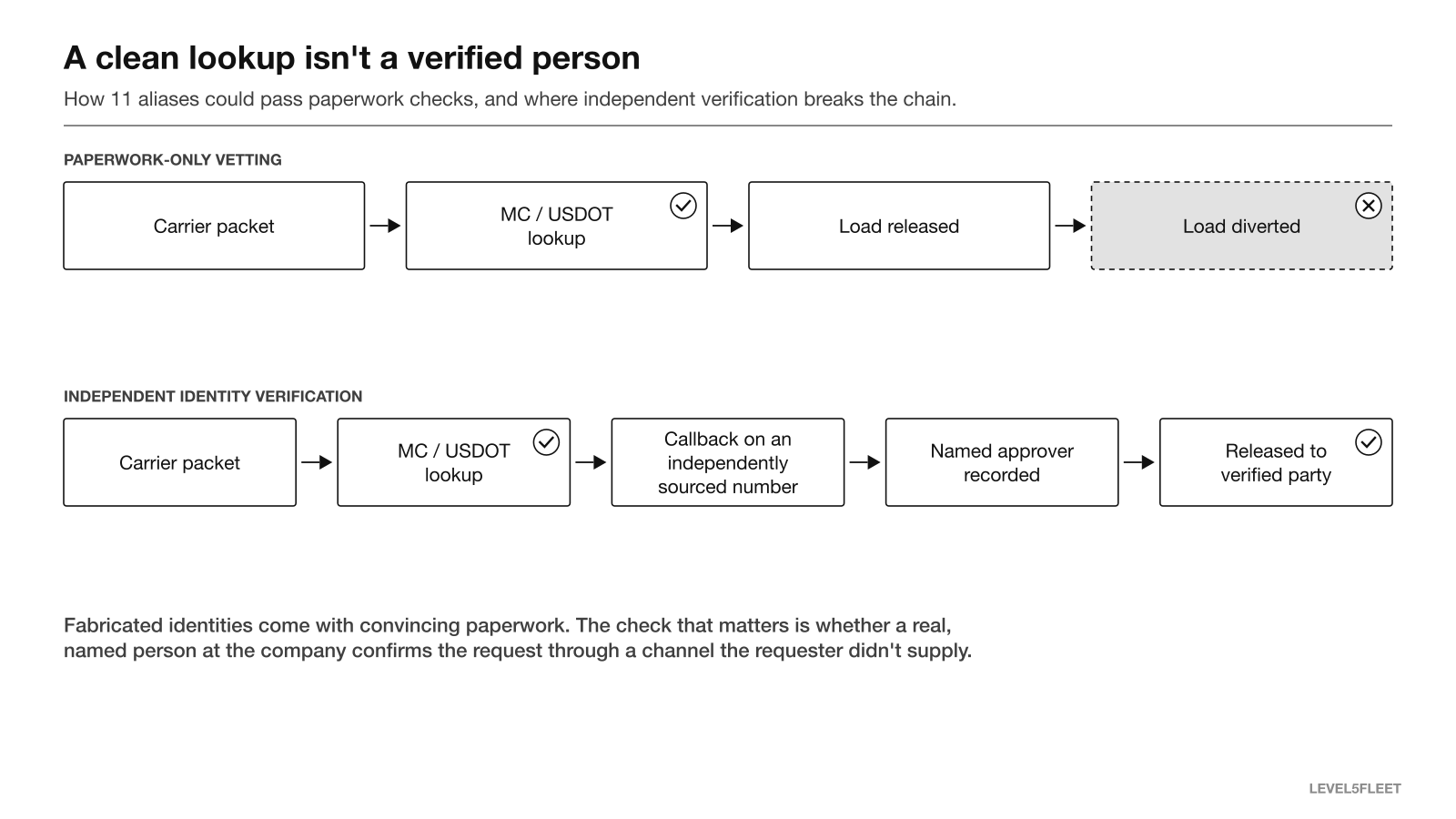
    Most carrier vetting confirms that a company exists. It does not confirm that the person you are talking to works for it. That gap is where this scheme lived.

    Diagram comparing paperwork-only vetting that ends in a diverted load with independent identity verification that ends in release to a verified party.
    Vetting check What it proves What it does not prove
    MC or USDOT number is active in FMCSA records A registered company with that number exists That the person emailing you represents it
    Certificate of insurance on file A policy was issued to that company That the certificate is current or genuine, or that the sender controls it
    Company name and logo on paperwork Someone has those documents Anything at all; logos and letterheads are easy to copy
    Email from the company’s usual domain The message came from that domain That the account is not compromised; IC3 warns familiar addresses are not proof
    Callback on a number you looked up independently The real company confirms the request Identity of the driver who shows up at pickup
    Verified identity recorded against the specific load A named, confirmed person approved this release Nothing about route integrity after pickup

    Perspective: the check that matters happens before the truck arrives

    Most cargo theft coverage focuses on the moment freight disappears. This case is a useful correction. Nothing went wrong on the road. Every load in this scheme left the dock exactly as the shipper or broker intended, because someone had already decided the person on the other end was legitimate.

    That is why I don’t think the answer to freight broker fraud is more tracking. A GPS ping tells you where the freight went, not whether the party you released it to should have had it.

    The second thing I take from this case is the timeline. Three and a half years of operation, two more years to sentencing. Prosecution worked, and it matters that it did, but it is not a prevention strategy. The only point where a shipper or broker controls the outcome is the moment of the decision to release. That decision deserves the same rigor we give to a wire transfer: independent confirmation, a named approver, and a record.

    — Gwagsi Glenn, Growth Analyst, Level5Fleet

    Where Admiral fits, and where it does not

    Level5fleet

    This case was unwound by a multi-year federal investigation, not a product, and no platform would have “caught” Zigmantas on its own.

    Would have prevented: identity verification before release. The whole scheme depended on counterparties accepting a fabricated carrier or broker identity before freight was handed over. That checkpoint is what Admiral Resolve is built for. Resolve verifies pickup, access and change requests before they are approved: whether the request came from the real person, whether that person acts for the company they claim, and whether they are authorized for that specific load. The named party confirms or declines the request itself, so a fabricated identity with convincing paperwork doesn’t pass on documents alone. Approvals and denials are recorded as an audit trail, and Resolve is free to start (fair usage limits apply). Combined with independent FMCSA lookups, this is the step that closes the opening used here.

    Would have shortened detection: pattern checks across bookings. Flagging the same bank details or phone numbers under different company names could have surfaced this scheme far sooner. Resolve’s decision records keep who-approved-what in one place, which helps that review, but alias detection depends on your own booking data; Admiral does not detect aliases automatically.

    Would not have helped on its own: physical locks and immobilization. Admiral Enforce embeds authorization rules on trailers and containers so doors stay locked and trailers stay immobilized until an action is authorized. That stops unauthorized hookups and cargo access. But in this case the freight was handed over to someone who had been wrongly approved. A lock enforces a decision; it cannot fix a wrong one. Enforce adds value only when the approval behind it has been verified, which is why Resolve comes first.

    If your team still decides who gets a load from paperwork the counterparty supplied, start there. Start using Resolve free on your next pickup request, and request an Enforce Pilot later if you also need physical enforcement on trailers or containers.

    FAQ

    What is a fake carrier in trucking?

    A fake carrier is a person or company that presents itself as a legitimate motor carrier to obtain loads it never intends to deliver. It may be an invented company or an impersonation of a real one using copied names and numbers. In the Zigmantas case, both types were used under at least 11 aliases.

    How do you spot a fake MC number?

    Look the MC or USDOT number up in FMCSA’s SAFER Company Snapshot, then confirm the contact details match the record and your own history with that carrier. A real number is not enough, because impersonators borrow real carriers’ numbers and, according to the FBI’s IC3, sometimes change the carrier’s contact details with regulators. Call back on a number you found yourself.

    What is the carrier vetting process?

    Carrier vetting is the set of checks a broker or shipper runs before tendering a load: registration and authority status, insurance, safety history and contact verification. Strong processes add independent callbacks, holds on recently changed records, and a recorded approval for each release. Vetting proves a company exists; identity verification proves you are dealing with it.

    What is 18 U.S.C. 659?

    18 U.S.C. § 659 is the federal law against theft from interstate or foreign shipments. It covers stealing goods, or obtaining them “by fraud or deception,” from trucks, trailers, warehouses and other points in an interstate shipment, with a maximum of 10 years in prison per count. The Zigmantas indictment included two counts of theft of interstate shipments.

    Sources

    1. U.S. Attorney’s Office, Northern District of Illinois, “Suburban Chicago Man Charged in Federal Court With Stealing More Than $9.5 Million in Interstate Shipments” (May 2024): https://www.justice.gov/usao-ndil/pr/suburban-chicago-man-charged-federal-court-stealing-more-95-million-interstate
    2. U.S. Attorney’s Office, Northern District of Illinois, “Suburban Chicago Man Sentenced to Five Years in Prison for Stealing More Than $10 Million in Interstate Shipments” (May 2026): https://www.justice.gov/usao-ndil/pr/suburban-chicago-man-sentenced-five-years-prison-stealing-more-10-million-interstate
    3. PacerMonitor, USA v. Zigmantas, 1:24-cr-00243 (N.D. Ill.): https://www.pacermonitor.com/public/case/53896636/USA_v_Zigmantas
    4. CBS News Chicago, “Chicago area man charged with stealing $9.5 million from shipments” (June 2024): https://www.cbsnews.com/chicago/news/aivaras-zigmantas-charged-theft-copper-liquor-interstate-shipments/
    5. FreightWaves, “Man charged with posing as carrier agent, nabbing $9.5M in goods” (2024): https://www.freightwaves.com/news/man-charged-with-posing-as-carrier-agent-nabbing-9-5m-in-goods
    6. CDL Life, “Man sentenced for impersonating carriers and freight brokers to steal $10.1 million worth of interstate shipments” (May 2026): https://cdllife.com/2026/man-sentenced-for-impersonating-carriers-and-freight-brokers-to-steal-10-1-million-worth-of-interstate-shipments/
    7. FreightWaves, “Inside the $10m freight fraud that rocked Chicago” (2026): https://www.freightwaves.com/news/inside-the-10m-freight-fraud-that-rocked-chicago
    8. Transport Topics, “Inside a $10.1M cargo theft ring” (2026): https://www.ttnews.com/articles/inside-cargo-theft-ring
    9. Carrier Atlas, “Chicago Man Gets 5 Years for $10M Freight Fraud Using Fake Carrier IDs” (May 2026): https://carrieratlas.com/news/chicago-man-gets-5-years-for-10m-freight-fraud-using-fake-carrier-ids
    10. FBI Internet Crime Complaint Center, “Cyber-Enabled Strategic Cargo Theft Surging,” PSA (April 30, 2026): https://www.ic3.gov/PSA/2026/PSA260430
    11. ATRI, “New ATRI Research Confirms the High Costs of Cargo Theft to Industry” (October 2025): https://truckingresearch.org/2025/10/new-atri-research-confirms-the-high-costs-of-cargo-theft-to-industry/
    12. 18 U.S.C. § 1343 (wire fraud), Legal Information Institute: https://www.law.cornell.edu/uscode/text/18/1343
    13. 18 U.S.C. § 1344 (bank fraud), Legal Information Institute: https://www.law.cornell.edu/uscode/text/18/1344
    14. 18 U.S.C. § 659 (interstate or foreign shipments by carrier), Legal Information Institute: https://www.law.cornell.edu/uscode/text/18/659
    15. FMCSA, Company Safety Records (SAFER Company Snapshot): https://www.fmcsa.dot.gov/safety/company-safety-records
  • Carrier Vetting Passed. The Freight Was Gone Anyway: Inside a $4.49M Impersonation Ring

    Carrier Vetting Passed. The Freight Was Gone Anyway: Inside a $4.49M Impersonation Ring

    Hands filling out a pickup form on a clipboard at a warehouse desk

    Carrier vetting confirms that a motor carrier is real, registered and authorized to haul freight. It does not confirm that the driver and truck at your dock work for that carrier. In a case the Manhattan District Attorney announced in June 2026, prosecutors allege eight men took about $4.49 million in freight using real carriers’ genuine MC and DOT numbers, so every registration check came back clean.


    TL;DR

    • Prosecutors allege an eight-person crew picked up six loads worth about $4.49 million between October 2025 and April 2026 by presenting as legitimate, registered carriers.
    • The crew allegedly used real carriers’ names, MC numbers and DOT numbers rather than fake ones, so a standard FMCSA lookup would have returned an active, legitimate carrier.
    • The failure point was authorization, not registration: nobody confirmed that this driver and this truck had been dispatched by the real carrier for this load.
    • The FBI’s April 2026 cargo-theft alert tells shippers and brokers to verify pickups independently, using secondary methods, before releasing any load.
    • A complete carrier vetting process ends at the dock with a check of the person and the equipment, through a channel the driver did not supply.

    Table of Contents

    What is carrier vetting?

    Carrier vetting is the process shippers and brokers use to confirm a motor carrier is legitimate before giving it freight. A typical process checks the carrier’s USDOT and MC numbers with FMCSA, its operating authority, its insurance and its safety record. It establishes that a company exists. It does not establish who arrives to collect the load.

    Most carrier vetting happens at onboarding or tender, and it is built to catch a fake trucking company: an invented name, a fake MC number, revoked authority, missing insurance. Those checks still matter. GAO has described “chameleon carriers” that register under a new identity “to disguise their former identity and evade detection by FMCSA.”

    Impersonation is a different problem. The carrier is real and its records are clean, because the impostor borrows them. Verisk CargoNet’s Q1 2026 report says “criminal networks have largely settled on impersonating legitimate motor carriers and logistics brokers.” A vetting process that stops at the database lookup is built for the older threat.

    The case: how an alleged ring passed carrier verification

    A tractor-trailer pulls up to a loading dock. The name on the door, the MC number and the DOT number all match the paperwork. Staff check the numbers, get a clean result and load the freight.

    Unbranded trailer pulling away from a loading dock at dusk, seen from inside the dock

    According to an indictment announced by Manhattan District Attorney Alvin L. Bragg, Jr. on June 3, 2026, that is how eight men allegedly moved about $4.49 million in cargo over roughly seven months, without forging a credential.

    The Manhattan DA’s Office, working with the NYPD and the NYC Business Integrity Commission, charged Murodullo Khasanov, Nodir Kobilov, Shavkatbek Mamadjanov, Rakhmiddin Abdullaev, Aleksey Vorobyev, Nizom Ismoilov, Doston Mardoev and Dilshod Nabiev in New York County Supreme Court under case IND-71638-26. Port Authority police were also reported to be part of the investigation. Bragg called it “a wide-ranging and brazen, multimillion-dollar interstate retail theft conspiracy.” All eight are presumed innocent, and no trial date has been reported.

    According to case reporting, prosecutors allege that load information came from phishing operations run by associated criminal groups; how those worked has not been made public. The crew then allegedly displayed the actual name, MC number and DOT number of an existing, legitimately registered carrier on a leased tractor-trailer and collected the freight as that carrier. Khasanov, the alleged organizer, is accused of using WhatsApp and Telegram to relay load information and documents and to dispatch drivers. Prosecutors allege the loads were driven into the Bronx and Manhattan, moved to other vehicles, stored and sold.

    The borrowed identity is what makes this case worth studying. Onboarding checks are good at catching a fake MC number. Here, prosecutors allege, the identity was genuine and only the people using it were not.

    Case timeline

    Date Event Source
    October 2025 Alleged scheme activity begins Manhattan DA indictment, via FreightWaves and Transport Topics
    November 2025 About $165,000 in frozen lamb collected by a truck allegedly impersonating a carrier at a logistics center in Oldmans Township, NJ FreightWaves; Transport Topics
    December 2025 About $432,000 in cheese (parmesan, pecorino, Manchego; about 25,395 lbs) taken from Elizabeth, NJ; the load was bound for Georgia FreightWaves; Transport Topics
    December 2025 About $295,000 in frozen beef stolen FreightWaves; Transport Topics
    About Feb. 3, 2026 More than $266,000 in copper rod (43,100 lbs) taken from a facility in Newark, NJ Recycling Today; FreightWaves
    March 2026 Two cigarette loads taken from one Virginia facility, bound for Tennessee and Florida: $709,923 and $2.6 million FreightWaves; Transport Topics
    April 2026 Alleged scheme activity ends Manhattan DA indictment, via FreightWaves
    June 3, 2026 DA Bragg announces the eight-defendant indictment (IND-71638-26) Manhattan DA press release
    June 2026 Prosecutors seek $1.5 million cash bail for Khasanov, who is ordered held pending a June 11 hearing New York Post

    Exact dates within each month have not been disclosed, except for the copper load.

    The numbers

    The six itemized loads add up to the $4.49 million total reported by FreightWaves and Transport Topics. Verisk and others rounded it to “nearly $5 million,” which is a rounding difference, not a conflicting fact. The $2.6 million cigarette load alone is more than half the total.

    No cargo recovery has been reported. The DA’s office has said it believes other, uncharged incidents may be tied to the same conduct and that the investigation is continuing. Verisk CargoNet says its analysts identified theft patterns that supported the case.

    The case reflects a wider trend in organized cargo theft:

    • $725 million: estimated U.S. and Canadian cargo theft losses in 2025, up 60% from 2024. The average value per theft rose 36% to $273,990 (FBI IC3, April 30, 2026).
    • $131.58 million across 767 events: Verisk CargoNet’s Q1 2026 totals. Losses were essentially flat year over year while event counts fell 5.3%.
    • +119%: New Jersey’s rise in Q1 2026 incidents, from 27 to 59. At least three of the six loads in this case left New Jersey facilities.
    • $304.6 million: Verisk’s Q2 2026 loss estimate.

    The pattern is fewer thefts, each worth more. “Criminal groups are investing more time in impersonation schemes,” said Ralph Pepe, senior intelligence analyst at Verisk CargoNet.

    What each vetting check proves, and what it doesn’t

    Most vetting steps prove something true about a company and nothing about the person at the dock. Here is how standard checks would have performed against this alleged scheme:

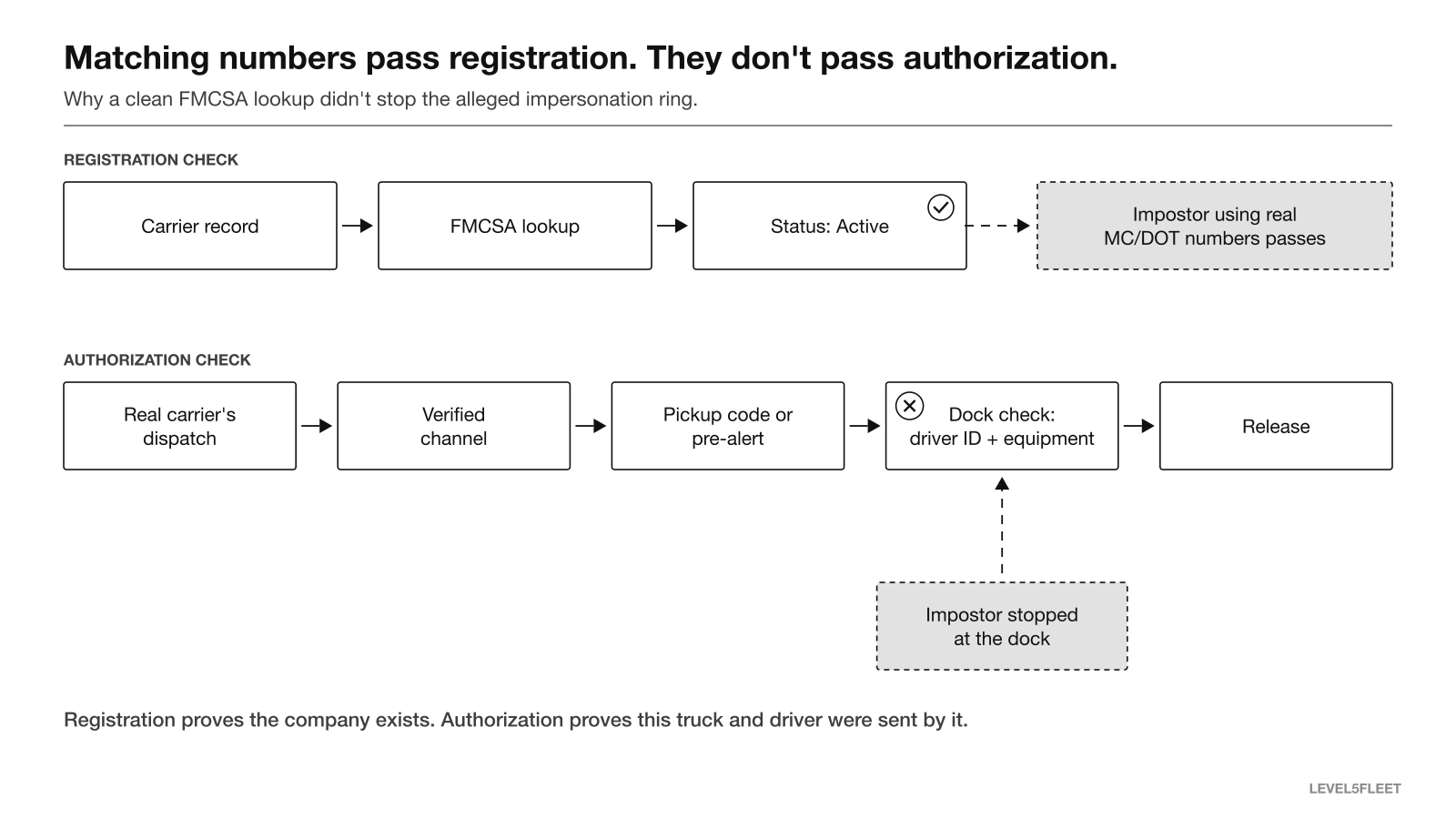
    Diagram showing an impostor using real MC and DOT numbers passing an FMCSA registration check but being stopped by an authorization check at the dock.
    Vetting check What it proves What it doesn’t prove Would it have caught this scheme?
    FMCSA lookup of the MC/DOT number A carrier with that number is registered and active That the truck presenting the number belongs to that carrier No. The numbers were allegedly real
    Operating authority and insurance on file The carrier may legally haul for hire and is insured That the carrier sent anyone to this pickup No
    Name and numbers on the truck door Someone marked the truck with those details Who controls the truck No. They allegedly matched
    Carrier packet, rate confirmation, BOL Documents were exchanged and look consistent That the documents came from the real carrier Unlikely, if load data was compromised
    Callback to a number the driver or email provides Someone answers that number That the person answering works for the carrier No. The callback can reach the impostor
    Callback to the carrier’s number on file in SAFER The real carrier can confirm or deny the dispatch Nothing on its own about the driver’s ID Likely. The real carrier knows it didn’t send a truck
    Pre-alert match (driver name, tractor and trailer numbers) plus ID check at the gate The person and equipment match what the real carrier assigned That the pre-alert itself wasn’t spoofed, unless it came through a verified channel Yes, if the pre-alert came from the verified carrier
    Pickup code sent shipper-to-carrier through a verified channel The driver got the code from the real carrier’s dispatch Driver identity on its own Yes, if the channel is independent of the driver

    The checks that work confirm authorization through a channel the impostor doesn’t control. FMCSA’s fraud guidance makes the same point: if the number a carrier or broker gives you does not match the one posted in SAFER, call the SAFER number to discuss the load.

    Warning signs of carrier impersonation at pickup

    When the paperwork is clean, the warning signs show up in the process instead:

    • The driver’s phone number, or the dispatch number on the paperwork, differs from the number listed for the carrier in FMCSA’s SAFER system.
    • No pre-alert arrived from the carrier, or the driver’s name, tractor number or trailer number doesn’t match the pre-alert.
    • The driver can’t name the carrier’s dispatcher, or the dispatcher can be reached only by text or a messaging app.
    • Pickup is requested early, outside the appointment window, or with pressure to skip a step “because the receiver is waiting.”
    • The trailer or tractor numbers on the equipment differ from those on the rate confirmation or BOL.
    • The carrier contact uses a free email address or a domain one character off from the real one.
    • A contact changes mid-load, or someone asks to reroute after tender.

    Any one of these is a reason to hold the load and verify.

    How to close the gap: a pickup verification checklist

    1. Keep onboarding vetting, but treat it as necessary, not sufficient. Check MC/DOT status, authority, insurance and safety record. Why: it filters out fake trucking companies and chameleon carriers, which still exist.
    2. Get dispatch contact details from SAFER or your own verified records, never from the load paperwork. Why: a callback to a number the impostor supplied only confirms the impostor.
    3. Require a pre-alert from the carrier’s verified dispatch for every pickup. It should include the driver’s name, tractor and trailer numbers and the arrival window. Why: it gives the dock something specific to match against besides the door placard.
    4. At the gate, match the driver’s government ID and the equipment numbers against the pre-alert before loading. Why: this is the step that turns registration into authorization.
    5. Use a one-time pickup code sent from shipper to the real carrier’s dispatcher, not to the driver. Why: a driver can only present the code if the real carrier gave it to him.
    6. Escalate every mismatch to a named supervisor, and allow no front-line overrides. Why: impostors rely on urgency and on staff not wanting to hold up a truck.
    7. Record who approved the release, when, and on what evidence. Why: a timestamped decision record gives investigators and insurers something to act on.
    8. Report attempts as well as losses. File with local police and IC3, and use FMCSA’s National Consumer Complaint Database for identity misuse. Why: in this case, patterns across incidents helped connect separate losses into one indictment.

    Pro Tip: At onboarding, record the dispatch number each carrier wants you to call, confirmed against SAFER, so the dock never relies on a number from the driver.

    Perspective: vet the handoff, not just the company

    I think the freight industry has merged two questions that need to stay separate: “Is this a real carrier?” and “Did this real carrier send this truck, for this load, right now?” Our tools are very good at the first. This case, as prosecutors describe it, was built to exploit the second.

    The fix isn’t a better database, since every database in this story would have returned the right answer. The fix is moving part of vetting to the moment custody changes hands, through a channel the person at the dock can’t influence. The FBI already says to “independently verify shipment requests and pickups using secondary methods prior to releasing any loads.”

    The release decision usually falls to the person with the least context and the most time pressure. If their only tool is a lookup impostors are built to pass, we are asking them to stop organized theft with a checkbox. They should get a clear yes or no, decided by the real carrier, and recorded.

    — Gwagsi Glenn, Growth Analyst, Level5Fleet

    Where Admiral fits, and where it doesn’t

    Level5fleet

    Admiral ties verified identity to what can happen to the freight. Here is how each part maps to this case, without overclaiming.

    Admiral capability Effect in this case Why
    Admiral Resolve (identity, company and authorization check on pickup, access and change requests) Could have prevented, if used at the release decision Resolve shows whether the requester is the real person, acts for the correct carrier, and “is allowed to make this change for this load, right now,” which is the gap this case exposed. The named party confirms or declines the request itself, so a matching MC/DOT number and a marked truck aren’t treated as proof. Requests can be forwarded to verify@ with no pre-enrollment, and each decision leaves an audit trail.
    Admiral Enforce (Trailer Immobilizer, Admiral Lock) Would not have applied as reported The crew allegedly brought its own leased tractor-trailer, and on-asset enforcement only controls Admiral-equipped trailers. In a drop-trailer program using equipped trailers, the immobilizer keeps the spring brakes engaged until an authorized driver’s fob or app talks to the Hub. That is a different scenario.
    Admiral Execute Only aids It carries an approved carrier, appointment or swap to the dock, so staff see who approved what. In-transit restrictions still depend on equipped trailers.
    Route-deviation alerting Not an Admiral claim Lane monitoring could have flagged diversions toward New York City sooner, shortening detection. Admiral’s location rules control where an equipped trailer’s doors and brakes may release, and the Hub records unplanned stops, but off-route alerting is a tracking function we don’t claim.
    Trailer locks and seals Would not have helped The freight left through the front door with legitimate-looking paperwork.

    The control that matters most here is an authorization check at the moment of release, and that is what Resolve is for. Our Admiral platform brochure calls it the one unverified link: every other check can return yes while the person acting for the carrier was never verified. No platform would have dismantled a ring that prosecutors say ran for about six months across several states; investigators and cross-incident pattern analysis did that. A verified release decision makes each pickup harder to fake.

    Resolve is free to use, within fair usage limits, with no hardware or contract. Start verifying pickups with Admiral Resolve, and request an Enforce Pilot when you want those decisions enforced on your own trailers.

    FAQ

    What is the carrier vetting process?

    The carrier vetting process is a set of checks a shipper or broker runs before tendering freight. It usually covers USDOT and MC registration, operating authority, insurance and safety history. A complete process adds a pickup-time check that the driver and truck were dispatched by the real carrier, confirmed through contact details you sourced yourself.

    How does carrier verification differ from carrier vetting?

    Vetting usually means qualifying a carrier before you work with it; verification means confirming a specific transaction, such as this pickup. This case shows a carrier can pass vetting while a pickup made in its name is fraudulent.

    What is a fake MC number, and does a valid one mean the carrier is legitimate?

    A fake MC number is one that doesn’t belong to the company presenting it: either invented, or borrowed from a real carrier. A valid MC number shows only that some carrier holds that authority. In this case, prosecutors allege, the numbers were genuine and belonged to real carriers who never sent the trucks.

    What is the FMCSA vetting process?

    FMCSA registers motor carriers and publishes registration, authority and safety data that shippers and brokers can check through SAFER. It does not confirm who shows up at a particular pickup. In its 2012 review, GAO reported that FMCSA’s new-applicant vetting program covered passenger and household goods carriers, not freight carriers. Pickup-level verification remains the job of the shipper and broker.

    How do you report FMCSA fraud or carrier identity theft?

    File a police report for any stolen cargo, then report to the FBI’s IC3 at ic3.gov or your local FBI field office. FMCSA’s fraud guidance also points to its National Consumer Complaint Database for misuse of registration information and to the USDOT Inspector General hotline.

    How can you spot a fake trucking company?

    Look for recent changes to contact details, a phone number that differs from SAFER, free email domains and no verifiable dispatch office. Because impostors now often pose as real, established carriers, a long clean record isn’t proof. Confirm the specific dispatch with the carrier directly.

    Sources

    1. Manhattan District Attorney’s Office, “D.A. Bragg, NYPD & BIC: Eight Indicted For Impersonating Shipping Carriers In Multi-State Retail Theft Ring,” June 3, 2026. https://manhattanda.org/d-a-bragg-nypd-bic-eight-indicted-for-impersonating-shipping-carriers-in-multi-state-retail-theft-ring/
    2. FreightWaves, “Eight indicted in alleged carrier impersonation scheme; prosecutors allege $4.49 million in cargo losses,” June 8, 2026. https://www.freightwaves.com/news/eight-indicted-in-alleged-carrier-impersonation-scheme-prosecutors-allege-4-49-million-in-cargo-losses
    3. Transport Topics, “Grand jury indicts 8 in cargo theft scheme tied to hacked data,” June 2026. https://www.ttnews.com/articles/cargo-theft-hacked-data
    4. Claims Journal, “Eight Indicted for Impersonating Shipping Carriers in Multi-State Retail Theft Ring,” June 10, 2026. https://www.claimsjournal.com/news/national/2026/06/10/338068.htm
    5. Recycling Today, “Copper included in goods stolen by alleged cargo theft ring, New York officials say,” June 2026. https://www.recyclingtoday.com/news/copper-included-in-goods-stolen-by-alleged-cargo-theft-ring-new-york-officials-say/
    6. Verisk, “Verisk CargoNet Assists in Manhattan DA Cargo Theft Indictment Targeting Multi-State Impersonation Ring,” June 9, 2026. https://www.verisk.com/company/newsroom/verisk-cargonet-assists-in-manhattan-da-cargo-theft-indictment-targeting-multi-state-impersonation-ring/
    7. New York Post (syndicated via Yahoo News), “Wannabe Uzbek mobsters staggering $4.5M ‘Goodfellas’ scheme,” June 3, 2026. https://www.yahoo.com/news/us/articles/wannabe-uzbek-mobsters-staggering-4-172247793.html
    8. FBI Internet Crime Complaint Center, “Cyber-Enabled Strategic Cargo Theft Surging,” PSA I-043026-PSA, April 30, 2026. https://www.ic3.gov/PSA/2026/PSA260430
    9. Verisk CargoNet, “2026 First Quarter Supply Chain Risk Trends Analysis.” https://www.cargonet.com/news-and-events/cargonet-in-the-media/2026-q1-theft-trends/
    10. Verisk, “Cargo theft losses more than double to $304 million in Q2,” 2026. https://www.verisk.com/company/newsroom/cargo-theft-losses-more-than-double-to-$304-million-in-q2-despite-a-drop-in-thefts-driven-by-high-value-metals-and-technology-heists/
    11. U.S. GAO, “Motor Carrier Safety: New Applicant Reviews Should Expand to Identify Freight Carriers Evading Detection,” GAO-12-364, March 2012. https://www.gao.gov/products/gao-12-364
    12. FMCSA, “Broker and Carrier Fraud and Identity Theft.” https://www.fmcsa.dot.gov/mission/help/broker-and-carrier-fraud-and-identity-theft
  • MATS 2026 – Strategies for Cargo Theft

    MATS 2026 – Strategies for Cargo Theft

    Cargo Theft Prevention Requires More Than Visibility: Key Insights from MATS 2026

    At MATS 2026, Level5Fleet presented “Strategies for Cargo Theft: Beyond Visibility,” a thought-provoking session that explored the root causes behind the growing rise of cargo theft, freight fraud, and supply chain security breaches across the transportation industry.

    For years, the logistics sector has invested heavily in GPS tracking, real-time cargo visibility, surveillance systems, telematics, and freight monitoring technologies. While these tools provide valuable operational data, cargo theft incidents continue to increase across North America and globally. The reason is simple: visibility alone does not prevent unauthorized actions from taking place.

    Our presentation challenged the common assumption that more data automatically leads to better security. In reality, many cargo losses occur not because information is unavailable, but because critical decisions are made during execution without enforceable authorization. By the time an issue is detected through tracking or monitoring systems, the theft or fraudulent activity has often already occurred.

    Moving from Monitoring to Prevention

    The session introduced a practical framework designed to strengthen freight security and cargo theft prevention by shifting authorization earlier in the logistics workflow and making it enforceable at the point of execution.

    Instead of only verifying who someone is, organizations should verify whether a specific action—such as a pickup, trailer movement, yard transfer, or final delivery—is authorized at a specific location and time. More importantly, systems must ensure that only authorized individuals can execute those actions.

    This approach combines authorization verification, asset security, fleet technology, and automated access control to create a proactive security model. By integrating authorization directly with equipment and assets, organizations can prevent unauthorized actions before they occur rather than relying solely on post-event detection and recovery.

    Building a Smarter and More Secure Supply Chain

    Modern freight operations require more than visibility dashboards and tracking alerts. Effective supply chain risk management demands the ability to control execution, validate permissions, and enforce security policies in real time.

    By enabling assets themselves to control access and operational execution, carriers, shippers, and logistics providers can:

    • Reduce cargo theft and freight fraud risks
    • Improve supply chain security and compliance
    • Streamline yard operations and asset utilization
    • Reduce operational friction and delays
    • Increase accountability across distributed logistics networks
    • Strengthen overall freight execution and performance

    The result is a shift from reactive monitoring toward true prevention—creating a more resilient, efficient, and secure transportation ecosystem.

    Watch the Full Presentation

    The complete MATS 2026 session, “Strategies for Cargo Theft: Beyond Visibility,” is available here:

    Stay Connected with Level5Fleet

    Want more insights on cargo theft prevention, freight security, fleet management technology, supply chain innovation, logistics trends, and transportation risk management?

    Follow Level5Fleet for industry updates, expert analysis, and practical strategies for building a smarter and more secure supply chain.

  • Level5Fleet Gains Industry Recognition as Cargo Theft Prevention Becomes a Critical Supply Chain Priority

    Level5Fleet Gains Industry Recognition as Cargo Theft Prevention Becomes a Critical Supply Chain Priority

    The growing threat of cargo theft and freight fraud continues to challenge shippers, carriers, brokers, and logistics providers worldwide. As criminal tactics evolve from traditional trailer theft to sophisticated impersonation schemes, fictitious pickups, and digital fraud, the industry is increasingly looking for solutions that move beyond visibility and recovery toward prevention.

    Recent industry coverage highlights how Level5Fleet is addressing this challenge through a new approach to freight security that combines authorization verification with physical enforcement at the asset level.

    Featured in Supply & Demand Chain Executive

    In March 2026, Supply & Demand Chain Executive featured Level5Fleet’s expanding Admiral platform and its role in helping organizations prevent cargo theft before freight moves.

    The article highlights how Admiral enables organizations to verify who is requesting access, pickup, or operational changes, determine what actions they are authorized to perform, and enforce those decisions directly on equipment. Approved authorization rules can then be propagated to trailers and containers, ensuring that access and movement occur only when approved.

    Read the full article:

    Supply & Demand Chain Executive Feature: Level5Fleet’s Trailer Security Platform to Prevent Cargo Theft

    Featured by SEN 1 Media

    In February 2026, SEN 1 Media highlighted Level5Fleet’s efforts to address what many experts describe as a growing logistics crisis: the rapid rise of cargo theft and freight fraud across global supply chains.

    The discussion centered on the industry’s shift away from purely reactive security measures toward preventive systems capable of validating authorization and controlling execution before freight is moved. This approach reflects a broader trend within transportation security as organizations seek stronger protection against increasingly sophisticated theft methods.

    Why Cargo Theft Is Becoming More Difficult to Prevent

    Cargo theft has evolved significantly in recent years.

    Industry reports show that organized criminal networks are increasingly leveraging fraudulent documentation, impersonation tactics, digital freight fraud, and fictitious pickups rather than relying solely on traditional physical theft. Trucks remain the primary target globally, while insider involvement and technology-enabled fraud continue to grow.

    According to recent cargo theft research from TT Club and BSI Consulting, cargo theft is becoming more sophisticated across road, rail, sea, and digital channels, creating new challenges for transportation providers and supply chain operators.

    This shift exposes a critical weakness in many existing security strategies: visibility systems can show where freight is, but they often cannot prevent unauthorized actions from occurring in the first place.

    Beyond GPS Tracking and Visibility

    For years, the logistics industry has invested heavily in:

    • GPS tracking
    • Real-time visibility platforms
    • Geofencing technologies
    • Cargo monitoring systems
    • Security cameras and surveillance

    While these technologies improve awareness, they primarily provide information after an event has occurred. Modern theft schemes increasingly exploit operational workflows and authorization processes rather than physical vulnerabilities alone.

    Level5Fleet’s approach focuses on connecting three critical elements:

    1. Identity verification
    2. Authorization validation
    3. Physical enforcement

    By linking approved decisions directly to equipment, organizations can ensure that only authorized individuals can access, move, or interact with freight assets. If authorization requirements are not met, equipment remains secured.

    The Future of Freight Security

    The freight industry is increasingly recognizing that effective cargo theft prevention requires more than tracking and alerts. As theft methods become more organized and technology-driven, prevention strategies must evolve as well.

    Industry leaders are now exploring solutions that combine:

    • Freight authorization controls
    • Asset-level enforcement
    • Digital identity verification
    • Automated workflow execution
    • Supply chain risk management

    This shift represents a move from monitoring incidents to preventing them, helping organizations reduce losses, improve operational consistency, and strengthen supply chain resilience.

    Additional Resources

    Learn more about cargo theft prevention, freight security, and transportation risk management:

    Stay Connected

    Follow Level5Fleet for ongoing insights into:

    • Cargo Theft Prevention
    • Freight Security
    • Supply Chain Security
    • Freight Fraud Prevention
    • Fleet Management Technology
    • Transportation Security
    • Logistics Innovation
    • Supply Chain Risk Management

    As the industry continues to face increasingly complex security challenges, prevention-focused solutions will play a growing role in protecting freight, reducing operational risk, and building a more resilient supply chain.

  • Cargo Theft Isn’t One Problem

    Cargo Theft Isn’t One Problem

    FreightWaves hosted a cargo theft hackathon at F3 last year, where one concept that emerged was the idea of a “kill chain” — the sequence of points where freight can be exploited, from tendering through delivery.

    SEN 1 media spoke with us at Manifest 2026 about how these incidents are evolving.

    When you look at the problem through that lens, a pattern starts to emerge.

    At the beginning of the chain, the industry has made real progress. There are now effective ways to reduce exposure before a load is ever accepted. Screening tools help identify risky actors, and most operations have strengthened their onboarding and vetting processes.

    At the other end, visibility has improved response. Tracking, alerts, and recovery workflows make it easier to react when something has already gone wrong.

    But between those two points lies the part of the chain where execution actually happens. Where loads are picked up, handed off, and moved under real-world conditions. That is also where most incidents take shape.

    What happens in that middle is often treated as a single problem, but in practice there are two distinct failure modes.

    The first is unauthorized execution. In these cases, actors do not break into the system from the outside. They insert themselves into it. Decisions are pushed through under time pressure — a last-minute change, a rescheduled appointment, a substituted driver or piece of equipment. Due diligence is performed, but in the moment, under operational pressure, it becomes easier to accept ambiguity or rely on incomplete information. The exploit is not bypassing the process. It is operating within it.

    The second is straight theft. Here, the exploit is not in the decision but in access. Once someone reaches the asset, there is often nothing that physically prevents movement or cargo access. The system may know something is wrong, but that knowledge does not translate into control.

    These are different mechanisms, and they fail in different ways. One exploits how decisions are made. The other exploits what happens after access is gained. What they share is where they occur. It is in the middle of the chain, where execution is dynamic, time-constrained, and difficult to control.

    Over time, the industry has become better at deciding who should be allowed to act, and better at responding when something goes wrong. But the moment where actions actually take place remains largely unconstrained.

    That is where the next shift is starting to emerge.

    It is not about adding more checks or more visibility. It is about how execution itself is handled: whether authorization can be clearly defined at the moment an action is taken, whether that authorization can be proven rather than inferred, and whether it can be enforced rather than simply observed.

    This is the part of the system that has historically been left to procedures and judgment. It is also where most incidents take shape.

    Stay Connected

    Want more insights like this? Follow Level5Fleet for future articles, freight industry trends, and updates on building a smarter, more secure supply chain:
    🔗 LinkedIn
    🐦 X: @Level5fleet
    📘 Facebook
    📸 Instagram

  • Level5Fleet Extends Admiral Its Trailer Security Platform, Beyond Asset Owners

    Level5Fleet Extends Admiral Its Trailer Security Platform, Beyond Asset Owners

    Verify who’s requesting pickup or changes — and enforce what you approve

    Las Vegas, NV — Manifest 2026 — Level5Fleet today announced an expansion of its Admiral platform, enabling every participant in the freight ecosystem to prevent modern cargo theft, whether or not they control physical equipment.

    Admiral is known for physical enforcement on trailers and containers, where authorization rules are embedded directly on the asset: who is authorized, where access is permitted, and when access is valid. If authorization is valid, access works. If it isn’t, doors remain locked and brakes remain engaged. This has proven effective for asset owners in preventing pilferage, strategic theft, and straight theft.

    The expansion extends Admiral’s enforcement model to non-asset owners. Many cargo theft incidents occur after someone is allowed to pick up a load, access a trailer, or make an in-transit change — without a reliable way to verify who is making the request or to enforce what was approved.

    Before authorizing a pickup, access, or change, Admiral now enables teams to:

    • verify who is making the request
    • see what they are allowed to do
    • record what is approved

    This prevents impersonation and authorization abuse, giving shippers, 3PLs, brokers, and intermediaries a practical way to prevent advanced strategic theft.

    When working with Admiral-enabled carriers, those authorization decisions propagate directly to the asset — extending protection to prevent traditional theft as well.

    Admiral now operates as three interoperable layers, each giving participants control at their point of responsibility:

    • Admiral Resolve lets shippers, carriers, and brokers verify requesters, confirm authorization, and record approvals before freight moves.
    • Admiral Enforce propagates approved decisions to the asset, embedding authorization rules directly on equipment so doors stay locked and movement is immobilized unless access is valid.
    • Admiral Execute automates operational workflows on top of enforced decisions — so check-ins, appointments, and handoffs happen automatically and supervision becomes audit, not action.

    Why enforcement must start at the decision becomes clear when looking at how strategic theft actually occurs.

    “In freight operations, strategic theft refers to cargo theft that occurs after access, pickup, or routing changes are approved — often through impersonation or manipulated exceptions rather than forced entry,” said Peter Stroud, COO of Level5Fleet.

    “The industry already has tools to assess whether a company is legitimate and reputable. The gap appears at execution. Admiral Resolve helps teams verify that the person making a request is who they claim to be, is acting on behalf of the expected company, and has authorization to make that specific change to that specific load.”

    “Resolve decides. Enforce makes it real. Execute scales it.”

    Each layer can be used independently, removing collaboration bottlenecks without requiring full-stack adoption.

    Admiral Resolve is available to use immediately at no cost — no hardware, contract, or rollout required. For asset owners, Admiral Enforce pilot programs are available.

    About Level5Fleet

    Level5Fleet builds trust infrastructure for freight execution. Its Admiral platform ties identity, authority, and physical enforcement directly to freight movement, so access decisions are verifiable and enforceable in the real world.

  • What the Windsor Whisky Theft Reveals About Asset-Level Security

    What the Windsor Whisky Theft Reveals About Asset-Level Security

    On a quiet night in Windsor, Ontario, thieves slipped into a secured freight yard by cutting through a perimeter fence. Within minutes, they hooked up a tractor, drove off with a trailer loaded with $500,000 worth of Crown Royal whisky, and disappeared into the night.

    No elaborate schemes, no forged paperwork. Just brute force and speed. It happened so quickly, the theft was discovered only after the thieves had long vanished.

    Breaking Down the Incident

    The facility relied on physical barriers, a solid fence around the yard. This was its primary security measure. While fences are essential deterrents, this incident revealed a critical weakness: once breached, there was no additional line of defense to stop the thieves from simply driving away with valuable cargo.

    This theft wasn’t sophisticated. And that’s precisely the point.

    Once the perimeter was breached, the trailer itself had no agency. There was no mechanism left to question movement, verify authorization, or resist removal. From that moment on, the outcome was predetermined.

    Why Perimeter Security Alone Isn’t Sufficient

    Fences, surveillance cameras, and yard guards offer layers of deterrence. Yet, once a thief bypasses these defenses, the cargo itself often offers minimal resistance:

    • The trailer was easily connected to an unauthorized tractor.
    • Doors provided no real barrier once the trailer was removed from the yard.

    These vulnerabilities create an inviting target, particularly for high-value freight. Preventing this kind of theft requires a control that lives with the asset, one that can distinguish authorized from unauthorized movement, even after perimeter defenses fail. Admiral Enforce is one implementation of this approach.

    Automated enforcement

    An asset-level enforcement system would have changed the outcome in two ways:

    • Movement enforcement: The trailer would have refused to move an inch without explicit authorization, verifying tractor identity, location, and timing.
    • Cargo access enforcement: Even if thieves didn’t attempt to isolate the trailer, internal lock system would ensure the doors remained sealed. With nothing external to pry, cut, or bypass, thieves would face a practically impossible task.

    Emotional Cost of Cargo Theft

    Beyond the immediate loss, incidents like this carry a quieter cost. Cargo theft isn’t just about financial loss; it damages reputation, erodes trust with customers, and impacts employee morale. Security breaches generate stress, anxiety, and feelings of vulnerability among those responsible for logistics.

    With asset-level enforcement in place, freight managers and owners gain back their peace of mind:

    • They trust the process, knowing cargo is secure at every step.
    • They maintain control over their shipments, significantly reducing operational anxieties.

    Conclusion: Moving Beyond Fences

    The Windsor whisky heist wasn’t just a failure of perimeter security, it was a wake-up call. Physical barriers alone cannot guarantee freight safety. True security comes from layers of intelligent, automated protection.

    Stay Connected

    Want more insights like this? Follow Level5Fleet for future articles, freight industry trends, and updates on building a smarter, more secure supply chain:
    🔗 LinkedIn
    🐦 X: @Level5fleet
    📘 Facebook
    📸 Instagram